

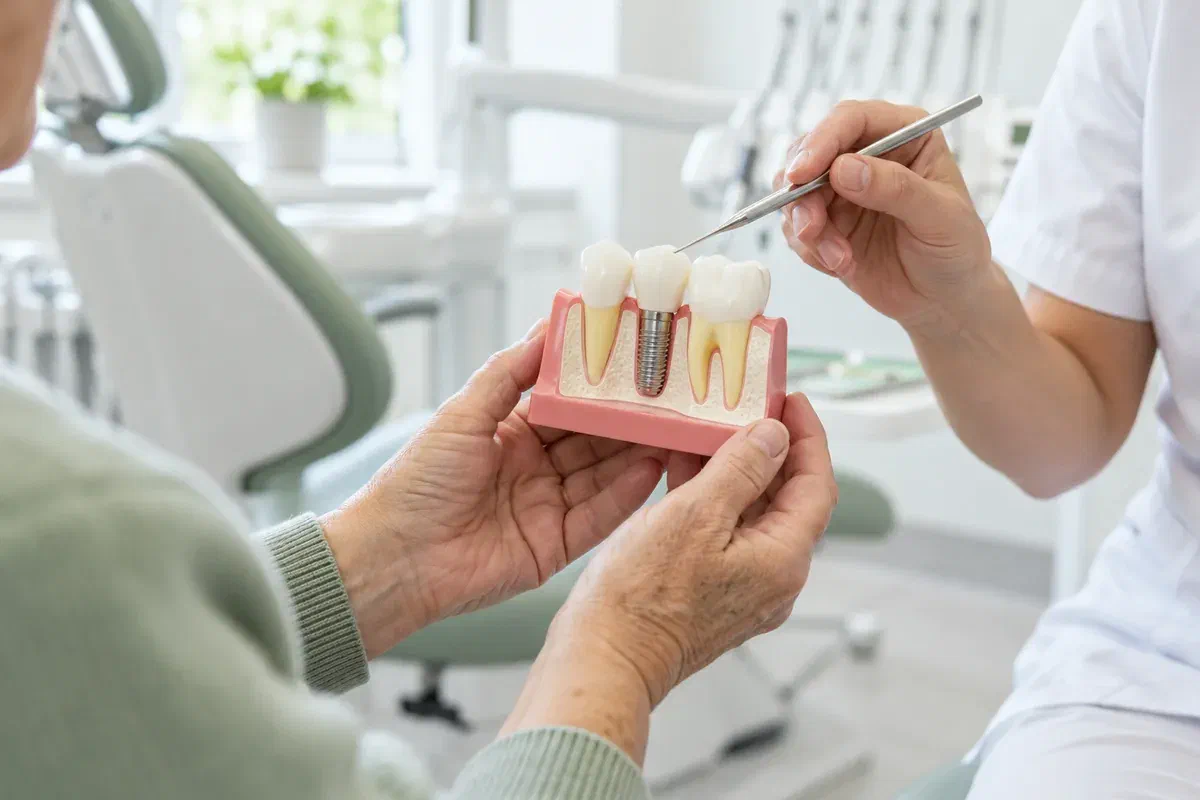
Illustrative older adult discussing implant options with a dentist
Restorative Dentistry

Dental Implant Consultations for Seniors in Mississauga

Managing several health conditions and a long medication list? An implant consultation for seniors coming from Mississauga starts with your medical picture, then looks at your teeth, your denture and the care a replacement would need.

Implant planning with your health in mind

A medication list is a good place to begin.

By later life, many people see a family doctor, a pharmacist and one or two specialists, and carry a pill organizer with several compartments. If that sounds familiar, you may wonder whether implants are even worth asking about. The answer depends on you, and finding it out is exactly what a consultation is for.

Age is not a cut-off. Instead, the dentist considers how your conditions are managed, which medicines you take, the state of your gums, bone and remaining teeth, how much treatment you feel ready for, and whether a replacement could be cleaned well. Some details may need a word with your physician.

From western Mississauga neighbourhoods such as Meadowvale or Churchill Meadows, you can come in for one focused conversation first. A companion is welcome. The dentist will explain what might help, where the limits are, what alternatives exist and what lifelong care looks like, and the choice is still yours.

Ask how your health fits the plan
Older patient's hands holding an implant teaching model during a consultation
Health and practical factors

Planning around the whole person

Comfort when chewing matters, yet any replacement also involves appointments, healing, cleaning and maintenance. Those demands, and how they fit with your health, should be weighed together with the dental findings.

Conditions, treatments and prescriptions

List each medicine and supplement, and mention conditions such as diabetes, heart problems or past cancer treatment. The dentist uses this to consider planning and healing, and to judge whether input from another clinician is needed.

The denture or teeth you rely on now

Describe what is hardest: a loose appliance, sore gums, appearance, or meals you have given up. Bring the denture so it can be examined, since an improved fit could sometimes help without any surgical step.

Energy for treatment and upkeep

Share anything about strength in your hands, vision, walking, getting to appointments, or the help you already have. These points simply help the team suggest a restoration and maintenance schedule that suit your life.

Never change or pause a prescribed medicine on your own because of dental plans. Any adjustment linked to treatment must be agreed individually with the clinicians who manage that medicine.

The purpose of a consultation

Clear goals make a complicated decision simpler.

When health is complex, it helps even more to keep the dental goal narrow and specific, perhaps steadying a lower denture or replacing one tooth that affects chewing. A defined goal lets you weigh whether the likely benefit is worth the treatment and coordination involved.

Implants are neither automatically suitable because they are available nor automatically ruled out by age or a list of conditions. A balanced review looks at your wishes and medical background, what the examination shows, and how the result would be cared for if your health changed.

Patient information: ITI — advanced age and medical conditions in implant care

Comparisons built on what you value

Tell the dentist what you would most like to improve and what you hope to avoid, such as surgery or a long series of visits. Options can then be judged against those priorities instead of starting from the largest plan.

Coordination is discussed openly

If another clinician's advice would help, the dentist can explain why and what would be asked. Raising this early prevents surprises and lets you understand how information about your health will be used.

Long-term care is planned in advance

Ask how a replacement would be cleaned, repaired and reviewed, and what would happen if your health or mobility changed. Planning for that now helps you choose something that stays manageable.

Your appointment

Careful review, then a conversation

You can ask to hear anything again, have it written down, or have it explained to someone you bring. The first appointment should make the assessment pathway clear, with no pressure to decide on a procedure.

  1. Start with your goals

    Talk about the missing teeth, your current appliance, and the daily tasks that are difficult. Raise any worries about surgery, cost, healing time or maintenance so they are considered from the outset.

  2. Medical history and examination

    The dentist reviews your conditions and medicines carefully, then examines the gums, remaining teeth and existing restorations. Records such as X-rays, or information from your physician, may be needed before any plan is suggested.

  3. Discuss the options that make sense

    Compare implant and non-implant approaches, including the number of stages, the effort required and the upkeep afterward. If a referral or medical consultation is advised, ask what question it is intended to settle.

  4. Agree what happens next

    You may want more information, time to discuss things with your doctor or family, or further planning. Ask for a written outline of agreed visits and which existing dental problems should be treated in any case.

After the conversation

File the plan with your health records.

Implant consultations can introduce new terms and several possible routes. Keep the written plan with your medication list and the clinic's contact details so you can review it, share it with your doctor if you wish, and ask follow-up questions.

Measure it against your aim

Ask yourself whether the suggested treatment tackles the problem that brought you in. Write down questions about fees, recovery, temporary teeth or maintenance so you are not working from memory.

Plan any support you would like

If you would need transport, help with communication, or care after a procedure, sort out those arrangements before treatment is booked. Someone you trust can help organize things while you make the decisions.

Update the dentist on medical changes

A new prescription, a hospital stay, or a change in how easily you manage daily cleaning may affect the plan. Share these before procedures and at later reviews so the recommendations remain safe and suitable.

Options to weigh

Simpler treatment is sometimes the stronger choice.

Approaches differ in stability, treatment demand, cleaning and cost. Assessment decides what is suitable, and when health is complex, the most extensive option is not necessarily the one that serves you best.

When avoiding procedures is a priority

Improve the denture without surgery

A fit or design problem may be correctable with an adjustment, a reline or a new denture. Ask how much each could help and what limitations would remain, especially if surgery is something you would prefer to avoid.

When retention is the main concern

A removable denture held by implants

Implants can help hold some removable dentures in place for suitable patients. Discuss the surgery, any medical coordination, attachment maintenance, and removing the denture for daily cleaning.

When health, bone and routine support it

A fixed restoration or conventional bridge

An implant-supported crown or fixed restoration may be considered for a suitable gap, and a conventional bridge or another approach may also apply. Compare the cleaning, repair needs and full course of treatment.

Health-related questions

Answers that account for your medical history

Every person's health, goals and support differ. These questions explore how medical factors and practical needs fit into an implant consultation.

(905) 876-4488
Does having diabetes rule out dental implants?
Not automatically. How well a condition is managed, along with your overall health and oral findings, matters for planning. The dentist may ask about recent results or speak with your physician. Ask how your situation affects the options.
Should I bring my pill bottles or a printed list?
Either works, as long as it is complete and current. A pharmacy printout is often easiest. Include supplements and over-the-counter products, and mention past treatments that may not appear on the list, such as infusions or radiation.
What if I take a blood thinner or a medicine for osteoporosis?
Mention it at the start, and keep taking it as prescribed. Some medicines affect planning or require advice from the prescriber. The team will explain whether coordination is needed and how it would be arranged.
Can my family doctor and dentist talk to each other?
With your consent, the dental team can request information or advice from your physician. Ask what would be shared and why. You can also bring a letter or recent summary from your doctor to the consultation.
Is age a factor at all in implant planning?
Age alone does not exclude anyone. What counts is health, oral condition, the expected benefit and your ability to manage treatment and upkeep. Ask the dentist to explain how these apply to you rather than relying on general rules.
I am coming from Mississauga. Can appointments fit around other medical visits?
Let the clinic know about your other regular appointments when you book. Some dental steps can be scheduled flexibly, though healing intervals and important follow-ups should not be shortened to make the calendar easier.
Implant consultations for seniors from Mississauga

Bring your list, and we will start there.

Visit our Bronte Street practice to discuss tooth replacement with your health, preferences and daily life in view. Please bring your medication list, your current denture if you wear one, and the questions you most want answered.

If a support person, extra appointment time, or help with mobility or communication would be useful, mention it when booking.

Visit Milton Dental Clinic
Unit 1, 342 Bronte St. S, Milton, ON L9T 5B7
Get directions Clinic hours
Monday–Thursday
11am–7pm
Friday–Sunday
By appointment only

Areas we serve

  • Milton
  • Oakville
  • Mississauga
  • Georgetown
  • Halton Hills
  • Acton
  • Campbellville
  • Brampton
  • Burlington
  • Puslinch
  • Rockwood
  • Erin
  • Caledon
  • Etobicoke
  • Old Milton
  • Bronte Meadows
  • Timberlea
  • Dorset Park
  • Dempsey
  • Clarke
  • Beaty
  • Coates
  • Harrison
  • Scott
  • Willmott
  • Ford
  • Bowes
  • Cobden
  • Walker
  • Mountain View
  • Milton Heights
  • Hawthorne Village
  • Valley View
  • Fallingbrook
  • Nassagaweya
  • Trafalgar
  • Esquesing
  • Nelson
  • Brookville
  • Moffat
  • Glen Williams
  • Norval
  • Limehouse
  • Stewarttown
  • Ashgrove
  • Hornby
  • Silver Creek
  • Speyside
  • Scotch Block
  • North Oakville
  • River Oaks
  • Glen Abbey
  • West Oak Trails
  • Palermo
  • Bronte Creek
  • College Park
  • Joshua Creek
  • Uptown Core
  • Preserve
  • Iroquois Ridge
  • Lisgar
  • Meadowvale
  • Meadowvale Village
  • Churchill Meadows
  • Erin Mills
  • Central Erin Mills
  • Streetsville
  • East Credit
  • Creditview
  • Heartland
  • Sheridan
  • Mount Pleasant
  • Credit Valley
  • Huttonville
  • Churchville
  • Springbrook
  • Northwest Brampton
  • Bram West
  • Fletcher's Meadow
  • Fletcher's Creek South
  • Alton Village
  • Orchard
  • Millcroft
  • Headon Forest
  • Tansley
  • Brant Hills
  • Tyandaga
  • Kilbride
  • Lowville
  • Aberfoyle
  • Morriston
  • Arkell
  • Hillsburgh
  • Freelton
  • Carlisle
  • Waterdown
  • Flamborough
  • Mountsberg

How can we help?

Milton Dental Clinic

Have a question about your smile? Choose the option that works best for you.

For urgent dental concerns, please call.
Messages are reviewed during clinic hours.