

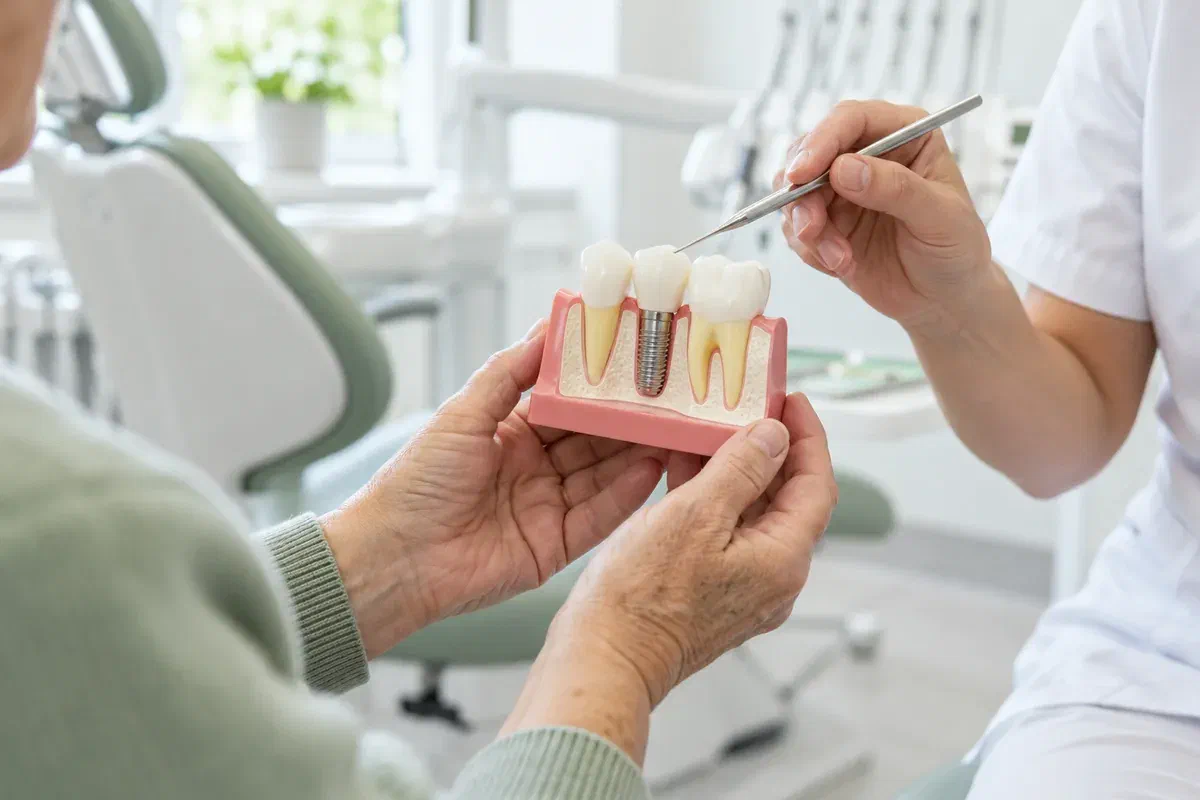
Illustrative older adult discussing implant options with a dentist
Restorative Dentistry

Dental Implant Consultations for Seniors in Oakville

Perhaps a relative suggested implants, or you have been wondering yourself. From Oakville, a senior implant consultation is a calm place to sort through your health, your current teeth or denture, and what treatment would really involve.

For Oakville seniors weighing implants

Your family can help. You decide.

Sometimes the idea arrives secondhand. A daughter reads about implants, a friend at church mentions getting one, or a grandchild notices you no longer order steak. Good intentions are welcome, yet the person who will live with the result is you, so the consultation begins with your own view of what needs fixing.

No age line separates people who can have implants from those who cannot. The dentist considers your overall health, the gums and bone in the area, any natural teeth that remain, how much treatment you are willing to undertake, and whether daily cleaning would be realistic. Each answer shapes the next.

Coming from Oakville, you may prefer to bring the relative who encouraged you, and that is perfectly fine. Let the team know how involved you want them to be. You will hear the potential gains, the trade-offs, the alternatives and the long-term care, then take whatever time you need.

Start the conversation on your terms
Older patient's hands holding an implant teaching model during a consultation
Before the appointment

Three things the dentist will want to understand

Being able to chew comfortably matters, but so do the visits, the healing time, the cleaning and the years of upkeep that come with any replacement. Those demands sit right beside the clinical findings.

The health picture as it stands

A current list of medications, supplements and medical treatments helps the dentist think through planning and healing. It also shows whether contacting your physician or another specialist would be worthwhile before anything is recommended.

How your denture really behaves

Tell the dentist what bothers you most, whether that is slipping while talking, tender gums, the way it looks, or certain foods. Bring the appliance along, because a fit problem may have a simpler solution than implants.

What daily care will ask of you

Mention arthritis, changes in eyesight, mobility, how you travel to appointments, or help you receive at home. These are ordinary facts of life, and they help identify a restoration you can actually keep clean.

Please do not stop or adjust any medicine because implants are being considered. Changes for dental treatment are only made through an individual plan with the clinicians who prescribe and monitor your care.

Making the visit count

Benefits, burdens and a fair comparison

When each suggestion is attached to a specific goal, such as ending a rocking lower denture or filling a space that bothers you at meals, the choice gets clearer. You can ask directly whether the improvement you would gain is worth the treatment it requires.

Implant work is not the best answer just because it is on offer, nor the wrong one just because you are older. An even-handed discussion considers your preferences and health, the examination findings, and how the replacement would be maintained if life changed.

Patient information: ITI — advanced age and medical conditions in implant care

Your goals set the terms

Share the improvement you most want and the things you would sooner avoid. Options are then judged against that, rather than the most elaborate plan being presented as the natural place to start.

Logistics are part of planning

Rides, appointment length, recovery and whether someone can stay with you afterward can all change how treatment is scheduled. Bringing these up early lets the team explain what is required and where there is room to adapt.

The years after treatment count too

Ask how the new teeth would be cleaned, repaired and reviewed over time. Considering upkeep now can help you choose something that remains comfortable to look after well beyond the first months.

What to expect in the chair

From your concerns to a clear next step

Feel free to ask for explanations again, in writing, or with your support person listening. This first appointment should make the assessment path understandable without any push to book a procedure.

  1. Put your priorities first

    Describe which teeth are missing, what appliance you wear, and the daily moments that have become frustrating. Share any unease about surgery, cost, recovery or upkeep at the outset so those points are built into the discussion.

  2. Medical review and oral examination

    Your history, medicines, gums, remaining teeth and current dental work are all reviewed. Radiographs or other information may be requested to understand the bone at a possible implant site and the overall condition of your mouth.

  3. Lay out the reasonable choices

    Compare implant and non-implant options, with their stages, the commitment they involve and the maintenance afterward. If a second clinician's view is advised, ask what that referral is supposed to clarify.

  4. Decide how you want to proceed

    You can ask for more information, take the options home to consider, or continue with detailed planning. Request a written outline of any appointments you accept, and ask which present issues need treatment no matter what you choose.

Reviewing the plan together

Talk it over at your kitchen table.

A consultation can introduce new words and more than one possible pathway. Keep your written plan and the clinic's number handy so you and anyone you trust can read it through, compare the choices, and follow up on questions.

Ask whether it solves your problem

Look at the plan and consider whether it addresses the specific issue that led you to book. Note questions about fees, healing, temporary teeth or ongoing care so nothing depends on recalling the conversation.

Accept help that suits you

If transport, communication support or care after a procedure is needed, work out those details before treatment is booked. Family members can organize the practical side while your wishes continue to steer the decision.

Share updates as they happen

New prescriptions, medical treatment or a change in how well you manage cleaning could alter the recommendations. Keep the dentist informed before procedures and through later checkups so the plan stays appropriate.

Approaches you might compare

Which concern are you trying to solve?

Every option balances stability, treatment demands, cleaning and cost differently. Suitability depends on an assessment, and the most extensive treatment is not automatically the best fit for what you value.

When the existing appliance needs work

Adjust or remake the current denture

The dentist may find a fit or design issue that can be improved without any implant surgery. Ask what an adjustment, reline or new denture could realistically change, and which limitations would remain.

When added stability is worth exploring

Implant-assisted removable denture

In suitable situations, implants can help keep certain removable dentures steady. Discuss the surgery, the attachments that wear and need maintenance, and taking the denture out to clean it, not stability alone.

When your mouth and care routine allow

Fixed teeth, a bridge or another plan

For the right gap, a single crown on an implant or a fixed span may be an option, and a tooth-borne bridge is worth setting beside it. Look at cleaning access, potential repairs and the full sequence of treatment.

What older adults ask us

Practical questions, honest answers

Goals and support at home differ from one person to the next. These questions explore the everyday side of implant treatment along with the clinical assessment.

(905) 876-4488
My son booked this appointment for me. Is that alright?
Of course. Anyone can help arrange a visit. At the appointment, the dentist will want to hear your own concerns and wishes, and you can decide how much your son takes part in the discussion and in any decisions.
Can the clinic share information with a relative after my visit?
Only with your permission. Tell the team who you would like to be kept informed and what they may be told. You can change that choice at any time, and your own instructions always come first.
Will I be left without teeth at any point during implant treatment?
That depends on the plan. Many approaches include a temporary tooth or denture while healing takes place. Ask what you would wear during each stage and how it might affect eating and speaking.
Are medicines for bone strength or blood thinning important to mention?
Yes, along with every other prescription, supplement and past treatment. Some may affect planning or call for advice from another clinician. Keep taking them as prescribed and ask how the team will obtain any medical input.
Is one implant for a single gap very different from implants for a denture?
They involve different designs, numbers of implants, cleaning routines and maintenance. Ask the dentist to explain which approach relates to your concern and what each would require from you over the years.
How can I keep the trips from Oakville to a sensible number?
Ask for an outline of the likely stages and whether some steps can share a visit. Healing between stages sets its own clock, yet a clear schedule still helps you and any driver plan ahead.
Implant consultations for seniors from Oakville

Bring your questions and, if you like, the person who encouraged you.

Our Bronte Street clinic welcomes you to explore tooth replacement in the context of your health, wishes and daily life. Please bring your current denture if you wear one, a medication list, and the questions on your mind.

When you call, mention anything that would make the visit easier, from a companion in the room to a longer slot or help with hearing, vision or mobility.

Visit Milton Dental Clinic
Unit 1, 342 Bronte St. S, Milton, ON L9T 5B7
Get directions Clinic hours
Monday–Thursday
11am–7pm
Friday–Sunday
By appointment only

Areas we serve

  • Milton
  • Oakville
  • Mississauga
  • Georgetown
  • Halton Hills
  • Acton
  • Campbellville
  • Brampton
  • Burlington
  • Puslinch
  • Rockwood
  • Erin
  • Caledon
  • Etobicoke
  • Old Milton
  • Bronte Meadows
  • Timberlea
  • Dorset Park
  • Dempsey
  • Clarke
  • Beaty
  • Coates
  • Harrison
  • Scott
  • Willmott
  • Ford
  • Bowes
  • Cobden
  • Walker
  • Mountain View
  • Milton Heights
  • Hawthorne Village
  • Valley View
  • Fallingbrook
  • Nassagaweya
  • Trafalgar
  • Esquesing
  • Nelson
  • Brookville
  • Moffat
  • Glen Williams
  • Norval
  • Limehouse
  • Stewarttown
  • Ashgrove
  • Hornby
  • Silver Creek
  • Speyside
  • Scotch Block
  • North Oakville
  • River Oaks
  • Glen Abbey
  • West Oak Trails
  • Palermo
  • Bronte Creek
  • College Park
  • Joshua Creek
  • Uptown Core
  • Preserve
  • Iroquois Ridge
  • Lisgar
  • Meadowvale
  • Meadowvale Village
  • Churchill Meadows
  • Erin Mills
  • Central Erin Mills
  • Streetsville
  • East Credit
  • Creditview
  • Heartland
  • Sheridan
  • Mount Pleasant
  • Credit Valley
  • Huttonville
  • Churchville
  • Springbrook
  • Northwest Brampton
  • Bram West
  • Fletcher's Meadow
  • Fletcher's Creek South
  • Alton Village
  • Orchard
  • Millcroft
  • Headon Forest
  • Tansley
  • Brant Hills
  • Tyandaga
  • Kilbride
  • Lowville
  • Aberfoyle
  • Morriston
  • Arkell
  • Hillsburgh
  • Freelton
  • Carlisle
  • Waterdown
  • Flamborough
  • Mountsberg

How can we help?

Milton Dental Clinic

Have a question about your smile? Choose the option that works best for you.

For urgent dental concerns, please call.
Messages are reviewed during clinic hours.