

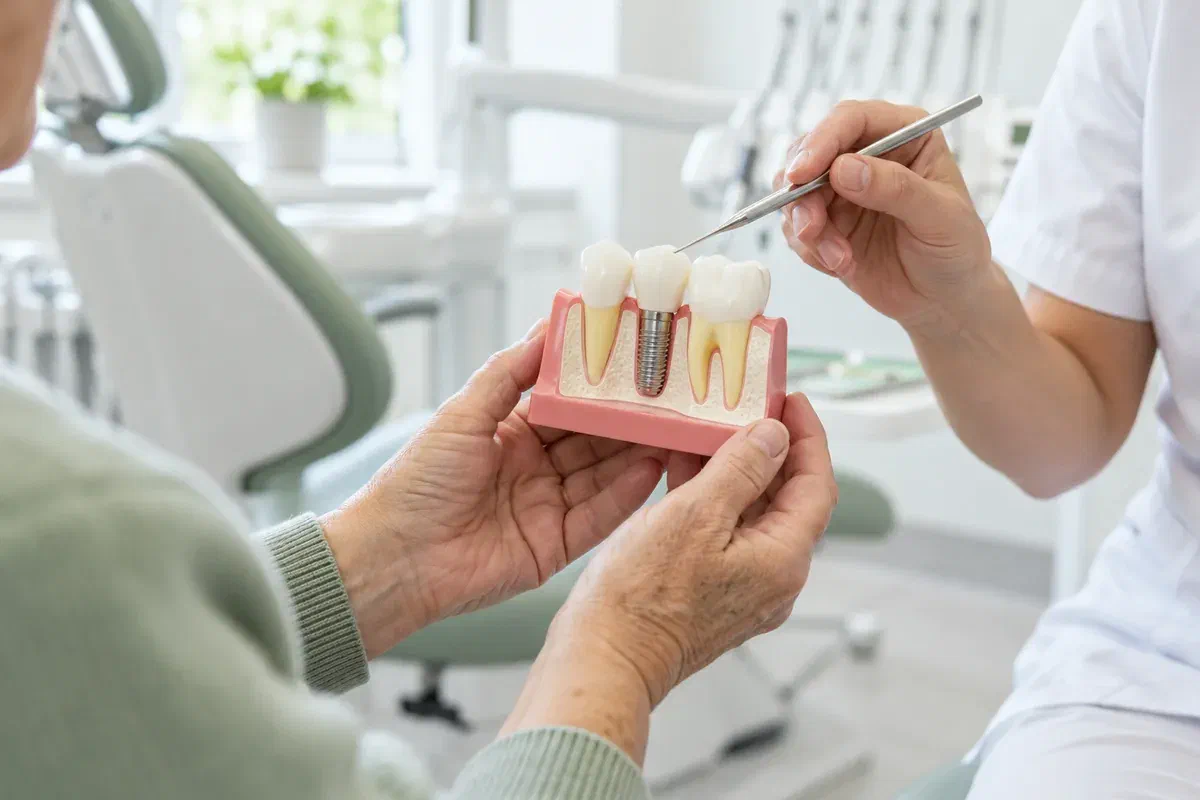
Illustrative older adult discussing implant options with a dentist
Restorative Dentistry

Dental Implant Consultations for Seniors in Old Milton

Has an old bridge or a long-serving denture started to let you down? An implant consultation near Old Milton reviews your health, your existing dental work and the upkeep involved before any replacement is chosen.

When long-standing dental work wears out

The denture that served you for years is not the only path forward.

Plenty of people in Old Milton, the town's historic downtown, have worn the same partial or full denture, or relied on the same bridge, for a very long time. Eventually the fit loosens, an anchor tooth gives trouble, or chewing simply takes more effort than it once did. That is often when the word implant first comes up.

Dentistry has changed since that original work was made, and so may your health, your gums and the bone beneath them. A consultation looks at all of it together. It asks what the treatment would demand, what it could realistically improve, and whether you could keep it clean comfortably over time.

Our Bronte Street practice is a short way from the older streets around Main Street, so a first conversation need not be a major outing. Feel free to bring a relative or friend. You will hear about benefits, drawbacks, alternatives and ongoing care, and the decision remains firmly in your hands.

Ask about replacing older dental work
Older patient's hands holding an implant teaching model during a consultation
Points to cover in Old Milton

What has changed since your last replacement?

A new restoration involves more than how it feels to chew. There are appointments, a recovery stretch, a cleaning routine and years of checkups, and each of those deserves attention next to what the examination finds.

New diagnoses or prescriptions

Health often shifts over the years an old denture or bridge has been in place. Bring a current medication list and details of recent treatment so the dentist can consider healing and decide whether to consult your physician or another specialist.

An appliance that no longer fits well

Describe the trouble plainly: slipping, sore spots, a changed look, or foods you now avoid. Bring the denture in, since gum and bone changes over time can sometimes be managed with a reline or remake rather than surgery.

Managing the routine in years ahead

Let the team know about stiff fingers, eyesight changes, mobility, how you get to appointments, or help you already receive. These facts are not a judgment, but they matter when choosing a design that stays practical to maintain.

Continue every medicine as prescribed while you explore implants. If dental treatment ever seems to call for a change, that has to be planned individually with the clinicians who manage your health.

What a careful review offers

Is the improvement worth the full commitment?

Linking any proposal to one clear purpose, such as replacing a failing bridge or ending a loose lower denture, keeps the discussion grounded. Once the purpose is named, you can judge more confidently whether the likely benefit justifies the treatment involved.

Having implants available does not make them the obvious choice, and years alone do not rule them out. A balanced conversation weighs your wishes and health, what the dentist sees, and how a new restoration would be cared for if your circumstances shifted later.

Patient information: ITI — advanced age and medical conditions in implant care

Options are lined up against your wishes

Explain what you hope to improve and what you would prefer to steer clear of. The dentist can then set realistic options beside those wishes instead of opening with the most extensive plan as though it were standard.

Practical matters are not left until last

Getting to visits, how long each one runs, the recovery period and support at home can all change how a plan is arranged. Raising them early means the team can explain what is necessary and what has some flexibility.

Care over the years is considered now

Find out how the proposed replacement would be cleaned, repaired and checked as time passes. Facing those questions at the outset helps you pick something that will still feel manageable long after treatment ends.

Inside the consultation

A steady conversation, one stage at a time

You can ask for any point to be repeated, put in writing, or explained to a person you bring along. The aim of this first meeting is to make the assessment route clear, with no expectation that you sign up for anything.

  1. Explain what has stopped working

    Talk about the teeth that are gone, the bridge or denture you rely on, and the moments when it lets you down. Voice any hesitation about surgery, expense, healing or upkeep so those concerns are part of the plan from day one.

  2. Health history and a thorough look

    The dentist reviews your medical background and medicines, then examines your gums, remaining teeth and older restorations. Images or further records may be needed to understand a possible implant site and how it relates to the rest of your mouth.

  3. Set each suitable approach out clearly

    Compare implant and conventional choices, including the stages, the effort they ask of you, and the maintenance that follows. If someone else's opinion is recommended, ask what specific question the referral should answer.

  4. Settle on your next move

    That could be gathering more facts, taking time to reflect, or continuing with planning. Request a clear outline of any visits you agree to, and confirm which current problems need care whatever you decide about replacing teeth.

In the days after your visit

Keep the details where you can find them.

A planning visit can involve several possible routes and some unfamiliar vocabulary. Store the written plan with the clinic's contact details so you can look it over again, weigh the choices, and call about anything still puzzling.

Check the plan against what you wanted

Consider whether the proposed work would truly solve the concern you came in with. Write down questions about costs, recovery, temporary teeth or upkeep instead of relying on what you remember from the chair.

Arrange help on your own terms

If you need transport, help with instructions, or someone nearby after a procedure, discuss those arrangements before treatment is scheduled. A trusted person can manage the logistics while your preferences guide the outcome.

Report changes in health or routine

A new medicine, a medical procedure, or more difficulty with daily care may affect the plan. Tell the dentist before treatment and at later reviews so the advice you receive stays suited to your circumstances.

Possible routes

Different problems call for different comparisons.

Each approach strikes its own balance of stability, treatment effort, cleaning and cost. Only an assessment can show what is suitable, and the biggest plan is not necessarily the one that fits your goals best.

When the appliance is the weak point

Renew the denture you know

An older denture may have a fit or design issue that can be put right without implants. Ask what an adjustment, reline or replacement denture could achieve, and what would still be limited afterward.

When better hold is worth investigating

Implants that secure a removable denture

For suitable cases, implants can help anchor some removable denture designs. Discuss the surgery, the attachments that need periodic servicing, and removing the denture for cleaning, rather than focusing on retention by itself.

When your mouth and upkeep can support it

A fixed restoration or a bridge

An implant crown or fixed restoration might suit the right gap, and a conventional bridge or another plan may also deserve a look. Compare cleaning access, likely repairs and every stage of the treatment sequence.

Questions we often hear

Ask anything, and expect a personal answer.

People come with different hopes and different help at home. These questions explore the everyday practicalities of implant care as well as the examination itself.

(905) 876-4488
My bridge has lasted decades. Does an implant automatically replace it?
Not automatically. If a bridge is failing, the dentist will look at the supporting teeth, gums and bone before suggesting anything. A new bridge, a denture or an implant may each be possible, and you can compare them with their demands in mind.
Is age by itself a reason implants are off the table?
It is not. Suitability depends on health, the condition of your mouth, what you hope to gain, and the effort of treatment and maintenance. Ask the dentist to explain how those factors look in your own case.
Will the dentist want to talk to my family doctor?
Sometimes. Depending on your medical history and medicines, the dentist may suggest getting information or advice from your physician before planning goes further. Ask what would be shared, why it matters, and how you will hear the result.
Can my old denture still be worn while I think things over?
Usually yes, provided it is not causing sores or damage. Let the dentist check it at the consultation. If it is irritating your gums, there may be short-term adjustments to help while you take time to decide.
What happens if cleaning becomes harder for me later?
Raise this before any treatment. Ask how the design could be maintained with help from someone else and whether its parts would stay manageable as your abilities change. The plan should reflect your likely future needs as well as today.
I live near Main Street. Can visits be timed around my usual routine?
Mention your preferred days and times when you book. Clinic hours run Monday to Thursday, with Friday to Sunday by appointment. Some steps can be arranged flexibly, though healing intervals and important follow-ups should not be shortened.
Implant consultations for older adults in Old Milton

Bring the denture, bring your questions, and leave with a clearer picture.

Visit our Bronte Street practice to talk about tooth replacement in light of your health, preferences and daily life. Please bring the denture or details of the bridge you have now, your medication list, and anything you want explained.

Let the clinic know ahead of time about hearing, vision, mobility or support-person needs so the appointment can be as comfortable as possible.

Visit Milton Dental Clinic
Unit 1, 342 Bronte St. S, Milton, ON L9T 5B7
Get directions Clinic hours
Monday–Thursday
11am–7pm
Friday–Sunday
By appointment only

Areas we serve

  • Milton
  • Oakville
  • Mississauga
  • Georgetown
  • Halton Hills
  • Acton
  • Campbellville
  • Brampton
  • Burlington
  • Puslinch
  • Rockwood
  • Erin
  • Caledon
  • Etobicoke
  • Old Milton
  • Bronte Meadows
  • Timberlea
  • Dorset Park
  • Dempsey
  • Clarke
  • Beaty
  • Coates
  • Harrison
  • Scott
  • Willmott
  • Ford
  • Bowes
  • Cobden
  • Walker
  • Mountain View
  • Milton Heights
  • Hawthorne Village
  • Valley View
  • Fallingbrook
  • Nassagaweya
  • Trafalgar
  • Esquesing
  • Nelson
  • Brookville
  • Moffat
  • Glen Williams
  • Norval
  • Limehouse
  • Stewarttown
  • Ashgrove
  • Hornby
  • Silver Creek
  • Speyside
  • Scotch Block
  • North Oakville
  • River Oaks
  • Glen Abbey
  • West Oak Trails
  • Palermo
  • Bronte Creek
  • College Park
  • Joshua Creek
  • Uptown Core
  • Preserve
  • Iroquois Ridge
  • Lisgar
  • Meadowvale
  • Meadowvale Village
  • Churchill Meadows
  • Erin Mills
  • Central Erin Mills
  • Streetsville
  • East Credit
  • Creditview
  • Heartland
  • Sheridan
  • Mount Pleasant
  • Credit Valley
  • Huttonville
  • Churchville
  • Springbrook
  • Northwest Brampton
  • Bram West
  • Fletcher's Meadow
  • Fletcher's Creek South
  • Alton Village
  • Orchard
  • Millcroft
  • Headon Forest
  • Tansley
  • Brant Hills
  • Tyandaga
  • Kilbride
  • Lowville
  • Aberfoyle
  • Morriston
  • Arkell
  • Hillsburgh
  • Freelton
  • Carlisle
  • Waterdown
  • Flamborough
  • Mountsberg

How can we help?

Milton Dental Clinic

Have a question about your smile? Choose the option that works best for you.

For urgent dental concerns, please call.
Messages are reviewed during clinic hours.