

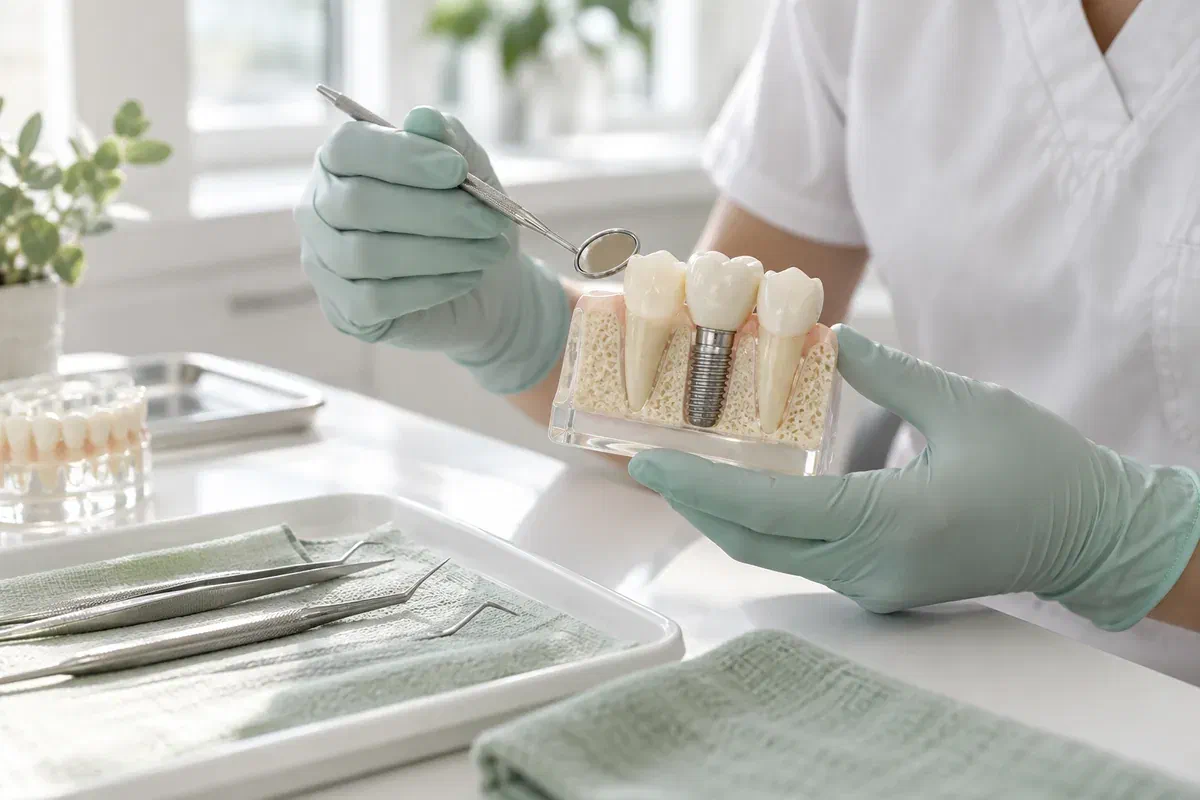
Illustrative discussion of ongoing implant maintenance with a patient
Restorative Dentistry

Dental Implant Maintenance in Mississauga

A crown that shifts when you chew can be unsettling, and the cause is not always what you expect. Implant maintenance for Mississauga examines the parts, the gum, the bite and your routine to find out what is going on.

That slight shift when you chew

Is it the crown, or something deeper?

The first reaction to a moving implant tooth is usually alarm. In practice, the part that moves is often above the bone: a crown that has loosened, a screw that has backed off, or an attachment that has worn. Those are repair questions. Less often, the tissue or bone supporting the fixture is involved, and that needs a different response.

Telling these apart is a large part of what implant maintenance is for. A review looks at the visible restoration, the connecting components, the gum seal and the bone, plus the way you bite and clean. Each one can fail in its own way, and treating the wrong one wastes time.

From Meadowvale, Churchill Meadows or elsewhere in Mississauga, the most useful thing you can bring is a clear account. When did the movement start? Does it happen only with certain foods? Has anything else changed in your health or mouth? Add any implant records you have, and we can build a plan around the restoration you live with.

Have a moving implant checked
Gloved clinician inspecting an implant teaching model with a dental mirror
Telling us what you feel

Your description is the first clue.

You do not have to know the anatomy of an implant to report a problem. Say what feels wrong, when it shows up and what makes it better or worse, and the examination can start from there.

Chewing on that side is different

Maybe food feels like it presses unevenly, or the implant tooth seems to meet before its neighbours. Recent fillings, crowns or tooth movement elsewhere can change the bite, so mention any work done since your last review.

Movement, clicking or a gap

Any of these could trace back to a crown, bridge, attachment or connecting part. They are not proof that the fixture is failing. They are a signal that something needs to be identified, and repeatedly testing it can make matters worse.

New health or medication changes

A change in your general health, a new prescription or less comfortable use of brushes and floss can all affect maintenance. Tell us, so the routine we suggest is one you can actually keep.

If the restoration becomes loose, the gum swells, there is discharge or pain is increasing, call for an assessment. These do not belong on the waiting list for your next routine visit.

Why it is worth sorting out

The right diagnosis leads to the right fix.

Regular reviews let the team follow the tissue, restoration and your routine over months and years. When something does change, that history makes it easier to see whether the cause is a cleaning issue, a mechanical fault or a tissue concern that needs a dedicated assessment.

Maintenance does not come with a guarantee that complications will never occur. Your plan should be specific to you, and new findings may alter how often you are seen or what care is offered. It is always fair to ask what is being monitored and why.

Patient information: European Federation of Periodontology — dental implants

Comparisons over time

Clinical notes and earlier records give a reference point for spotting change. If another office placed your implant, whatever details you can collect about the system and restoration will make ongoing coordination smoother.

Hardware problems kept separate from tissue problems

A worn component and inflamed gum may produce similar complaints but call for different care. Reviewing both stops anyone concluding that every symptom means poor cleaning, or that one loose part means replacing everything.

Repairs thought through in advance

Ask whether parts for your system can be obtained, how cleaning access might be improved and who would handle a repair. Knowing the answers ahead of time makes an unexpected problem far less disruptive.

What to expect at the chair

Listen, examine, act, then plan

The visit is built around your particular restoration. Maintaining a single crown is not the same as maintaining a fixed bridge on several implants or a removable denture that clips into place.

  1. Start with your account

    We go through how the implant was placed and restored, past repairs and cleanings, and the routine you follow now. We also ask about health and medication updates and any movement, symptoms or difficulty with an appliance.

  2. Find the source

    The clinician examines the restoration, its components, your bite and the nearby gum. If the history or findings call for it, further records or imaging may be recommended to see what an examination alone cannot show.

  3. Treat what can be treated today

    Cleaning and routine care are adapted to the restoration in your mouth. If a part, the tissue or the design needs a separate procedure, you are told what was found and what is being proposed.

  4. Close the loop

    Before you leave, we go over home care for your restoration, the signs that should prompt a call and your next interval. Where a surgeon or another dentist shares your care, responsibilities are made clear.

Until the next review

Hands off the hardware, eyes on any change

Following a plan is easier when you understand the reasons behind it. Ask for a demonstration if anything is unclear, keep implant details together and contact us as soon as something feels different.

Clean the way you were shown

Stay with the aids and technique suggested for your restoration. When a spot becomes hard to reach or a tool begins to drag, report it; force rarely helps, and a quick reassessment often does.

Never try to tighten or reattach

Screws, attachments and loose crowns are not home projects. Using glue or a tool can hide the original fault and may ruin a component that could have been reused with the correct equipment.

Hold on to the paperwork

Implant system information, notes on past repairs and the names of the clinicians involved are worth keeping. They save time if care changes hands or a team unfamiliar with your implant needs to examine it.

What happens next

Routine care, a repair, or tissue treatment

A review can end in one of several ways. The team should make clear whether you need ongoing prevention, work on a replaceable component, or attention to the tissue that supports the implant.

Nothing beyond routine care found

Ongoing individual maintenance

Your reviews and professional cleanings continue, with home advice to match the restoration. The interval takes your risk factors into account, and you know whom to call if anything changes in between.

A mechanical fault identified

Work on a component

A crown, screw or attachment that has loosened or worn may need a restorative appointment and details of the implant system. Ask which part is affected, whether a compatible replacement exists and what fixing it should resolve.

Routine maintenance is not enough

Care for the gum and bone

Inflammation or a change in support around the fixture may require more investigation and specific treatment. You will be told whether a specialist referral is advisable and how it fits alongside maintaining the restoration.

Questions about loose or shifting implants

What a moving crown might mean

When an implant tooth starts to shift, knowing what to do and who to call takes much of the worry out of it. These answers cover that situation and the longer-term care around it.

(905) 876-4488
What usually causes an implant crown to feel loose?
Common possibilities include a loosened screw, a crown that has come unbonded or a worn attachment. Tissue or bone changes are another possibility. An examination is needed to tell which, so call rather than guessing.
Can a loose implant screw be fixed without replacing the implant?
In many cases a component issue can be managed without replacing the fixture, but it depends on the design, the part involved and its condition. The clinician can explain the options once the cause is known.
Should I keep chewing on a crown that moves?
It is sensible to avoid that side and not to test the movement repeatedly until it has been examined. Continue cleaning gently, and do not try to tighten or glue anything. Contact the clinic to arrange an assessment.
Is X-ray imaging needed to find out why an implant tooth moves?
It may be, depending on the history and findings, but it is not automatic. Ask what any proposed image is meant to show and whether earlier images exist for comparison. Clinical examination provides much of the information too.
If a specialist placed my implant, who should look at it when it moves?
That should be agreed within your care plan. Often the restorative dentist assesses the crown and components, while tissue concerns may involve the specialist. Keep everyone’s contact details and ask how findings will be shared.
Coming from Mississauga, how do I avoid extra trips for one problem?
Describe the issue clearly when you call, bring any implant records and ask whether assessment and minor care can happen at the same visit. Some repairs still need parts ordered or a second appointment, and the team can tell you in advance.
Mississauga implant maintenance

Find out what is moving and why.

Book a review at our Bronte Street practice to examine your implant restoration, its components and the supporting tissue, along with your home routine. We can explain what we find, look into new changes and organize the right next step when more than cleaning is required.

If something has come off, store it safely and phone us. Let us know about movement, swelling or worsening discomfort when you book.

Visit Milton Dental Clinic
Unit 1, 342 Bronte St. S, Milton, ON L9T 5B7
Get directions Clinic hours
Monday–Thursday
11am–7pm
Friday–Sunday
By appointment only

Areas we serve

  • Milton
  • Oakville
  • Mississauga
  • Georgetown
  • Halton Hills
  • Acton
  • Campbellville
  • Brampton
  • Burlington
  • Puslinch
  • Rockwood
  • Erin
  • Caledon
  • Etobicoke
  • Old Milton
  • Bronte Meadows
  • Timberlea
  • Dorset Park
  • Dempsey
  • Clarke
  • Beaty
  • Coates
  • Harrison
  • Scott
  • Willmott
  • Ford
  • Bowes
  • Cobden
  • Walker
  • Mountain View
  • Milton Heights
  • Hawthorne Village
  • Valley View
  • Fallingbrook
  • Nassagaweya
  • Trafalgar
  • Esquesing
  • Nelson
  • Brookville
  • Moffat
  • Glen Williams
  • Norval
  • Limehouse
  • Stewarttown
  • Ashgrove
  • Hornby
  • Silver Creek
  • Speyside
  • Scotch Block
  • North Oakville
  • River Oaks
  • Glen Abbey
  • West Oak Trails
  • Palermo
  • Bronte Creek
  • College Park
  • Joshua Creek
  • Uptown Core
  • Preserve
  • Iroquois Ridge
  • Lisgar
  • Meadowvale
  • Meadowvale Village
  • Churchill Meadows
  • Erin Mills
  • Central Erin Mills
  • Streetsville
  • East Credit
  • Creditview
  • Heartland
  • Sheridan
  • Mount Pleasant
  • Credit Valley
  • Huttonville
  • Churchville
  • Springbrook
  • Northwest Brampton
  • Bram West
  • Fletcher's Meadow
  • Fletcher's Creek South
  • Alton Village
  • Orchard
  • Millcroft
  • Headon Forest
  • Tansley
  • Brant Hills
  • Tyandaga
  • Kilbride
  • Lowville
  • Aberfoyle
  • Morriston
  • Arkell
  • Hillsburgh
  • Freelton
  • Carlisle
  • Waterdown
  • Flamborough
  • Mountsberg

How can we help?

Milton Dental Clinic

Have a question about your smile? Choose the option that works best for you.

For urgent dental concerns, please call.
Messages are reviewed during clinic hours.