

Illustrative discussion of ongoing implant maintenance with a patient
Restorative Dentistry

Dental Implant Maintenance in Old Milton

Had your implant for years, perhaps from a dentist who has since retired? Implant maintenance for Old Milton picks up the thread, reviewing the restoration, gum, bite and home routine you rely on today.

Implants with a long history

What happens when the original dentist is gone?

Plenty of people in Old Milton, Milton’s historic downtown, have lived on the same street for decades, and some have carried an implant almost as long. The office that placed it may have changed hands or closed. That does not leave the restoration without a future; it simply means a new team needs to learn what is there.

Over time, several things can shift at once. The crown may wear against neighbouring teeth, the gum line can change, an attachment may loosen, and your own health may be different from when the work was done. Maintenance looks at each of these separately, because a crown that is hard to clean is a different matter from one that has started to move.

Bring whatever you can find: a treatment summary, an implant card, the name of the original clinic, even a rough year. Then describe anything that feels different when you chew or clean. From there we can talk about a plan that suits the restoration you have now and the way your mouth has changed around it.

Arrange a review of an older implant
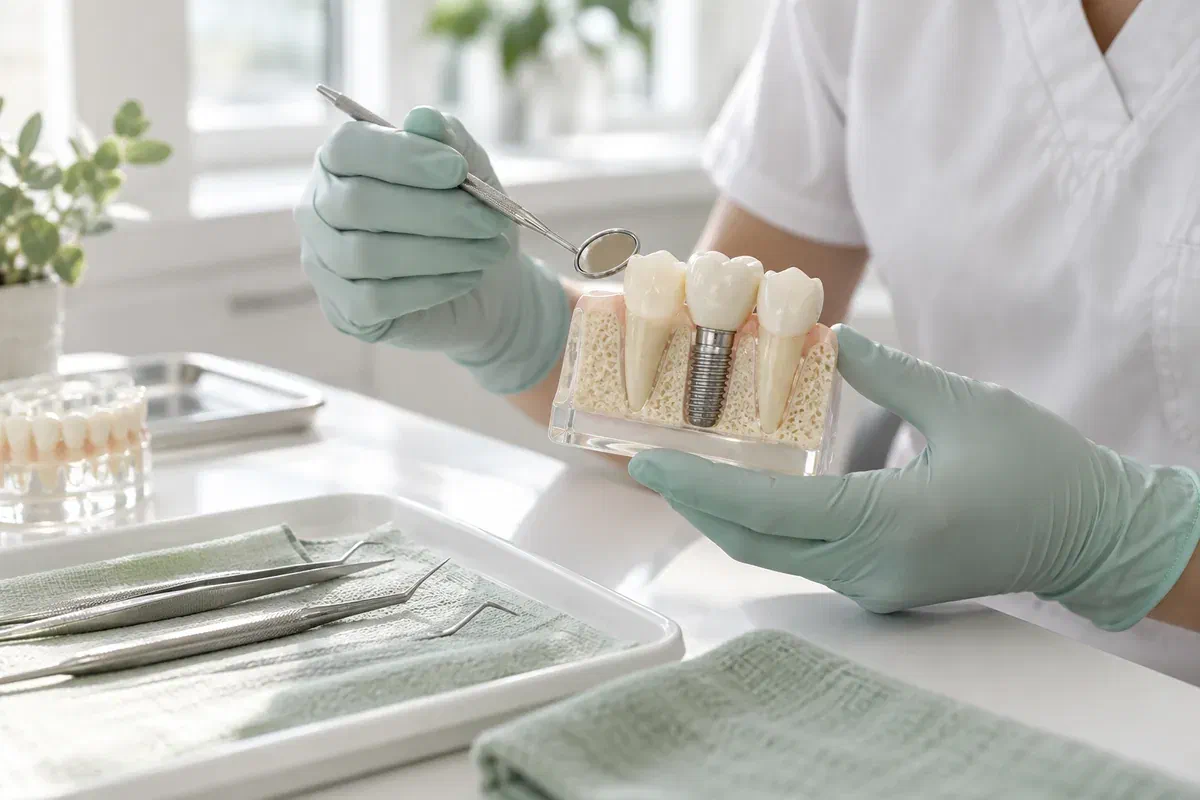
Gloved clinician inspecting an implant teaching model with a dental mirror
Clues worth sharing

The details you notice help the most.

You are not expected to name the part involved. Tell us what you feel, when it happens and whether it has been building gradually, and the clinician can examine the restoration and surrounding tissue with that context.

Your teeth meet in a new way

Over the years, other teeth may have been filled, crowned or lost, and the implant can end up taking a different share of the load. Describe any new contact or sore chewing, and list dental work done since the implant went in.

A slight looseness has appeared

Movement may come from the crown, a bridge, an attachment or another component rather than the fixture in the bone. It still should not be ignored. The clinician needs to work out which piece is moving and what is causing it.

You are managing differently now

New medicines, a health condition or less nimble fingers can all affect how well you clean. Mention any of these so the plan can be shaped around what you can comfortably keep up today.

A loose restoration, swelling, discharge or pain that keeps getting worse should be looked at promptly. Please call rather than holding it for a routine visit.

The value of looking again

Today’s findings give tomorrow a reference point.

When the earlier history is patchy, a careful review becomes the new starting line. The team records how the tissue, restoration and your routine look now, which makes it far easier to recognise change at later visits and to tell an ordinary cleaning need from something requiring repair.

No maintenance routine can guarantee that an implant will stay trouble free, whatever its age. Recommendations should be personal and may change if something new is found. Feel free to ask what is being monitored and how the suggested interval connects to your history.

Patient information: European Federation of Periodontology — dental implants

A fresh baseline when old notes are missing

Current findings, and any earlier records you can locate, help the clinician interpret future changes. Information about the implant system and restoration from the original office is especially useful if it can still be obtained.

Wear and tissue, assessed side by side

An older restoration may show mechanical wear, and the tissue around it can change independently. Checking both prevents the easy assumption that every symptom is about hygiene or that a worn part means the implant has failed.

Thinking ahead about parts

Some older systems are harder to source parts for. Ask about replacement components, cleaning access and who would handle a repair, so you know the options before anything breaks.

What the visit includes

Four steps, built around an implant’s past

A review is shaped by what is in your mouth and how it got there. One implant crown, a fixed bridge and an implant-retained denture each come with their own maintenance needs.

  1. Piece together the history

    We talk through when and where the implant was placed, repairs since then, earlier professional care and your routine at home. Health and medication changes, new symptoms and any trouble with an appliance are all part of the conversation.

  2. Examine what is there today

    The clinician reviews the restoration, your bite and the nearby gum. If the history is uncertain or findings suggest it, additional records or imaging may be recommended to fill in what cannot be seen.

  3. Clean, or explain what else is needed

    Care is matched to the restoration you actually have. If a component, the tissue or the original design needs a different approach, you hear what was found and what the proposed next step is.

  4. Agree on the routine and the return date

    You go home knowing how to clean and handle the restoration, which signs mean you should call and when to come back. Where other clinicians are involved, we clarify who is responsible for each stage.

Living with an established implant

Small habits keep an older restoration in view.

A plan only helps if you can follow it. Ask to see techniques demonstrated, keep your paperwork together, and phone when something changes instead of waiting for the next reminder.

Use the method suited to your restoration

Follow the brushing and cleaning approach shown for your implant. If a gap has become harder to reach or a floss or brush now catches, let us know, because the fix may be a reassessment rather than more effort.

Resist home repairs

Do not tighten screws, bend attachments or glue a loose crown. These need the right assessment and tools, and a home repair can mask the cause or ruin a part that could otherwise have been reused.

Start a simple implant file

Keep any system details, notes on major repairs and the names of clinicians who have treated the implant. This is particularly helpful for an older restoration that may one day need a team unfamiliar with it.

Where a review can lead

Three paths, depending on what is found

Not every review ends the same way. The team should explain whether you need routine prevention, attention to a replaceable part, or treatment for the tissue that supports the implant.

When the restoration and tissue are steady

Ongoing tailored maintenance

Regular reviews and professional cleaning continue with home-care advice that suits you. The interval reflects your risk factors and current condition, and you know how to report anything that changes between visits.

When wear or looseness is found

A component assessment or repair

A worn, loose or damaged part may need a separate restorative appointment and information about the implant system. Ask which part is involved, whether compatible replacements can be found and what the repair would fix.

When cleaning is not resolving it

Care for the supporting tissue

Inflammation or changes in the support around the implant may need further assessment and treatment. The clinician can explain whether a referral is sensible and how that care will tie in with your maintenance.

Questions we often hear

Answers for implants that have been around a while

Long-term care runs more smoothly when you know who is responsible and what each visit is for. These questions look at keeping an established restoration in good working order.

(905) 876-4488
I don’t know what brand my implant is. Can it still be maintained?
Often, yes. Routine review and cleaning do not always depend on knowing the system. If a component needs replacing, though, the brand and design matter more, so it is worth trying to obtain records from the original office if they still exist.
Does an older implant crown eventually need to be replaced?
There is no fixed date. A crown may wear, chip or become harder to clean, and the clinician can tell you whether repair, monitoring or replacement makes sense. The decision depends on what is found rather than on age alone.
Could a wobbly implant tooth just be a loose crown?
It could. Movement can come from different parts of the restoration, and the source has to be identified by examination. Avoid wiggling it to check, and do not attempt to tighten or reattach anything at home. Call to arrange an assessment.
Are X-rays part of every implant review?
Not routinely. Imaging should be justified by your history and what the clinician needs to know. Ask what an image would show and whether earlier records exist for comparison. Other findings can also inform the review.
How should my routine change as I get older?
It may not need to change at all, but if grip, eyesight or health makes cleaning harder, say so. Different aids or a revised interval might help. A maintenance plan is meant to be adjusted as your circumstances shift.
Is it worth arranging care nearby if my implant was placed outside Old Milton?
Many people prefer ongoing care close to where they live. Bring any records you have and the contact details of the office that placed the implant, and we can discuss what to request so information can be shared if a repair is ever needed.
Implant maintenance, Old Milton

Bring your older implant up to date.

Our Bronte Street practice is close to the historic core, and we welcome implants of every age. Book a review of the restoration, supporting tissue and your daily routine, and we will explain what we see and arrange the next step if more than cleaning is needed.

Keep any piece that has come loose in a safe container and call us. When you book, mention movement, swelling or discomfort that is increasing.

Visit Milton Dental Clinic
Unit 1, 342 Bronte St. S, Milton, ON L9T 5B7
Get directions Clinic hours
Monday–Thursday
11am–7pm
Friday–Sunday
By appointment only

Areas we serve

  • Milton
  • Oakville
  • Mississauga
  • Georgetown
  • Halton Hills
  • Acton
  • Campbellville
  • Brampton
  • Burlington
  • Puslinch
  • Rockwood
  • Erin
  • Caledon
  • Etobicoke
  • Old Milton
  • Bronte Meadows
  • Timberlea
  • Dorset Park
  • Dempsey
  • Clarke
  • Beaty
  • Coates
  • Harrison
  • Scott
  • Willmott
  • Ford
  • Bowes
  • Cobden
  • Walker
  • Mountain View
  • Milton Heights
  • Hawthorne Village
  • Valley View
  • Fallingbrook
  • Nassagaweya
  • Trafalgar
  • Esquesing
  • Nelson
  • Brookville
  • Moffat
  • Glen Williams
  • Norval
  • Limehouse
  • Stewarttown
  • Ashgrove
  • Hornby
  • Silver Creek
  • Speyside
  • Scotch Block
  • North Oakville
  • River Oaks
  • Glen Abbey
  • West Oak Trails
  • Palermo
  • Bronte Creek
  • College Park
  • Joshua Creek
  • Uptown Core
  • Preserve
  • Iroquois Ridge
  • Lisgar
  • Meadowvale
  • Meadowvale Village
  • Churchill Meadows
  • Erin Mills
  • Central Erin Mills
  • Streetsville
  • East Credit
  • Creditview
  • Heartland
  • Sheridan
  • Mount Pleasant
  • Credit Valley
  • Huttonville
  • Churchville
  • Springbrook
  • Northwest Brampton
  • Bram West
  • Fletcher's Meadow
  • Fletcher's Creek South
  • Alton Village
  • Orchard
  • Millcroft
  • Headon Forest
  • Tansley
  • Brant Hills
  • Tyandaga
  • Kilbride
  • Lowville
  • Aberfoyle
  • Morriston
  • Arkell
  • Hillsburgh
  • Freelton
  • Carlisle
  • Waterdown
  • Flamborough
  • Mountsberg

How can we help?

Milton Dental Clinic

Have a question about your smile? Choose the option that works best for you.

For urgent dental concerns, please call.
Messages are reviewed during clinic hours.