

Illustrative patient discussion of a second opinion about implant treatment
Restorative Dentistry

Dental Implant Second Opinions in Old Milton

A tooth that has carried a large filling or crown for decades may now be marked for removal and an implant. An implant second opinion near Old Milton looks again at that tooth and the plan so the decision rests on findings you understand.

An old tooth, a new recommendation

Before you let a familiar tooth go.

Many people who have lived around Old Milton for years carry dental work from several decades and several dentists. When a tooth with a big filling, a root canal, or an aging crown is suddenly described as a candidate for extraction, it is natural to want someone else to look before agreeing.

That is what an implant second opinion is for. A dentist reassesses the tooth, the surrounding gum and bone, and the proposed treatment, then explains how the recommendation connects to what can be seen. It starts from curiosity about your situation, not from a belief that the first dentist was mistaken.

Our Bronte Street practice is a short way from Milton’s historic downtown, and we welcome people who simply want a clearer explanation. Prior records are helpful, yet the state of your mouth today counts just as much, and we will tell you plainly what the review can and cannot determine.

Ask for a second look at your plan
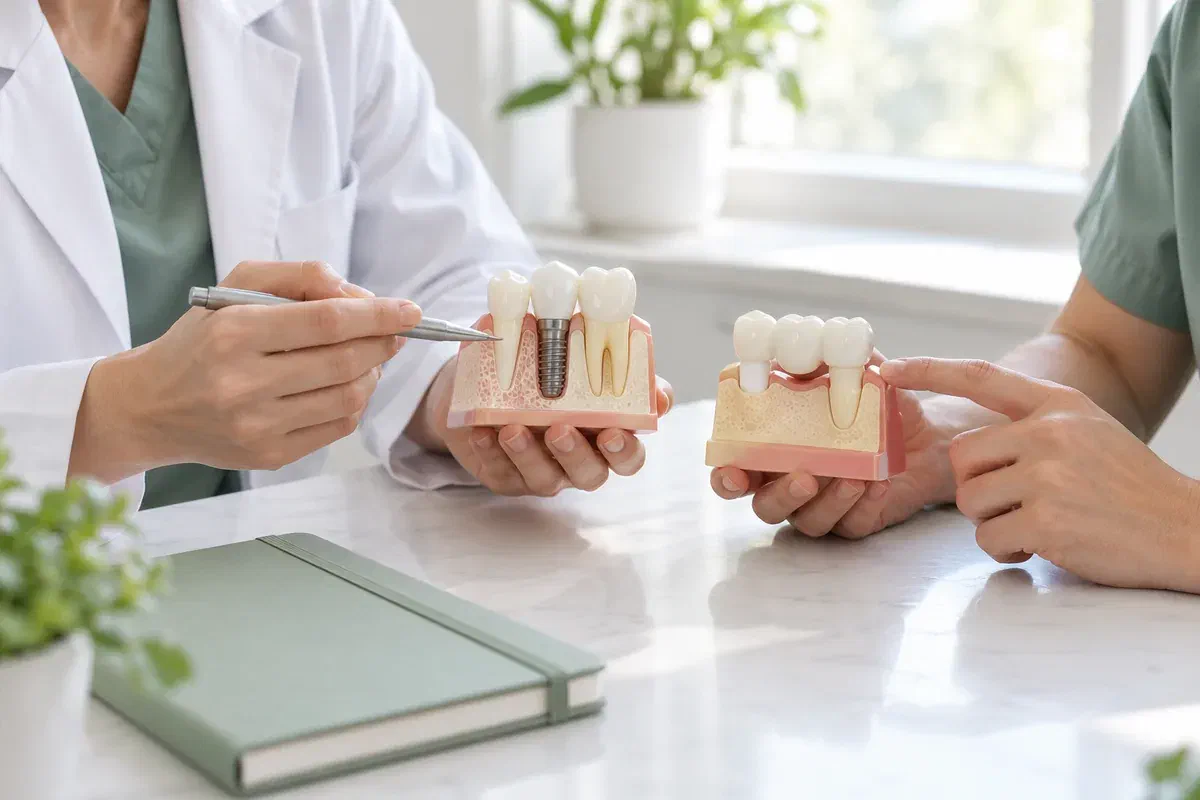
Dental professionals comparing implant and bridge teaching models
Pinpointing the worry

Is the tooth beyond keeping, or is that still an open question?

Most people come in with one central doubt. It might be the tooth’s future, the order of the proposed steps, or what living with a new restoration will involve. Writing it down before the visit gives the consultation a clear target.

A long-restored tooth slated for removal

Ask what, specifically, threatens the tooth: a crack, recurrent decay, bone loss, or something else. A careful reassessment examines the tooth on its own merits and asks whether a reasonable way to keep it exists before planning its replacement.

Proposals with different building blocks

Plans can differ in preparation, grafting, temporary teeth, and the final crown or bridge. Bring each one in writing so the conversation can look at what was included and the thinking behind it, not simply which number is lower.

An implant that hasn’t felt right

Say what has changed, whether that is tenderness, a gap where food collects, an altered look, or movement. Information about the implant’s parts and when it was placed can matter, and a specialist may need to be involved.

Significant pain, swelling, discharge, or a crown that has come loose should be assessed promptly rather than held until a planning appointment. Phone the clinic so we can talk about the symptom first.

The value of a fresh pair of eyes

See how each step earns its place.

A further opinion is a chance to go back over the evidence and ask how a plan serves your own goals. It may confirm the original advice, suggest a different path, or reveal gaps in the information that need filling before any approach can be properly weighed.

Disagreement between dentists is not proof of error. A tooth with a long history can often be managed in more than one sensible way, each carrying different compromises. It helps to ask where the views match, where they diverge, and which assumptions drive the gap.

Distinguish what is known from what is expected

Some statements about a tooth are clear findings, and others are predictions about how it may behave. Sorting one from the other is especially important when the choice is between keeping a tooth and committing to a multi-stage implant plan.

Test the plan against what you want

You might value keeping natural teeth, a certain appearance, avoiding surgery, or simpler upkeep as the years go on. A second assessment helps you ask whether the proposal matches those wishes and what it cannot deliver.

Return to your dentist better prepared

Some people take what they learn back to the dentist who made the original proposal. A second opinion can serve exactly that purpose, with no expectation that you move your care.

What to expect at the appointment

The consultation, in four parts.

Expect more than a brief look at an estimate. When you book, ask which records would help, what the assessment fee includes, how wide the review will be, and whether extra investigations could come up.

  1. Describe the choice in front of you

    Explain what has been proposed and which parts you are unsure of. Tell us about your goals, current discomfort, how earlier dental work has gone, and any relevant medical details, so the context of your question is clear.

  2. Look at records and at your mouth

    Written plans, X-rays or scans, and implant information all help. The dentist examines the teeth and gums as they are today and tells you whether the information on hand is enough to reach an opinion.

  3. Go over findings and sensible options

    We explain what the examination supports, what remains unclear, and how the choices compare. If a specialist referral or more records would help, ask what particular question that step is meant to resolve.

  4. Agree on what you’ll decide next

    Before you leave, confirm the key conclusions and any advised follow-up. You can request a readable summary and then decide whether to speak with your original dentist, collect more information, or carry on planning.

Putting the second opinion to work

Two sets of notes, read together.

The new opinion is most useful when its reasoning sits next to the first plan. Keep both together, and avoid comparing a single sentence from each without the findings that sit behind it.

Confirm the plans cover the same teeth

Check which teeth or implants are included, what preparation each plan lists, and what final restoration is proposed. A plan that does more will usually cost more and take longer, so the two may not be direct equivalents.

Settle how the offices will share information

If you want findings or records passed along, discuss the right arrangements with each team. Clear communication helps answer questions about past treatment, implant components, and who is responsible for care going forward.

Keep active problems in hand

A long-term decision can take time, but any current issue still needs attention. Ask which concerns are safe to leave for now and which should be dealt with sooner, so waiting for certainty doesn’t let something worsen.

Possible outcomes

Keep, change, or wait for more information.

Another opinion won’t necessarily produce a different plan. Its worth lies in helping you see the choices plainly and know what you would need in order to choose between them.

Where the evidence supports it

Proceed with the original plan

The reassessment may back the first recommendation and clarify why it was made. Details such as timing, a temporary tooth, ongoing care, and cost can then be discussed with the dentist who will carry it out.

Where another approach is reasonable

Choose a different direction

This could mean saving the tooth for now, redesigning the restoration, or opting for a replacement other than an implant. Ask what that path offers and what limits or added commitments come with it.

Where the picture is unclear

Collect more facts first

Further records, tests, or a specialist’s view may be warranted. Ask which decision the new information could change and how any present concern will be looked after while you wait.

Older teeth and implants in Old Milton

Your questions, answered plainly.

Wanting a plan explained again is reason enough to ask. These answers may help you prepare and set expectations for the visit.

(905) 876-4488
My tooth has a root canal and a crown. Can it still be saved?
Sometimes, but it depends on what is wrong with it now. Cracks, recurrent decay, and the amount of remaining tooth structure all play a part. The dentist can explain what the examination shows and whether keeping it is a realistic option.
Are my old X-rays from another dentist still useful?
They can help show how a tooth or the bone around it has changed over time. Recent imaging is often needed to assess the present condition, and the dentist will explain whether new images are justified.
Will a second opinion take into account my medications and health history?
It should. Some medical conditions and medications are relevant to implant surgery and healing. Share an up-to-date list, and the dentist may suggest coordinating with your physician before any surgical planning.
Is it reasonable to ask for an opinion if I’ve already paid a deposit?
Yes. A second opinion is about understanding the recommendation. Questions about the deposit itself belong with the office that took it, but you can still seek another assessment while you decide.
Could two dentists both be right about my tooth?
Quite possibly. One may favour trying to keep it and the other may favour replacement, each for defensible reasons. Ask both to explain the trade-offs so you are comparing complete reasoning rather than conclusions alone.
Can I be sure the outcome will let me keep my tooth?
No. The reassessment might support extraction or might identify another option, but it cannot promise a particular answer. What it can offer is a clearer explanation of the findings, the choices, and the uncertainties.
Implant second opinions for Old Milton

Bring that tooth’s story with you.

Arrange a consultation at our Bronte Street practice to talk through an implant recommendation or an existing restoration. Bring past records and your questions, and we’ll keep the visit focused on the choice you are weighing.

When you call, let us know about pain, swelling, or anything that feels loose so an urgent concern can be separated from a planning visit.

Visit Milton Dental Clinic
Unit 1, 342 Bronte St. S, Milton, ON L9T 5B7
Get directions Clinic hours
Monday–Thursday
11am–7pm
Friday–Sunday
By appointment only

Areas we serve

  • Milton
  • Oakville
  • Mississauga
  • Georgetown
  • Halton Hills
  • Acton
  • Campbellville
  • Brampton
  • Burlington
  • Puslinch
  • Rockwood
  • Erin
  • Caledon
  • Etobicoke
  • Old Milton
  • Bronte Meadows
  • Timberlea
  • Dorset Park
  • Dempsey
  • Clarke
  • Beaty
  • Coates
  • Harrison
  • Scott
  • Willmott
  • Ford
  • Bowes
  • Cobden
  • Walker
  • Mountain View
  • Milton Heights
  • Hawthorne Village
  • Valley View
  • Fallingbrook
  • Nassagaweya
  • Trafalgar
  • Esquesing
  • Nelson
  • Brookville
  • Moffat
  • Glen Williams
  • Norval
  • Limehouse
  • Stewarttown
  • Ashgrove
  • Hornby
  • Silver Creek
  • Speyside
  • Scotch Block
  • North Oakville
  • River Oaks
  • Glen Abbey
  • West Oak Trails
  • Palermo
  • Bronte Creek
  • College Park
  • Joshua Creek
  • Uptown Core
  • Preserve
  • Iroquois Ridge
  • Lisgar
  • Meadowvale
  • Meadowvale Village
  • Churchill Meadows
  • Erin Mills
  • Central Erin Mills
  • Streetsville
  • East Credit
  • Creditview
  • Heartland
  • Sheridan
  • Mount Pleasant
  • Credit Valley
  • Huttonville
  • Churchville
  • Springbrook
  • Northwest Brampton
  • Bram West
  • Fletcher's Meadow
  • Fletcher's Creek South
  • Alton Village
  • Orchard
  • Millcroft
  • Headon Forest
  • Tansley
  • Brant Hills
  • Tyandaga
  • Kilbride
  • Lowville
  • Aberfoyle
  • Morriston
  • Arkell
  • Hillsburgh
  • Freelton
  • Carlisle
  • Waterdown
  • Flamborough
  • Mountsberg

How can we help?

Milton Dental Clinic

Have a question about your smile? Choose the option that works best for you.

For urgent dental concerns, please call.
Messages are reviewed during clinic hours.