Hard build-up that will not move
Some deposits are not safe to remove with home tools. Prying with a pointed object can scratch the acrylic or alter parts that keep the denture stable, so set it aside for the appointment.


Make the trip from Etobicoke count. Bring your denture, your cleaning products and your questions to one well-planned appointment, and leave with a routine that suits the appliance plus a clear sense of which problems need help sooner.
When the clinic is a longer journey, preparation does a lot of the work. Bring the appliance itself, the brush you use, every cleanser or soak in the cupboard and a note of anything that has changed. Its materials decide what is safe: acrylic, metal frameworks, soft liners and attachments do not all accept the same products or pressure.
We will also want to look at your mouth. Gums, palate and any natural teeth sit under the denture all day, and a persistent smell or sore patch might come from them, or from the fit, rather than from residue on the appliance.
With everything in front of us, one appointment can usually cover a great deal. We can review products, assess deposits and surface wear, demonstrate a method, and say whether a professional clean, a routine change or another type of care is the sensible next step.
Between visits, it is tempting to solve a dull or stale denture with a stronger cleaner or firmer brush. That can damage the surface. Write the concern down instead, and bring it with the appliance.
Some deposits are not safe to remove with home tools. Prying with a pointed object can scratch the acrylic or alter parts that keep the denture stable, so set it aside for the appointment.
Jot down roughly when you first spotted it and anything new in your routine or diet at the time. Those details let us tell surface staining apart from a change in the acrylic itself.
Track how your mouth feels as well as how the denture looks. Recurring smell, redness or tenderness may need the tissues examined and the fit reviewed, rather than a stronger product.
Denture cleansers belong outside the mouth and should be used as the label says. Soaking solutions are not mouthwash, and tablets must not go in your mouth.
If visits are spaced out, the home method carries more weight. A routine matched to the material keeps deposits manageable without wearing the surface, and it should be simple enough to repeat daily: brush, soak if advised, rinse, store.
The appointment can also tell you whether cleanliness is the real issue. A breaking-down liner, a rough patch or a loose appliance may need something else, and ongoing soreness should be assessed rather than covered up by more cleaning.
Patient information: American Dental Association — denture care and maintenance
Bring the actual packaging so nothing is left to memory. We sort the products into keep, adjust and stop, taking any metal, liner or attachment on your appliance into account.
You will try the routine in the chair, with attention to grip, vision and reaching the fitting surface. Mention anything that feels awkward so an alternative can be worked out before you leave.
You should leave knowing which changes can be saved for the next visit and which need prompt attention. Ask which deposits, smells, cracks or symptoms fall into each group.
We match what we find on the appliance with how you look after it. If a change in product came before staining or irritation, bring that product, or its name, so it can be reviewed.
We start with your questions, then the denture's age, any liners or attachments, your cleaning method and overnight storage. Mention repairs and any contact with heat, abrasives or household cleaners.
The clinician checks the appliance surface and the parts of your mouth it rests on. Residue may be the entire problem, or the exam may turn up a fit issue, a crack or irritated tissue as well.
If professional cleaning suits the appliance, it can often be discussed or arranged around this visit. You get product and technique advice for the material, with any limits clearly explained.
Practise handling and brushing the denture, including awkward spots. Confirm rinsing and storage, and agree on a realistic return time that keeps trips to a minimum while still catching problems.
Follow the advice given for your denture and every product used with it. Keep appliance cleaning and mouth care as separate steps, and call before trying something new if it has metal, a soft liner or attachments.
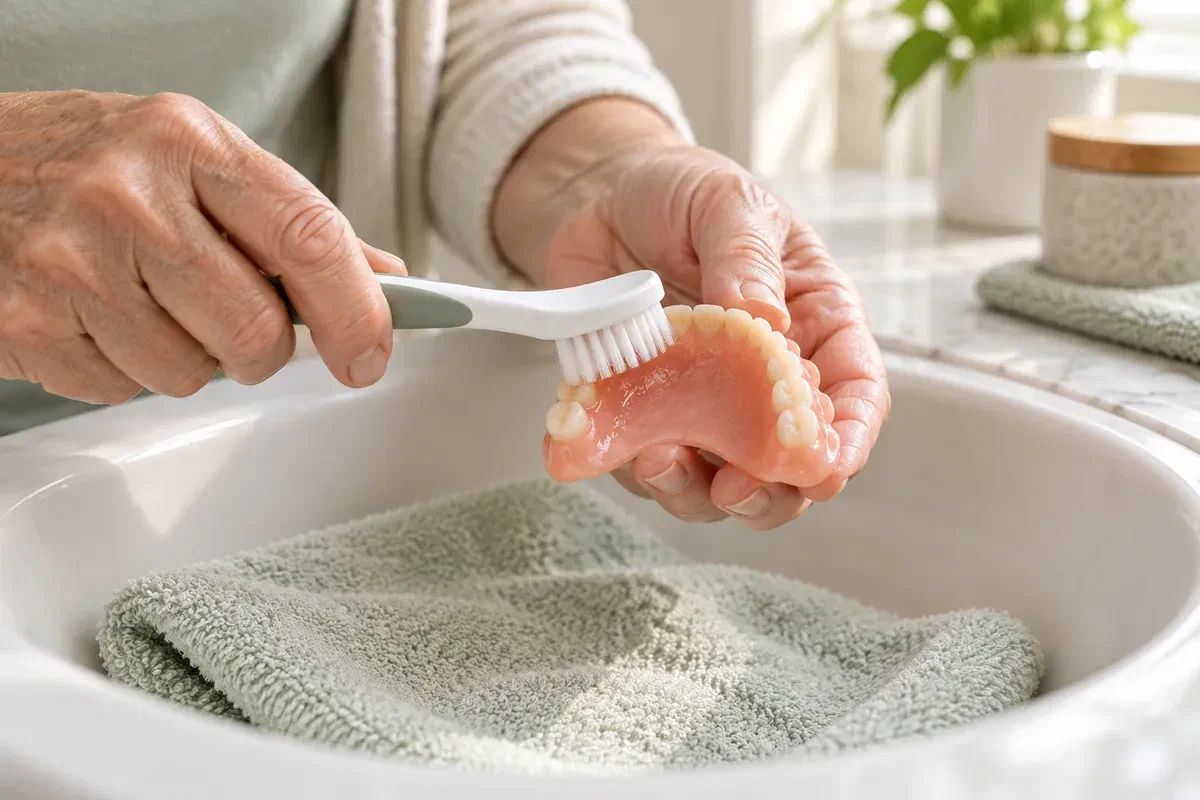
A folded towel in the sink or a basin with a little water softens the landing if the denture slips. Keep a secure hold without flexing the thinner sections; if your grip is unreliable, mention it and we can suggest aids.
Typically a soft brush and a product without grit. Skip vigorous scrubbing, sharp tools and household cleaners, follow the label and rinse well before you wear it.
Your own teeth still need fluoride toothpaste, and your gums need the care you were shown. Denture products may not suit those tissues, so do not mix the routines.
Patient information: Mayo Clinic — denture cleaning
A little planning saves a second trip. These are the questions people coming from Etobicoke tend to ask before they set out.
Our Bronte Street clinic can usually cover deposits, discolouration, your cleaners and the awkward corners of the appliance in a single sitting. Arrive with the denture and a few notes on your routine, and you will leave with a plan you can follow at home.
Ongoing soreness, redness or a looser fit are worth mentioning on the phone, so we can examine your mouth during the same appointment. For sudden swelling or severe pain, call before travelling.
