

Illustrative dentist and patient discussing denture options at a consultation
Restorative Dentistry

Denture Consultations in Oakville

Someone has mentioned dentures, and your first thought is about the teeth you still have. A consultation for Oakville households starts there: which teeth can stay, what could replace the missing ones, and what each path involves.

Keeping what is healthy

Your own teeth come into the conversation first

The word denture can sound like an all-or-nothing decision. It rarely is. Plenty of people who book a consultation still have many natural teeth, and the real question is how to replace a few missing ones without putting the healthy ones at risk.

So the appointment begins with an honest look at what you have. The dentist checks each remaining tooth, the gums and bone around it, and how your bite distributes force. That examination shows which teeth are reliable anchors and which may need treatment or closer watching.

From Oakville, you can expect the visit to stay practical. You will hear what each option would ask of the teeth you keep, how it would be cleaned, and what remains uncertain, so the next decision is clearer than when you walked in.

Ask which teeth can stay
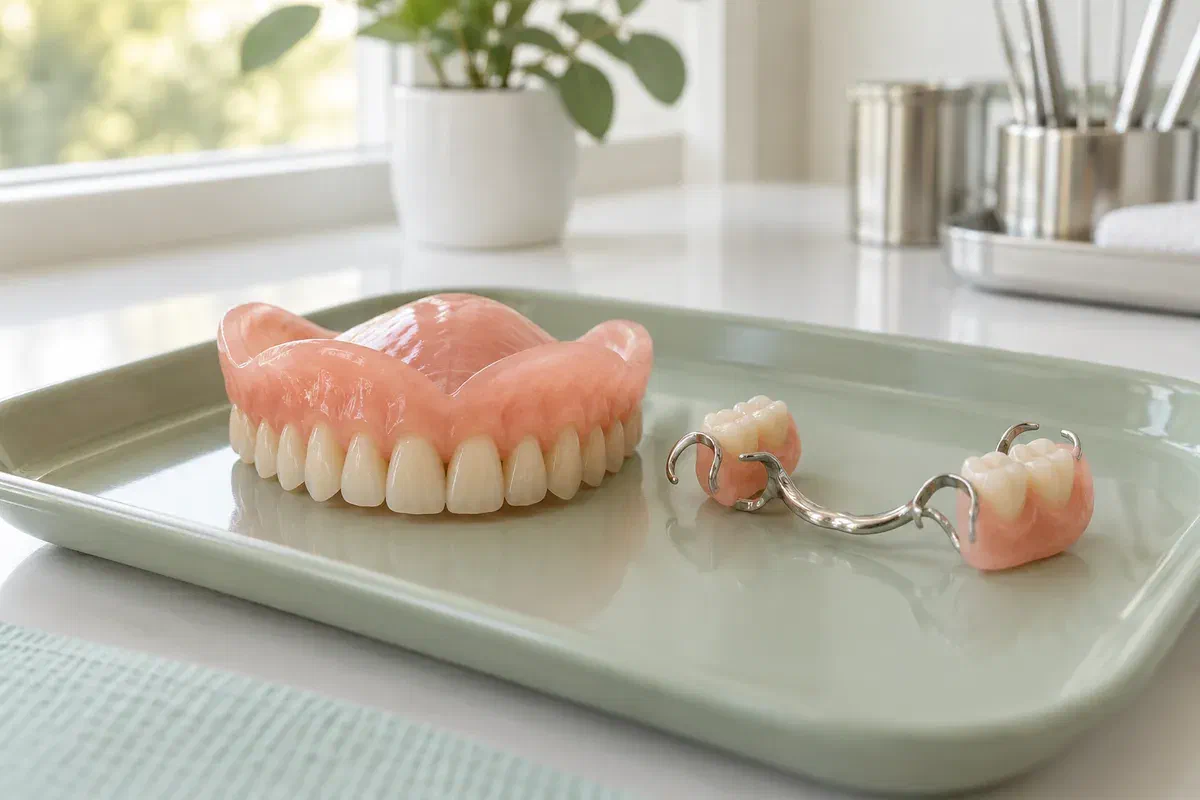
Complete and partial removable dentures displayed as illustrative examples
Starting points we often hear

Missing a few, worried about the rest

Your concern may be about chewing, appearance or the future of a particular tooth. Say it plainly, and the dentist can match it to what the examination finds.

A handful of gaps

Where the spaces are and how sturdy the surrounding teeth look will shape the advice. You may hear that a partial is reasonable, that a fixed option deserves comparison, or that a gap can be monitored for now. Each comes with its own support needs.

A partial that never felt right

Bring it along and explain what went wrong: rocking, a visible clasp, food trapping or soreness. The fix might be an adjustment, a new fitting surface, a repair or a different design, and the review helps tell those apart.

A tooth that has been flagged

If you have been told a tooth may need to come out, ask whether it could be treated instead and what happens to the plan if it is removed. Talk through temporary teeth, healing and the follow-up visits that keep things on track.

Swelling, real pain, a sore that will not heal or a broken appliance deserve a mention when you call. Those may be handled at a separate, sooner visit.

What a careful assessment gives you

Options weighed against the teeth you keep

Any replacement affects the natural teeth near it. A removable partial may rest on or clip to them; a bridge involves preparing neighbouring teeth; an implant needs its own surgical assessment. Understanding those effects is part of choosing well.

A detailed plan may need more information first, such as X-rays, impressions, periodontal treatment or a specialist opinion. Ask what is still open and what each next step is designed to clarify.

Patient information: Canadian Dental Association — dentures

Advice grounded in your mouth

The health of the gums, the strength of the remaining teeth, the shape of the ridges and the bite are reviewed together. That explains why a design is suggested, or why something else needs attention before any appliance.

A say in how it looks and feels

Talk about how much metal you would accept, where clasps might show, and how easy the appliance must be to remove and clean. The team can say which preferences fit the support you have.

Appointments and costs in sequence

Ask which stages are expected, what the estimate covers and how follow-up adjustments work. Seeing the whole path helps you compare long-term care as well as the appliance.

Step by step

From your concerns to a clear choice

Ask anything along the way. If an interpreter, a support person or extra time would help, let us know when you book.

  1. Explain what you want to protect

    We talk about missing teeth, any appliance you have tried, past dental work and the reason for your visit. Mention health conditions, medications, and how much time you can give to appointments and daily care.

  2. Examine teeth, gums and support

    The dentist looks closely at each remaining tooth and the tissues around it, and at any existing partial in place. Records may be recommended to see bone levels or roots that cannot be judged by eye.

  3. Compare what fits your mouth

    Partial dentures, bridges and implant-based options are discussed where relevant. Ask what each would improve, its limits, and whether gum care, fillings or a specialist visit should come first.

  4. Choose the next move

    That may be more records, time with an estimate or the start of planning. Confirm what was agreed and whether any problem you have now should be dealt with before the larger plan.

After you leave

Compare on paper, not from memory.

Three routes with different costs and steps are hard to recall accurately. Keep the plan and your questions together, and ask us before assuming what a line on the estimate includes.

Measure the plan against your goal

If keeping natural teeth was your priority, check that the proposal reflects it. Note anything you would like explained further, such as cleaning, comfort, visible metal or temporary replacements.

Sort out timing early

Ask how many visits are likely, whether a current partial is needed for impressions, and if there would be any time without it. Share work and family commitments while respecting the clinical order of steps.

Protect your remaining teeth meanwhile

Keep brushing and cleaning between teeth, and follow the advice for any appliance you wear now. Call about a new ache, swelling or a broken clasp rather than waiting for the next planning visit.

Three routes to compare

Removable, full or fixed?

The suggestion you receive should come with reasons tied to your mouth. Weigh preparation, function, handling, maintenance and cost, not looks alone.

Several healthy teeth remain

Removable partial denture

A partial fills chosen gaps and takes support from the teeth and gums around it. Ask how it is held, what it asks of the anchor teeth, and how food and plaque are kept away from them.

No reliable teeth left in an arch

Complete denture

When an entire upper or lower set must be replaced, a full denture is one route. Discuss timing, ridge health, appearance and adaptation, particularly if teeth would be removed and an immediate denture placed.

A fixed or anchored solution

Bridge or implant support

In some situations a bridge, or implants that hold a crown or a denture, may suit better. They need their own assessment and should be compared as complete plans, surgical steps and upkeep included.

Questions about keeping teeth

Not sure a denture is even right for you?

These questions come up often when people still have most of their teeth. They may help you prepare for the conversation.

(905) 876-4488
Does booking a denture consultation mean my teeth will be taken out?
No. The visit is an assessment and a discussion. Healthy teeth should not be removed simply to make an appliance easier. Ask which teeth are sound, which need treatment, and how each option would work with them.
How does a partial denture stay in place?
Most partials rest on the gums and are held by clasps or other attachments on nearby teeth. The design depends on where the gaps are and how strong those teeth are. Ask the dentist to show you where it would grip and how you would remove it.
Can gum disease affect whether a partial will work for me?
It can. Teeth that support a partial need healthy gums and bone around them. If gum problems are found, treating them may come before planning an appliance, and the dentist can explain how that changes the timeline.
Will clasps harm the teeth they hold onto?
A well-planned partial aims to spread load sensibly, but anchor teeth do need good cleaning and regular checks. Ask how the design protects them and what home care would help keep them healthy.
Is it reasonable to get a second opinion before extractions?
Yes. Removing a tooth cannot be undone, and asking for another view is a normal part of deciding. The dentist can explain the findings and, where appropriate, suggest a specialist assessment.
How might appointments be planned if I am coming from Oakville?
Ask for the likely sequence at the consultation so you can see how many visits are involved. Some steps can sometimes be grouped, while others need time between them for healing or lab work. Planning ahead makes it easier to fit care around work and family.
Planning a visit from Oakville

Start with the teeth you want to keep.

Book a denture consultation at our Bronte Street practice in Milton. Bring any partial you have, notes from earlier dental work and your questions about natural teeth, and we can focus the time on what would actually help.

Tell us if you would like a support person with you, or if you need help with communication or getting in and out of the chair.

Visit Milton Dental Clinic
Unit 1, 342 Bronte St. S, Milton, ON L9T 5B7
Get directions Clinic hours
Monday–Thursday
11am–7pm
Friday–Sunday
By appointment only

Areas we serve

  • Milton
  • Oakville
  • Mississauga
  • Georgetown
  • Halton Hills
  • Acton
  • Campbellville
  • Brampton
  • Burlington
  • Puslinch
  • Rockwood
  • Erin
  • Caledon
  • Etobicoke
  • Old Milton
  • Bronte Meadows
  • Timberlea
  • Dorset Park
  • Dempsey
  • Clarke
  • Beaty
  • Coates
  • Harrison
  • Scott
  • Willmott
  • Ford
  • Bowes
  • Cobden
  • Walker
  • Mountain View
  • Milton Heights
  • Hawthorne Village
  • Valley View
  • Fallingbrook
  • Nassagaweya
  • Trafalgar
  • Esquesing
  • Nelson
  • Brookville
  • Moffat
  • Glen Williams
  • Norval
  • Limehouse
  • Stewarttown
  • Ashgrove
  • Hornby
  • Silver Creek
  • Speyside
  • Scotch Block
  • North Oakville
  • River Oaks
  • Glen Abbey
  • West Oak Trails
  • Palermo
  • Bronte Creek
  • College Park
  • Joshua Creek
  • Uptown Core
  • Preserve
  • Iroquois Ridge
  • Lisgar
  • Meadowvale
  • Meadowvale Village
  • Churchill Meadows
  • Erin Mills
  • Central Erin Mills
  • Streetsville
  • East Credit
  • Creditview
  • Heartland
  • Sheridan
  • Mount Pleasant
  • Credit Valley
  • Huttonville
  • Churchville
  • Springbrook
  • Northwest Brampton
  • Bram West
  • Fletcher's Meadow
  • Fletcher's Creek South
  • Alton Village
  • Orchard
  • Millcroft
  • Headon Forest
  • Tansley
  • Brant Hills
  • Tyandaga
  • Kilbride
  • Lowville
  • Aberfoyle
  • Morriston
  • Arkell
  • Hillsburgh
  • Freelton
  • Carlisle
  • Waterdown
  • Flamborough
  • Mountsberg

How can we help?

Milton Dental Clinic

Have a question about your smile? Choose the option that works best for you.

For urgent dental concerns, please call.
Messages are reviewed during clinic hours.