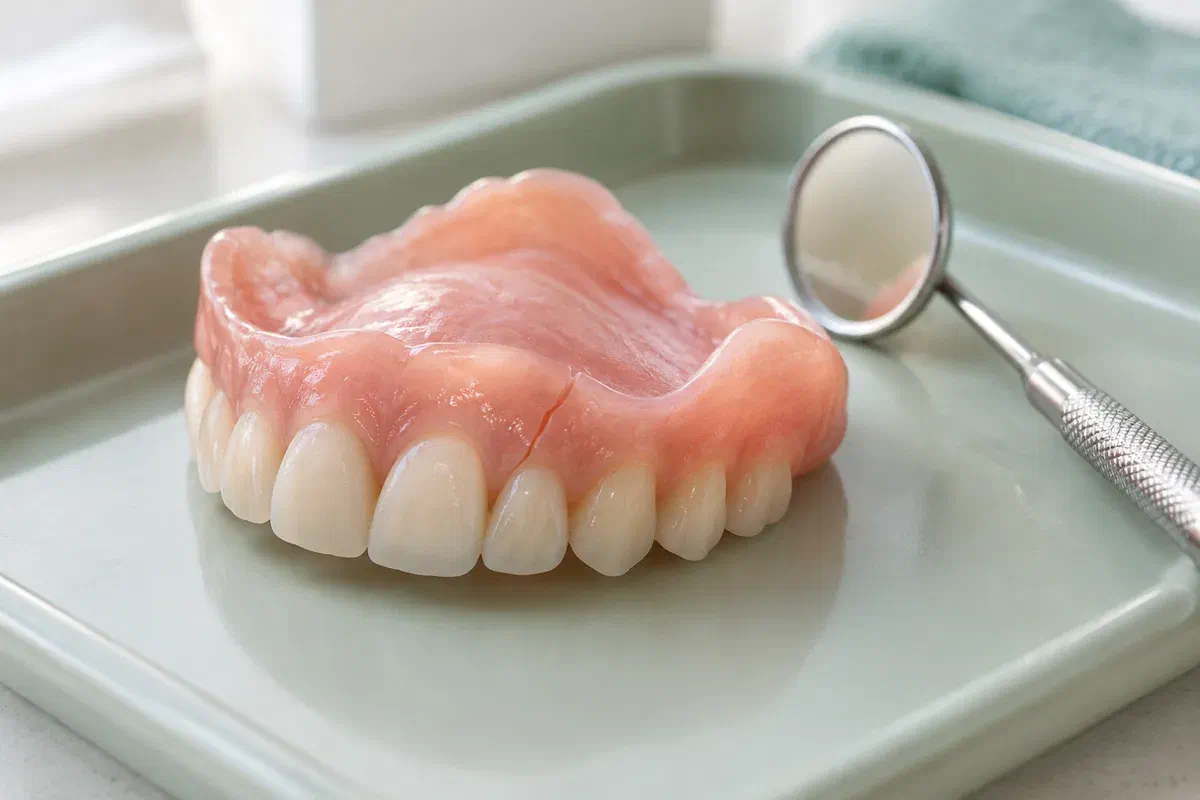
The pink base is cracked or split
Avoid bending it to see how deep the crack runs, and do not keep wearing a split base without advice. Mention whether it was dropped or cracked during ordinary use.


When your only denture breaks, work, meals, and conversations all feel harder overnight. From Mississauga, call our Milton team first; we can advise on the days before your assessment and then explain whether the damage can be repaired.
For many people, a denture is not optional equipment. It is how you eat lunch at work, how you speak on a video call, and how you feel comfortable at a family dinner. So when it cracks, loses a tooth, or has a clasp give way, the most pressing question is often what to do until it is sorted.
Our first advice is simple: phone before doing anything else. Tell the team whether you have no other appliance, and describe the damage. We can suggest how to manage, whether it is reasonable to wear it carefully, or whether it is better left out until the dentist has seen it.
At the assessment, the dentist examines the denture and any pieces you brought from Mississauga, along with your mouth. You will hear whether a repair makes sense, whether the fit needs attention at the same time, and what the timing looks like, including whether a dental laboratory will be involved.
A clear description over the phone helps the team plan the right appointment. The dentist will later want to know how the denture felt before it failed, and how the damage happened.
Avoid bending it to see how deep the crack runs, and do not keep wearing a split base without advice. Mention whether it was dropped or cracked during ordinary use.
A loose tooth can come away while eating, so take care. If it has already come off, put it in a secure container and bring it. The dentist will decide whether it can be reused.
A bent or snapped clasp may make a partial unstable or press on a natural tooth. Do not reshape it yourself. The dentist will look at the part, the tooth, and the fit together.
Call ahead so the team can advise and arrange the right visit. How quickly the work can be finished depends on the assessment and any lab involvement, so a same-day repair cannot be guaranteed.
When the damage is limited and the rest of the denture is sound, a repair can return a familiar appliance to use. The dentist considers the base and teeth around the break, so the repair rests on material that can support it.
If your denture has broken before, mention it. Fit, design, or bite pressures may be part of the reason, and a plan that addresses them can reduce the chance of being caught without a denture again.
Patient information: Canadian Dental Association — caring for dentures
Each type of failure carries its own decisions. Once you see what has happened, the reasoning behind the proposed work, or why a method will not suit, becomes easier to follow.
Where the rest of the denture works well, repair may preserve the look and bite you are used to. Tell the dentist which features matter to you.
Ask what the repair should achieve, what it leaves unchanged, and when to come back. A clear follow-up is especially useful when you rely on a single appliance.
You can call without knowing whether the denture is repairable. The assessment answers that, looks at your mouth as well, and sets out the timing and arrangements.
Tell us what broke, when, whether you have any denture to wear, and whether there is pain, swelling, or a cut. Bring the appliance, the pieces, and notes on past repairs.
The dentist checks the damage and the rest of the denture. Your gums, any natural teeth, and your bite may also be assessed so that underlying problems come to light.
Discuss the repair or alternative, the cost, how long it is likely to take, and whether a lab is needed. Ask whether the result is intended to last or to tide you over.
The repaired denture is checked for comfort and function. Follow the care advice and book a review if it begins to rub, rock, or feel unlike itself.
A repair joins an appliance that still needs daily cleaning and regular checks. Ask whether the repaired area or the cause of the break means you should handle it any differently.
Clean the denture over a folded towel or a basin with some water, and use a case at work or when travelling. If your grip has become unsteady, ask the team for tips on removal.
If the denture starts clicking, shows a new line, or fits differently, call before it fails completely. The team can judge how quickly it should be seen.
Your mouth changes over time even when the denture does not. Mention sore areas, worn teeth, or using more adhesive than before, so problems are dealt with as a whole.
These answers focus on managing without a usable denture and on the decisions that follow a break.
Contact our Bronte Street clinic about a cracked base, a missing tooth, or a damaged clasp. We will review the denture, explain the realistic repair options, and discuss any fit issues to address at the same time.
Please call to check availability before making the trip, and bring every saved piece in a closed container, without glue.
