

Illustrative consultation about movement of a lower denture
Restorative Dentistry

Denture Stabilization in Milton

If family dinners have turned into careful, one-sided chewing, the denture may need more than extra paste. Close to home in Milton, we look at fit, support and bite, then explain which options could make it steadier.

Steadier meals in Milton

When dinner becomes a balancing act

Many people first notice the problem at an ordinary meal. You cut food smaller than everyone else, keep to one side, or press the denture back with your tongue between bites. Those small workarounds are worth describing, because they show where and when the appliance stops behaving the way it should.

Stabilization is a goal, not one treatment. A denture can move because its fitting surface no longer matches the gums, because the teeth on it have worn or meet unevenly, or because the mouth simply offers less support than before. Each cause points toward a different answer, from adjustment or relining to a new appliance or implant-related support.

Our first visit is about understanding your version of the problem. The dentist examines the mouth and the denture together, listens to what you now avoid, and then explains which approaches are worth discussing in more detail, along with what each would ask of you over time.

Ask about a denture that slips
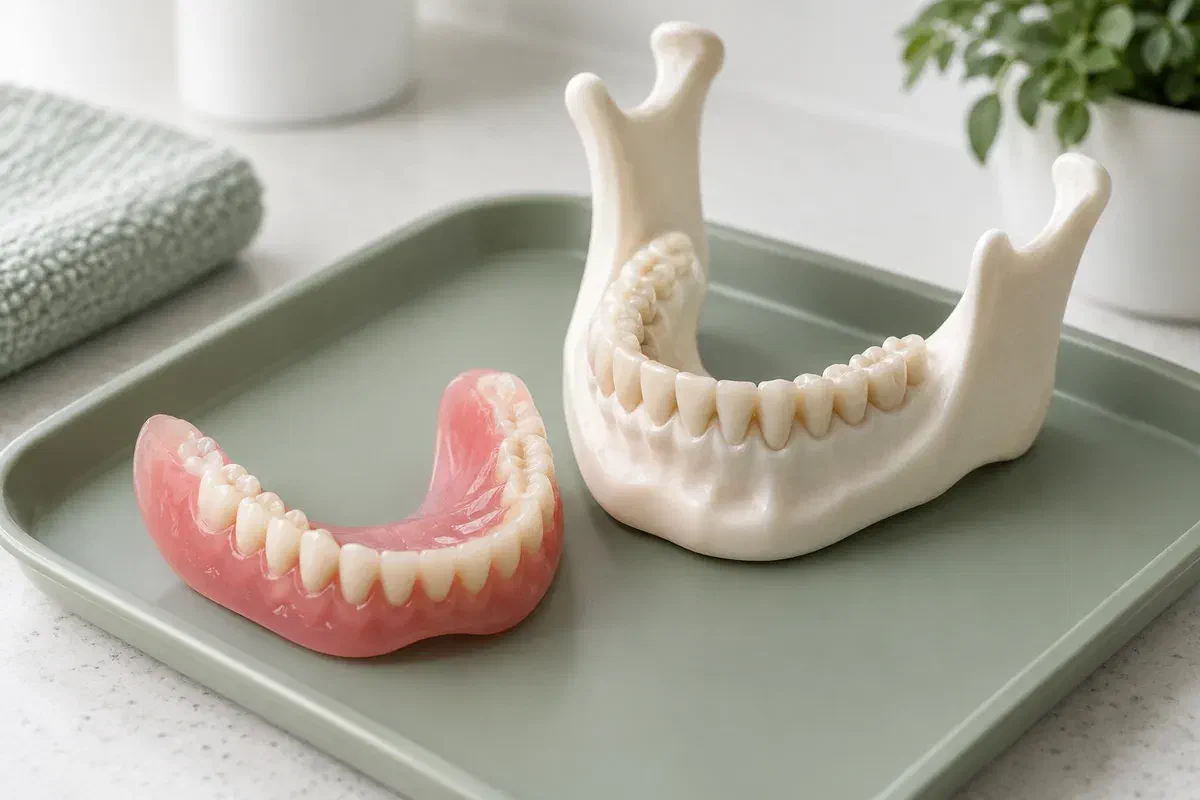
Lower removable denture beside a lower-jaw teaching model
What the movement tells us

Pay attention to when it happens

The timing and setting of the movement usually say more than the movement alone. Before your visit, jot down a few moments when the denture felt secure and a few when it clearly did not.

It loosens while you talk or laugh

Lifting during speech or a big laugh can relate to the edges of the denture and how it sits against the cheeks, lips and tongue. Mention the words or expressions that seem to trigger it so the borders and support can be examined.

One side rocks when you chew

Rocking with harder or chewier food may involve the bite as much as the fit. If the teeth on the denture meet unevenly, relining the underside alone might leave part of the problem in place, so both are reviewed together.

The adhesive tube empties faster

Needing more paste than you used to is a signal worth sharing. Bring the product you use and describe how you apply it, so the dentist can consider adhesive as one part of the picture rather than the fix for everything.

Call before your visit if the denture is causing pain, a piece has broken, or the fit changed suddenly. We can tell you whether it should be seen promptly and whether to keep wearing it in the meantime.

Why the assessment matters

The right fix depends on the real cause

Looking closely at the appliance and the mouth helps sort out which issues can be solved within the denture you already have and which call for a different plan. It also gives an honest starting point for discussing limits, especially when the gums and bone now give less support than they once did.

What you should leave with is clarity, not a promise that the denture will never shift again. That means knowing what improvement is being aimed for, which limitations may remain, and what care will keep the result working. Being able to take the denture out and clean it properly stays part of that discussion.

Patient information: Canadian Dental Association — dentures and overdentures

See what is causing the instability

Support, tooth contacts and the condition of the appliance can each play a part. Ask the dentist which finding matters most and whether several factors need attention before any treatment is chosen.

Weigh options in everyday terms

Each approach brings its own number of appointments, costs, upkeep and handling. Comparing those practical demands beside the expected improvement helps you choose something that suits your routine and your household.

Agree on goals you can live with

Tell us which meals, conversations or activities feel hardest. The clinician can then explain where a given treatment might help and where a removable denture is likely to keep some limits.

How a stability visit works

We start with the denture already in your pocket

Nothing needs to be decided in advance. Implants, a reline or a new denture can all wait until the reason for the movement has been looked at properly and explained to you.

  1. Tell us its history

    Bring the appliance and share roughly how old it is, any repairs it has had and when the looseness began. Let us know about adhesive, sore spots and any recent changes to your own remaining teeth.

  2. Examine mouth and denture together

    The dentist checks support, fit and how the teeth meet. Part of this is deciding whether the concern is limited to one area or reflects wider changes, and whether more records are needed before recommending anything.

  3. Talk through the realistic choices

    We explain what could be improved within the current denture and what would need a replacement or another kind of support. You can ask about the likely benefit, the stages involved, upkeep and any referral that might be suggested.

  4. Treat, then check how it is working

    What happens next depends on the approach you choose. Afterward, fit and function are reviewed, care instructions are given, and there is a plan for reassessing any movement or soreness that lingers in daily use.

Keeping the improvement

Follow-up is part of the treatment

Your care routine depends on what was done, whether an adjustment, a new fitting surface, a replacement or added support. Ask for instructions that match the new arrangement instead of carrying on with old habits.

Practise putting it in and taking it out

A changed appliance can feel different to insert or remove. Ask the team to demonstrate, then practise while they watch. Let us know if gripping, lining it up or cleaning it is awkward, so the routine can be adapted.

Keep the planned review appointments

Some designs have parts that need checking or replacing over time. Find out what maintenance is expected, how it will be booked and which changes in fit or handling mean you should come in sooner.

Describe any new movement clearly

Notice whether looseness returns slowly or all at once, and what you were doing when it happened. Those details help separate a fresh problem from a limitation that was already explained during planning.

Options for a steadier denture

Different causes, different routes

Each approach below suits a different situation, and only an examination shows which ones apply to you. A bigger treatment is not automatically better for every denture that moves.

Good when much of it still works well

Refine the denture you have

An adjustment or reline may be suggested if the rest of the appliance remains suitable. Ask which part of the movement it is meant to correct and whether worn teeth or bite changes also need attention.

Good when several features need rethinking

Start fresh with a new denture

A replacement may be raised if the teeth, base or overall design are no longer right. It lets those elements be planned again together, though a removable denture still comes with realistic limits on support.

Good for some people after full assessment

Consider implant-retained support

For certain patients, implants can help hold a removable denture. This needs its own evaluation and a frank discussion of surgery, healing, cleaning, upkeep, cost and alternatives. A loose denture alone does not make someone a candidate.

Milton denture questions

Common questions before you book

Most people who come in about a moving denture have a few practical questions first. Here are some we hear often, answered without assuming any one treatment is right for everyone.

(905) 876-4488
Is a loose denture something I just have to live with?
Not necessarily. Movement often has identifiable causes, such as a worn fitting surface, uneven tooth contacts or changes in the gums. An examination can show whether improvement is possible within your current denture or whether another approach is worth discussing.
Should I stop wearing my denture if it has started to hurt?
Call us and describe the soreness. Depending on what you tell us, the team may suggest leaving it out for a while or coming in soon. Persistent pain or a sore that does not settle should be examined rather than ignored.
Can my upper and lower dentures need different solutions?
Yes. They sit on different parts of the mouth and are supported differently, so one may be fine while the other moves. The dentist will look at each appliance on its own merits and explain what applies to the one causing trouble.
Is it safe to reline my denture at home with a kit?
It is best to ask first. Home products can change the fitting surface in ways that are hard to undo and may hide the real cause of movement. Bring the denture in so the fit can be assessed before anything is added to it.
Would implant support mean my denture never comes out?
Not usually. Many implant-retained dentures are still removable and are taken out for cleaning as instructed, while fixed restorations are a separate treatment. Ask which type is being discussed and what daily care each would involve.
Can I book an evening visit around work in Milton?
Our Bronte Street clinic is open until 7 p.m. Monday to Thursday, with weekend times by appointment. Mention when you book that the visit is about denture movement so enough time is set aside for the examination and discussion.
Book in Milton

Bring the denture and your questions

Visit our Bronte Street practice for a careful look at a denture that lifts, shifts or rocks. We will check the appliance and the mouth that supports it, then explain the options that could address the cause.

Please bring the denture, the adhesive you use and a short list of the moments when you would like it to feel steadier.

Visit Milton Dental Clinic
Unit 1, 342 Bronte St. S, Milton, ON L9T 5B7
Get directions Clinic hours
Monday–Thursday
11am–7pm
Friday–Sunday
By appointment only

Areas we serve

  • Milton
  • Oakville
  • Mississauga
  • Georgetown
  • Halton Hills
  • Acton
  • Campbellville
  • Brampton
  • Burlington
  • Puslinch
  • Rockwood
  • Erin
  • Caledon
  • Etobicoke
  • Old Milton
  • Bronte Meadows
  • Timberlea
  • Dorset Park
  • Dempsey
  • Clarke
  • Beaty
  • Coates
  • Harrison
  • Scott
  • Willmott
  • Ford
  • Bowes
  • Cobden
  • Walker
  • Mountain View
  • Milton Heights
  • Hawthorne Village
  • Valley View
  • Fallingbrook
  • Nassagaweya
  • Trafalgar
  • Esquesing
  • Nelson
  • Brookville
  • Moffat
  • Glen Williams
  • Norval
  • Limehouse
  • Stewarttown
  • Ashgrove
  • Hornby
  • Silver Creek
  • Speyside
  • Scotch Block
  • North Oakville
  • River Oaks
  • Glen Abbey
  • West Oak Trails
  • Palermo
  • Bronte Creek
  • College Park
  • Joshua Creek
  • Uptown Core
  • Preserve
  • Iroquois Ridge
  • Lisgar
  • Meadowvale
  • Meadowvale Village
  • Churchill Meadows
  • Erin Mills
  • Central Erin Mills
  • Streetsville
  • East Credit
  • Creditview
  • Heartland
  • Sheridan
  • Mount Pleasant
  • Credit Valley
  • Huttonville
  • Churchville
  • Springbrook
  • Northwest Brampton
  • Bram West
  • Fletcher's Meadow
  • Fletcher's Creek South
  • Alton Village
  • Orchard
  • Millcroft
  • Headon Forest
  • Tansley
  • Brant Hills
  • Tyandaga
  • Kilbride
  • Lowville
  • Aberfoyle
  • Morriston
  • Arkell
  • Hillsburgh
  • Freelton
  • Carlisle
  • Waterdown
  • Flamborough
  • Mountsberg

How can we help?

Milton Dental Clinic

Have a question about your smile? Choose the option that works best for you.

For urgent dental concerns, please call.
Messages are reviewed during clinic hours.