

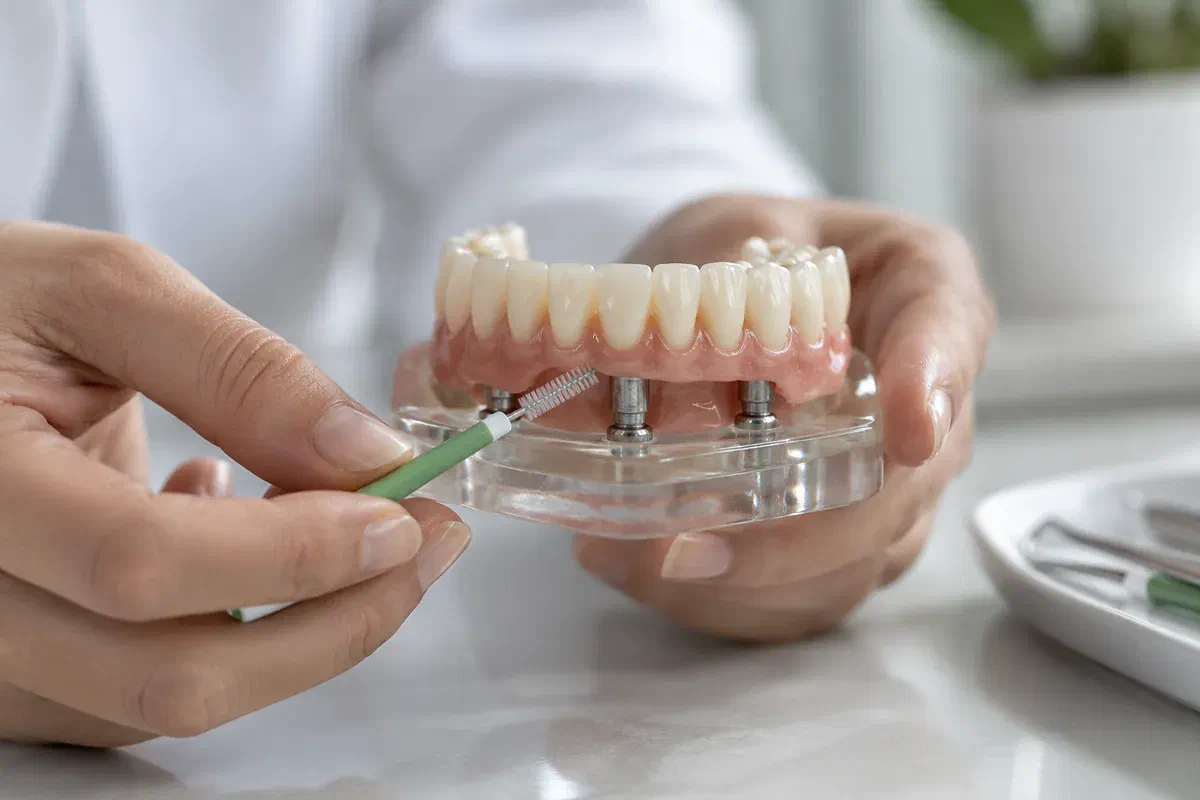
Illustrative discussion of a fixed full-arch implant restoration
Restorative Dentistry

Fixed Implant Dentures

A fixed implant denture replaces an arch of teeth with a restoration you do not remove at home. Explore fixed implant dentures in Milton, including suitability, treatment stages, daily cleaning, and the long-term care the design requires.

A closer look at fixed implant dentures

Plan for teeth that stay in place and care that fits your life.

A fixed implant denture is a full-arch restoration supported by dental implants. It may also be described as a fixed implant bridge. Unlike a removable overdenture, it is not taken out by the patient for routine cleaning; access beneath and around the restoration must be considered in its design and care.

The restoration and the implants are different parts of the treatment. The implants provide support within the jaw, while the visible appliance replaces teeth and, where needed, lost gum form. Planning needs to consider both the support and the appearance, speech, bite, and cleaning access of the final teeth.

At Milton Dental Clinic, you can begin with an assessment and a discussion of fixed and removable options. We can review the starting point, explain the information needed, and identify any specialist involvement appropriate to the case. The decision should account for the full treatment and maintenance commitment, not only the appeal of leaving the appliance in place.

Discuss fixed implant denture options
Cleaning brush demonstrated beneath a fixed implant teaching model
Before choosing a fixed design

Consider support, access, and the mouth as a whole.

A fixed restoration can be relevant to people missing an arch of teeth or facing extensive tooth loss. Suitability is established through assessment, including whether remaining teeth can reasonably be retained.

A removable appliance limits everyday confidence

Tell the clinician which difficulties you experience with movement, handling, or meals. Those concerns help frame the comparison, but they do not by themselves establish that a fixed implant design is suitable.

Several remaining teeth have uncertain prospects

Ask for an explanation of each relevant diagnosis and the options for retaining useful teeth. A full-arch replacement plan should follow that discussion rather than assume all remaining teeth need removal.

You want to understand the cleaning commitment

Daily access beneath a fixed restoration matters from the planning stage. Discuss hand strength, vision, dexterity, and any caregiver assistance so the proposed design can be considered in practical terms.

The number and position of implants are determined by the clinical and restorative plan. A named package or advertised implant count does not replace an assessment of your mouth.

The intended role of a fixed restoration

Provide support without overlooking the responsibilities.

For a suitable patient, an implant-supported fixed arch can provide teeth that remain attached during ordinary use. The intended improvement should be explained in relation to the person's current difficulties and the findings from planning.

Fixed does not mean maintenance-free or guaranteed for life. Implant and tissue health, the condition of the restoration, and the way forces are managed all need review. Ask about possible complications, repair arrangements, and ongoing costs as part of the initial decision.

Patient information: Leeds Teaching Hospitals — dental implant patient information

Understand how the proposed teeth are supported

The clinician should explain the relationship between implant support and the final restoration. This helps you compare the fixed plan with a removable design without relying only on how the appliance is described.

Discuss appearance and function together

Tooth position, visible gum replacement, speech, and the bite are connected planning considerations. Explain your priorities and ask what opportunities exist to review the proposed arrangement before the final restoration is completed.

Make maintenance part of suitability

A design must be considered alongside your ability to care for it. Ask for a practical explanation of cleaning access and professional review so the ongoing routine is understood before treatment begins.

Planning a fixed implant arch

Connect the surgical plan with the final teeth.

Treatment usually involves several stages and may involve a coordinated team. Ask who will provide each part, how temporary teeth are managed, and what findings could change the planned sequence.

  1. Assess the mouth, health history, and priorities

    The clinician reviews remaining teeth, tissues, existing appliances, and medical factors. Appropriate imaging and other records help establish the support available and whether additional assessment or preparatory care is needed.

  2. Compare designs and agree on a complete plan

    Discuss fixed and removable alternatives, implant support, materials, temporary arrangements, risks, and maintenance. Clarify any proposed extractions or grafting and the rationale for each irreversible part of treatment.

  3. Complete planned surgical and healing stages

    The sequence depends on the findings and agreed approach. Temporary tooth timing and the amount of chewing force allowed are separate clinical decisions; a fixed final result does not guarantee immediate fixed teeth.

  4. Fit the restoration and establish ongoing care

    Records and fitting checks guide the final appliance. The team assesses relevant contacts and function, demonstrates cleaning, and arranges reviews for both the restoration and the tissues supporting the implants.

Living with a fixed implant denture

Clean beneath the teeth as well as around them.

Because you do not remove the restoration at home, the daily routine must reach the areas around its supporting components. Ask for a demonstration using the tools and technique suitable for the actual design.

Build a realistic daily cleaning routine

Learn how to reach beneath the restoration without forcing unsuitable tools into the space. Tell the team if an area is difficult to access so the technique and design can be reviewed rather than leaving it uncleaned.

Attend implant and restoration reviews

Professional checks assess tissue health, hygiene, contacts, and component condition. The interval should reflect your needs, and the team should explain whether any professional removal or other maintenance is anticipated.

Report movement, damage, or tissue changes

Contact the team about looseness, a chipped area, persistent bleeding, or discomfort. Avoid testing a moving restoration or attempting to tighten components yourself; the source of the change needs assessment.

Patient information: Canadian Dental Association — dental implants and ongoing care

Comparing full-arch replacement approaches

Choose the design you can support and maintain.

Fixed and removable approaches differ in daily handling, cleaning access, treatment requirements, and cost. The assessment should explain which options are suitable rather than treating one design as the default.

When an implant-free approach is appropriate

A conventional removable denture

A removable appliance may remain a suitable option depending on the mouth and your priorities. Ask about its expected support, limitations, and care requirements when comparing it with implant treatment.

When added retention and removal are useful

An implant-retained removable overdenture

A removable implant-related design is taken out as instructed for cleaning. It has its own support and maintenance needs, which should be compared with a fixed arch rather than assumed to be identical.

When the full plan is clinically and practically suitable

A fixed implant-supported arch

A fixed restoration remains attached during daily use. Suitability includes the available support, restorative design, cleaning access, health factors, and your commitment to professional maintenance over time.

Questions about fixed implant dentures

Know what stays fixed and what still needs care.

A full-arch treatment decision deserves a clear explanation of design, stages, and maintenance. These questions can help prepare for a discussion of the options relevant to your mouth.

(905) 876-4488
Do I take a fixed implant denture out at night?
A fixed restoration is not designed for you to remove at home. A removable implant overdenture is a different design. Ask the team to identify the proposed appliance clearly and demonstrate the cleaning routine required around and beneath it.
Does a fixed full arch require one implant for every replacement tooth?
Not necessarily. A full-arch restoration can be supported by a planned arrangement of implants, but the number and positions depend on the clinical and restorative requirements. Ask how the proposed support was determined rather than comparing plans by implant count alone.
Can I receive fixed temporary teeth on the day implants are placed?
That may be considered in selected circumstances, but it is not guaranteed. The plan depends on clinical conditions and the requirements for using the implants. Discuss both the preferred temporary arrangement and the alternative if immediate fixed teeth are unsuitable.
How do I clean underneath a restoration that I cannot remove?
The team should demonstrate access and suitable tools for your specific design. Ask to practise the technique and explain any difficulty with grip or visibility. Cleaning requirements should be discussed during planning, not discovered only after the restoration is fitted.
Does fixed mean the denture can never be removed by a dentist?
Some fixed restorations can be removed professionally when indicated, but the method and maintenance arrangements depend on the design. Ask whether professional removal is anticipated and who would manage it. Do not attempt to loosen or remove any component yourself.
What ongoing costs should I discuss before choosing a fixed implant arch?
Ask about routine reviews, professional cleaning, possible component replacement, repair of the tooth material, and management of complications. The initial treatment fee does not necessarily cover every future need. Clarify those arrangements and any relevant coverage before proceeding.
Fixed implant dentures in Milton

Let’s consider the complete plan for a fixed smile.

Arrange a consultation at our Bronte Street clinic to discuss full-arch replacement. We can review your starting point, compare relevant designs, and explain what further planning or specialist assessment may be needed.

Bring details of existing implants or appliances if available, and tell us about your priorities for daily use and cleaning.

Visit Milton Dental Clinic
Unit 1, 342 Bronte St. S, Milton, ON L9T 5B7
Get directions Clinic hours
Monday–Thursday
11am–7pm
Friday–Sunday
By appointment only

How can we help?

Milton Dental Clinic

Have a question about your smile? Choose the option that works best for you.

For urgent dental concerns, please call.
Messages are reviewed during clinic hours.