

Illustrative discussion of a fixed full-arch implant restoration
Restorative Dentistry

Fixed Implant Dentures in Milton

Wondering what “fixed” really means for a full arch of teeth? In Milton, you can talk through implant-supported dentures that stay in place, who they may suit, how treatment is staged, and the cleaning and reviews they ask of you.

Fixed full-arch teeth, explained in Milton

The question most people start with: will I ever take them out?

The short answer is no, not at home. A fixed implant denture, sometimes called a fixed implant bridge, is a full arch of replacement teeth held on dental implants. You keep it in day and night, which is the main difference from a removable overdenture that clips onto implants and comes out for cleaning.

That convenience brings its own homework. Since the arch stays put, your daily routine has to reach underneath it and around the posts that hold it, and the design has to leave room for that. Two pieces of work are involved: implants that anchor in the jawbone, and a visible arch that replaces teeth and sometimes missing gum. Each needs planning in its own right.

A first visit is an assessment and a conversation. Dr. Anjum can look at where your mouth is today, compare fixed and removable designs with you, describe the records a plan would need and mention when a specialist may be part of the team. Make the choice with the whole commitment in view, not only the appeal of teeth that never come out.

Talk about a fixed full arch
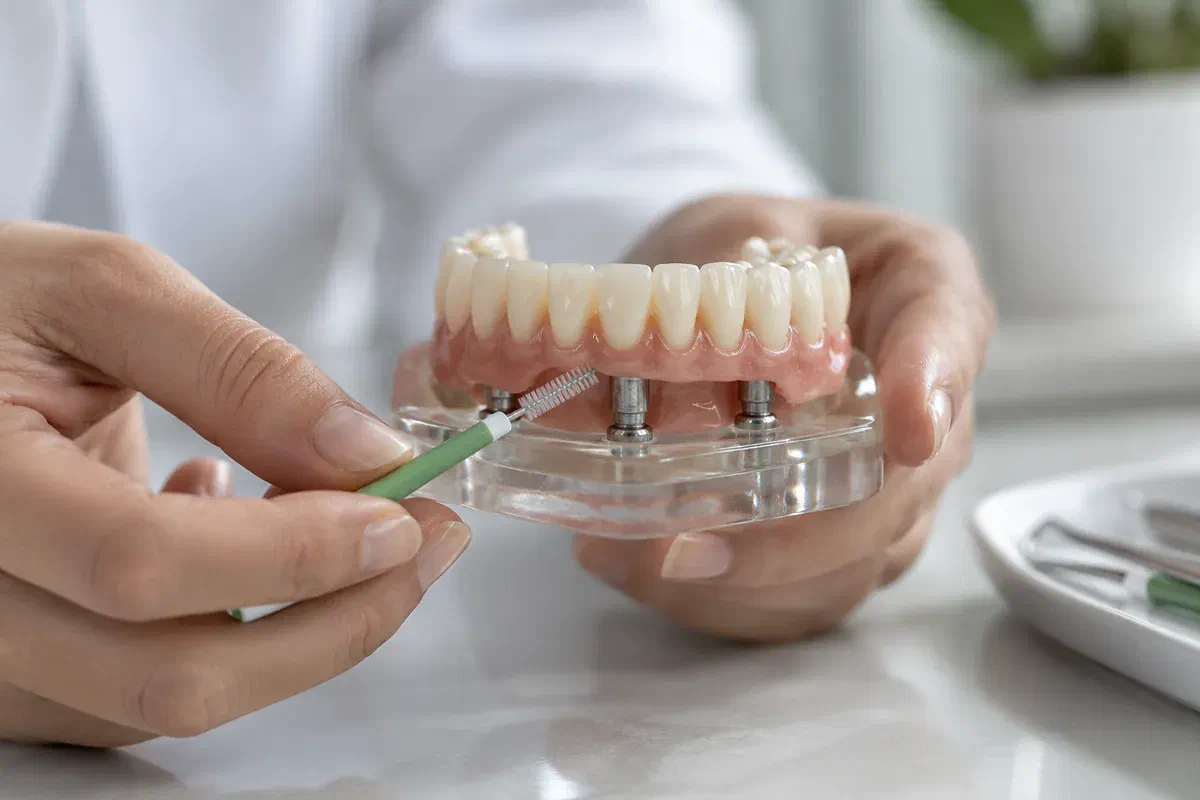
Cleaning brush demonstrated beneath a fixed implant teaching model
What brings people in

Three situations that start the conversation

People ask about a fixed arch when most teeth in a jaw are gone or a large amount of tooth loss is expected. Whether it suits you is decided by examination, including a frank look at which natural teeth could still be kept.

Your current denture shifts or feels uncertain

Describe exactly when it moves, slips while eating or feels awkward to handle. That detail shapes the comparison between designs, though frustration with a removable appliance alone does not show that a fixed one is right for you.

Some natural teeth are doubtful

Each questionable tooth deserves its own diagnosis and a discussion of whether it can be saved. A plan to replace a whole arch should come after that review, not start from the idea that every remaining tooth has to go.

You are unsure you could clean it well

Mention grip, eyesight, hand steadiness or whether someone helps you at home. Those details belong in early planning, because a fixed arch is only suitable if the cleaning it needs is realistic for you.

How many implants are used, and where they sit, comes from your examination and the restorative design. A package name or a number in an advertisement cannot stand in for that assessment.

What a fixed arch is meant to do

Teeth that stay put, with duties attached

When the plan suits the person, an implant-supported fixed arch gives teeth that stay attached through talking, eating and laughing. How much difference that makes should be explained against your own present problems and what the planning records show.

Staying in place is not the same as needing no care, and nothing about it is guaranteed to last a lifetime. The implants, the gums around them, the arch itself and the forces of your bite all need regular checking. Questions about complications, how repairs are handled and what they may cost belong in the very first discussion.

Patient information: Leeds Teaching Hospitals — dental implant patient information

Know what holds the teeth up

Ask for a clear picture of how the implants and the final arch work together. With that, you can weigh a fixed plan against a removable one on its real merits rather than on a product description.

Weigh looks and use side by side

Where the teeth sit, how any replacement gum looks, how you speak and how the arches meet are linked choices. Share what matters most to you and ask when you will be able to preview the arrangement before it is finalized.

Treat upkeep as part of the decision

Whether a design suits you depends partly on whether you can look after it. Ask how cleaning access will work and how often professional checks are expected, so the long-term routine is clear before anything is started.

From first records to fitted teeth

How a fixed arch is usually staged

This is rarely a single appointment, and more than one clinician may be involved. It helps to ask who handles each stage, what you will wear in the meantime and what findings could change the order of things.

  1. Examine, record and listen

    Your remaining teeth, gums, any current denture and your medical history are reviewed. Suitable imaging and records show how much support is available and whether other assessment or earlier treatment is needed first.

  2. Settle on a design and a full plan

    Fixed and removable choices, implant support, materials, interim teeth, risks and maintenance are all discussed. Any extraction or grafting that is proposed should come with a clear reason, since those steps cannot be undone.

  3. Move through surgery and healing

    The order depends on what was found and what you agreed. When interim teeth go in, and how firmly you may chew on them, are separate clinical decisions, so a fixed end result does not promise fixed teeth straight away.

  4. Fit the final arch and set up reviews

    Records and try-in checks guide the finished arch. The team looks at how your teeth meet and function, shows you how to clean, and books reviews of both the arch and the tissues around the implants.

Daily life with a fixed arch

The cleaning happens underneath, too

Because the arch stays in, your routine has to reach the gaps under it and around the parts that hold it. Ask the team to show you on your own design, with tools that actually fit the spaces you have.

Settle into a routine you can keep

Find out how to clean under the arch without pushing tools that do not fit. If a spot is hard to reach, say so, so the method or the design can be looked at again rather than that area going uncleaned.

Keep your review appointments

These visits check your gums, hygiene, how your teeth meet and the state of the components. How often you come should match your needs, and you should hear whether professional removal or other upkeep is expected.

Call about anything that changes

Get in touch if the arch feels loose, a piece chips, bleeding keeps happening or something aches. Do not wiggle it to check or try to tighten anything yourself; the cause needs a proper look.

Patient information: Canadian Dental Association — dental implants and ongoing care

Ways to replace a whole arch

Three designs worth comparing

Handling, cleaning, treatment needs and cost all vary between fixed and removable arches. Your assessment should show which ones fit your mouth, not present one as the automatic choice.

If implants are not the right route

A standard removable denture

A traditional denture may still be a sound choice, depending on your mouth and priorities. Ask how well it is likely to sit, where its limits are and what care it needs when you set it beside implant options.

If extra hold plus removal appeals

A removable overdenture on implants

This design clips onto implants and comes out as directed for cleaning. Its support and upkeep differ from a fixed arch, so compare the two directly instead of assuming they work the same way.

If the whole plan fits clinically and practically

A fixed implant-supported arch

This arch stays attached through the day. Whether it suits you depends on available support, the design, how easily you can clean it, your health and your willingness to attend reviews over the years.

Common questions

Straight answers about fixed full arches

Deciding on a full arch is easier with clear information about design, timing and upkeep. These answers can help you prepare for an appointment.

(905) 876-4488
Is a fixed implant denture the same thing as an overdenture?
No. A fixed arch stays in and is not removed at home, while an overdenture clips onto implants and comes out for cleaning. Ask the team to name the exact design being proposed and show you the cleaning it would involve.
How is the number of implants for a full arch decided?
It comes from your examination, imaging and the design of the final teeth. There is no single correct number for everyone, so ask how your proposed support was worked out rather than comparing plans on implant count.
Will I have teeth while the implants heal?
Most plans include some form of interim teeth, but the type and timing depend on your situation. Fixed interim teeth are possible in some cases and not in others, so ask what the backup would be if they are not suitable.
Can I still have a fixed arch if I have worn a denture for years?
Possibly. Long-term denture wear can change the shape of the jaw, so imaging and assessment are needed to see what support is available. The result may point toward a fixed design, a removable one, or further planning first.
What should I tell the team about my health before planning?
Share your medical conditions, medications and smoking or vaping habits, along with any past problems with healing. These can affect planning and timing, and some situations call for coordination with your physician.
How often will I need to come back once the arch is fitted?
Review intervals depend on your gums, your cleaning and the design. Being close by in Milton makes those visits easier to keep, but the right interval is something the team should set and explain for you.
Start the conversation in Milton

Bring your questions about a full arch.

Book a consultation at our Bronte Street practice to talk about replacing a whole arch. We can look at your starting point, compare designs that may suit you and explain any further planning or specialist input that could be needed.

If you have records for existing implants or dentures, bring them along, and let us know what matters most to you for eating, speaking and cleaning.

Visit Milton Dental Clinic
Unit 1, 342 Bronte St. S, Milton, ON L9T 5B7
Get directions Clinic hours
Monday–Thursday
11am–7pm
Friday–Sunday
By appointment only

Areas we serve

  • Milton
  • Oakville
  • Mississauga
  • Georgetown
  • Halton Hills
  • Acton
  • Campbellville
  • Brampton
  • Burlington
  • Puslinch
  • Rockwood
  • Erin
  • Caledon
  • Etobicoke
  • Old Milton
  • Bronte Meadows
  • Timberlea
  • Dorset Park
  • Dempsey
  • Clarke
  • Beaty
  • Coates
  • Harrison
  • Scott
  • Willmott
  • Ford
  • Bowes
  • Cobden
  • Walker
  • Mountain View
  • Milton Heights
  • Hawthorne Village
  • Valley View
  • Fallingbrook
  • Nassagaweya
  • Trafalgar
  • Esquesing
  • Nelson
  • Brookville
  • Moffat
  • Glen Williams
  • Norval
  • Limehouse
  • Stewarttown
  • Ashgrove
  • Hornby
  • Silver Creek
  • Speyside
  • Scotch Block
  • North Oakville
  • River Oaks
  • Glen Abbey
  • West Oak Trails
  • Palermo
  • Bronte Creek
  • College Park
  • Joshua Creek
  • Uptown Core
  • Preserve
  • Iroquois Ridge
  • Lisgar
  • Meadowvale
  • Meadowvale Village
  • Churchill Meadows
  • Erin Mills
  • Central Erin Mills
  • Streetsville
  • East Credit
  • Creditview
  • Heartland
  • Sheridan
  • Mount Pleasant
  • Credit Valley
  • Huttonville
  • Churchville
  • Springbrook
  • Northwest Brampton
  • Bram West
  • Fletcher's Meadow
  • Fletcher's Creek South
  • Alton Village
  • Orchard
  • Millcroft
  • Headon Forest
  • Tansley
  • Brant Hills
  • Tyandaga
  • Kilbride
  • Lowville
  • Aberfoyle
  • Morriston
  • Arkell
  • Hillsburgh
  • Freelton
  • Carlisle
  • Waterdown
  • Flamborough
  • Mountsberg

How can we help?

Milton Dental Clinic

Have a question about your smile? Choose the option that works best for you.

For urgent dental concerns, please call.
Messages are reviewed during clinic hours.