

Illustrative discussion of a fixed full-arch implant restoration
Restorative Dentistry

Fixed Implant Dentures in Mississauga

Told that several teeth are failing and a full arch might be next? Mississauga adults can get a careful assessment of which teeth are worth keeping, whether a fixed implant denture fits, and what treatment and upkeep would involve.

When teeth are failing · Mississauga

Keep, repair or replace the whole arch?

Sometimes the conversation starts with a single loose tooth and grows. When most of the teeth in one jaw are in doubt, a fixed implant denture may come up: a full arch of teeth, also called a fixed implant bridge, anchored to implants and left in place rather than taken out like an overdenture. Before that step, each remaining tooth deserves a fair hearing.

If replacement does make sense, the work has two sides. The implants give support inside the jaw. The arch you see restores the teeth and, where tissue has receded, some of the gum line. Planning brings them together, so that appearance, speech, the way your teeth close and how you will clean underneath are all settled before anything permanent happens.

People from Mississauga, especially from western areas such as Meadowvale and Churchill Meadows, often begin with an assessment at our Bronte Street practice. Dr. Anjum can go through your teeth one by one, set out fixed and removable possibilities, and explain which records or specialist input would be needed. The aim is a choice made with the whole commitment in view.

Have your teeth assessed first
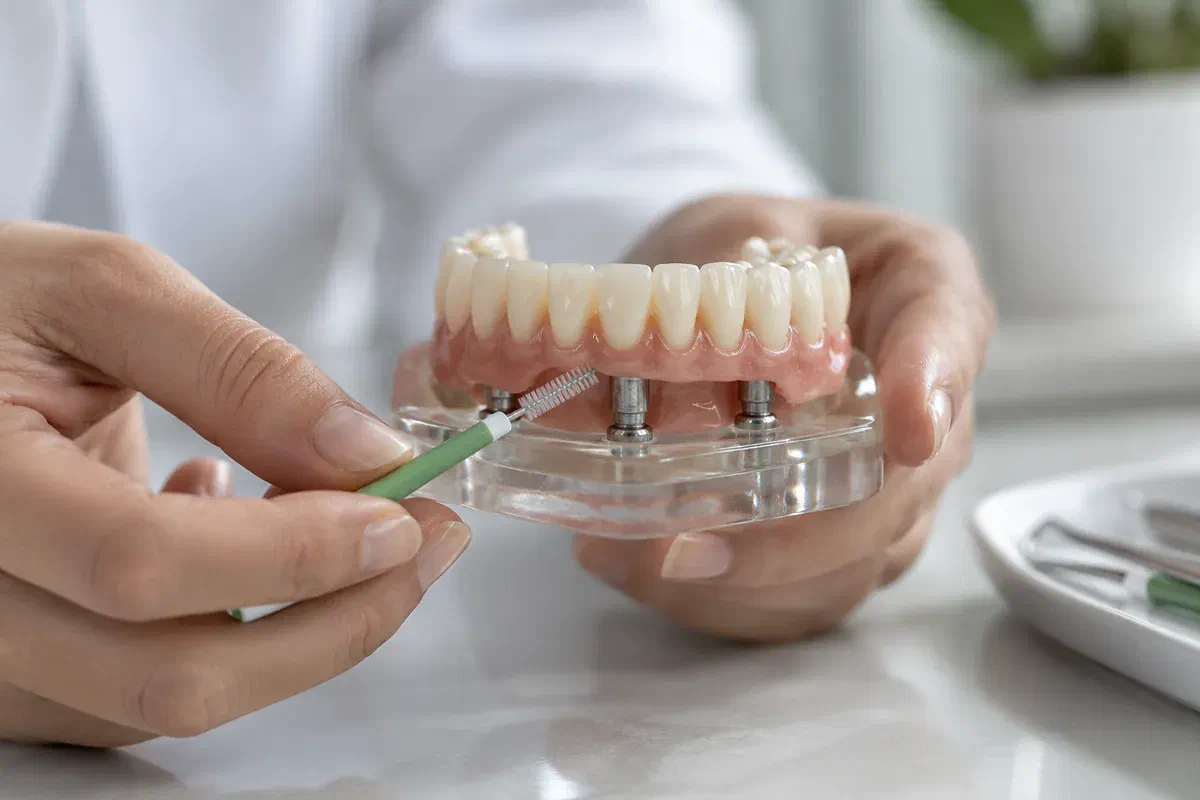
Cleaning brush demonstrated beneath a fixed implant teaching model
Sorting out the starting point

What exactly is wrong, and with which teeth?

Full-arch replacement is usually considered when a jaw has lost, or is likely to lose, most of its teeth. Assessment decides suitability, and a central part of it is whether any natural teeth can reasonably be retained.

Your partial or full denture keeps letting you down

Tell the clinician when it moves, what you struggle to eat and how handling it feels. That helps frame the options, but disliking a removable appliance does not, by itself, show that fixed implant teeth suit you.

Several teeth have a guarded prognosis

Ask what is wrong with each one and what could be done to keep the useful ones. Replacing an arch should be a conclusion reached after that discussion, never an assumption made at the start.

You are not sure what daily care would ask of you

Cleaning beneath fixed teeth is part of planning, not an afterthought. Share any limits with your hands or vision and whether someone helps you at home, so the design can be considered realistically.

Implant number and placement depend on your examination and on how the final teeth are designed. A fixed count promoted in advance does not replace that judgment.

What replacing an arch can offer

One stable arch instead of many uncertain teeth

In the right case, a fixed implant arch provides teeth that stay attached as you eat and speak, in place of teeth that keep needing attention. Any improvement should be described against your present problems and the specific findings of planning.

That does not make it maintenance-free, and no one should promise it will last forever. The implants and gum tissue, the arch material and your bite forces all call for review over time. Ask about complications, how repairs are arranged and what continuing costs to budget for.

Patient information: Leeds Teaching Hospitals — dental implant patient information

Understand the foundation

The clinician should explain how the implants and the arch fit together. With that understanding you can weigh fixed against removable options on function, not on the label attached to each.

Plan the smile and the bite together

Where teeth sit, how replacement gum looks, how you talk and how the arches meet are linked. Tell us your priorities and ask at which stage you can see and comment on the arrangement before it is finished.

Weigh upkeep as part of suitability

Your ability to maintain a design is part of its suitability. Ask to have cleaning access and the review schedule explained clearly so you know the commitment beforehand.

How the stages connect

Extractions, implants and teeth, in the right order

Full-arch treatment normally unfolds in stages and may involve a coordinated team. Ask who provides each part, how interim teeth will work and what findings could alter the plan.

  1. Diagnose each tooth and review your health

    Your teeth, gums, any appliance and your medical background are examined. Imaging and other records clarify available support and whether gum treatment or other preparatory care should come first.

  2. Decide on a design and agree the full plan

    Fixed and removable options, implant support, materials, interim teeth, risks and maintenance are all on the table. For each proposed extraction or graft, ask for the reason, because those steps are permanent.

  3. Work through surgery and healing

    Sequence follows your findings and the agreed approach. Interim tooth timing and how much you may chew are distinct clinical decisions; aiming for a fixed final arch does not ensure fixed teeth on the first day.

  4. Fit the arch and plan maintenance

    Records and fitting checks shape the final arch. The team checks how it functions, demonstrates cleaning and books reviews for the restoration and for the tissues supporting each implant.

Caring for the new arch

A new routine replaces the old repairs

With fixed teeth, daily care has to reach beneath the arch and around the parts holding it. Ask the team to show you on your own arch, using tools that suit its particular spaces.

Learn a routine and stick with it

Work out how to reach under the arch without forcing anything into gaps that are too tight. Point out any area you cannot manage, so the method or design can be reviewed instead of that spot being skipped.

Keep regular professional reviews

Visits check gum health, hygiene, contacts and the condition of components. Your interval should match your needs, and the team should say whether professional removal or other servicing is planned.

Report changes rather than waiting

Get in touch about looseness, chipping, persistent bleeding or discomfort. Do not test the arch by moving it or tighten anything yourself; the cause needs to be found.

Patient information: Canadian Dental Association — dental implants and ongoing care

Three ways forward

Removable, clip-on or fixed

These designs differ in handling, cleaning, treatment and cost. Your assessment should identify which are suitable instead of assuming that one is right for everyone.

When implants are not called for

A conventional full or partial denture

A removable appliance may remain appropriate for your mouth and priorities. Ask about the support it is likely to give, its limits and its care, and compare those honestly with implant treatment.

When retention and removability both help

An implant overdenture

This design attaches to implants but is taken out for cleaning as directed. It has distinct support and maintenance needs, so compare it carefully with a fixed arch.

When the plan suits you clinically and practically

A fixed implant arch

Fixed teeth stay attached during daily use. Suitability depends on support, design, cleaning access, your health and a commitment to professional maintenance over the years.

Questions before extractions

Deciding what to keep and what to replace

Losing several teeth at once is a significant decision. These answers cover common concerns and can help you prepare for a frank conversation.

(905) 876-4488
Should I try to save my remaining teeth before choosing a full arch?
It depends on each tooth’s diagnosis. Some may be worth treating and keeping, while others may not. Ask for a tooth-by-tooth explanation so a full-arch plan follows from findings rather than assumptions.
Can extractions and implant placement happen at the same appointment?
In some situations they can, and in others healing is needed first. It depends on the condition of the bone and gums and on the overall plan. Ask which sequence is proposed and why.
What is bone grafting, and will I need it?
Grafting adds or preserves bone where support is lacking. Whether it is needed depends on imaging and the planned implant positions. If it is suggested, ask what it would achieve and how it changes the timeline.
Does gum disease affect whether implants are suitable?
Active gum disease usually needs to be brought under control first, and a history of it is something the team will weigh. Tell us about past gum treatment so it can be considered in planning.
Can I see what the new teeth will look like before they are made?
Planning often includes stages where you can review tooth position and appearance. Ask when those opportunities occur and how changes can be made before the final arch is completed.
How do I plan a staged treatment from Mississauga?
Ask for an outline of the stages and approximate visits at your consultation. Extractions and surgery may call for a recovery day, so plan work and transport around those appointments in particular.
Mississauga consultations

Start with a tooth-by-tooth review.

Arrange a visit to our Bronte Street office to discuss your remaining teeth and the full-arch options. We will look at each tooth, compare the designs worth considering and tell you whether specialist input or more records would help.

If you have recent X-rays, a treatment plan or details of existing implants or dentures, please bring them with you.

Visit Milton Dental Clinic
Unit 1, 342 Bronte St. S, Milton, ON L9T 5B7
Get directions Clinic hours
Monday–Thursday
11am–7pm
Friday–Sunday
By appointment only

Areas we serve

  • Milton
  • Oakville
  • Mississauga
  • Georgetown
  • Halton Hills
  • Acton
  • Campbellville
  • Brampton
  • Burlington
  • Puslinch
  • Rockwood
  • Erin
  • Caledon
  • Etobicoke
  • Old Milton
  • Bronte Meadows
  • Timberlea
  • Dorset Park
  • Dempsey
  • Clarke
  • Beaty
  • Coates
  • Harrison
  • Scott
  • Willmott
  • Ford
  • Bowes
  • Cobden
  • Walker
  • Mountain View
  • Milton Heights
  • Hawthorne Village
  • Valley View
  • Fallingbrook
  • Nassagaweya
  • Trafalgar
  • Esquesing
  • Nelson
  • Brookville
  • Moffat
  • Glen Williams
  • Norval
  • Limehouse
  • Stewarttown
  • Ashgrove
  • Hornby
  • Silver Creek
  • Speyside
  • Scotch Block
  • North Oakville
  • River Oaks
  • Glen Abbey
  • West Oak Trails
  • Palermo
  • Bronte Creek
  • College Park
  • Joshua Creek
  • Uptown Core
  • Preserve
  • Iroquois Ridge
  • Lisgar
  • Meadowvale
  • Meadowvale Village
  • Churchill Meadows
  • Erin Mills
  • Central Erin Mills
  • Streetsville
  • East Credit
  • Creditview
  • Heartland
  • Sheridan
  • Mount Pleasant
  • Credit Valley
  • Huttonville
  • Churchville
  • Springbrook
  • Northwest Brampton
  • Bram West
  • Fletcher's Meadow
  • Fletcher's Creek South
  • Alton Village
  • Orchard
  • Millcroft
  • Headon Forest
  • Tansley
  • Brant Hills
  • Tyandaga
  • Kilbride
  • Lowville
  • Aberfoyle
  • Morriston
  • Arkell
  • Hillsburgh
  • Freelton
  • Carlisle
  • Waterdown
  • Flamborough
  • Mountsberg

How can we help?

Milton Dental Clinic

Have a question about your smile? Choose the option that works best for you.

For urgent dental concerns, please call.
Messages are reviewed during clinic hours.