You are uneasy about the gap
Let us know where the missing tooth bothers you most, and whether a family event or work occasion is close. You will hear what kind of appearance is realistic and how much lead time a careful fitting needs.


Temporary appliances are lighter than permanent ones, which also makes them easier to crack, bend or misplace. A flipper tooth is a removable partial that may cover a gap until lasting treatment begins. From Bolton or elsewhere in Caledon, find out how to protect yours and what to do if something goes wrong.
A flipper earns its name from how easily it can be popped in and out. That convenience comes with a trade-off. The appliance, a small removable partial denture holding one or more artificial teeth on a slim base, is not as sturdy as a definitive denture, and a drop onto tile or a bite on something hard can damage it.
Each one is designed around a particular gap and anchored by neighbouring teeth. It typically fills a defined interval, such as healing after an extraction or the planning of a lasting replacement. Because it is not intended for heavy chewing or long service, a little care goes a long way toward keeping it in working order.
For people coming from Caledon, a sturdy routine and a clear plan for mishaps can save unexpected trips. At your consultation we can examine the space, explain whether an interim appliance suits you and describe how to look after it. We will agree on its limits, the review dates and what to do if it breaks.
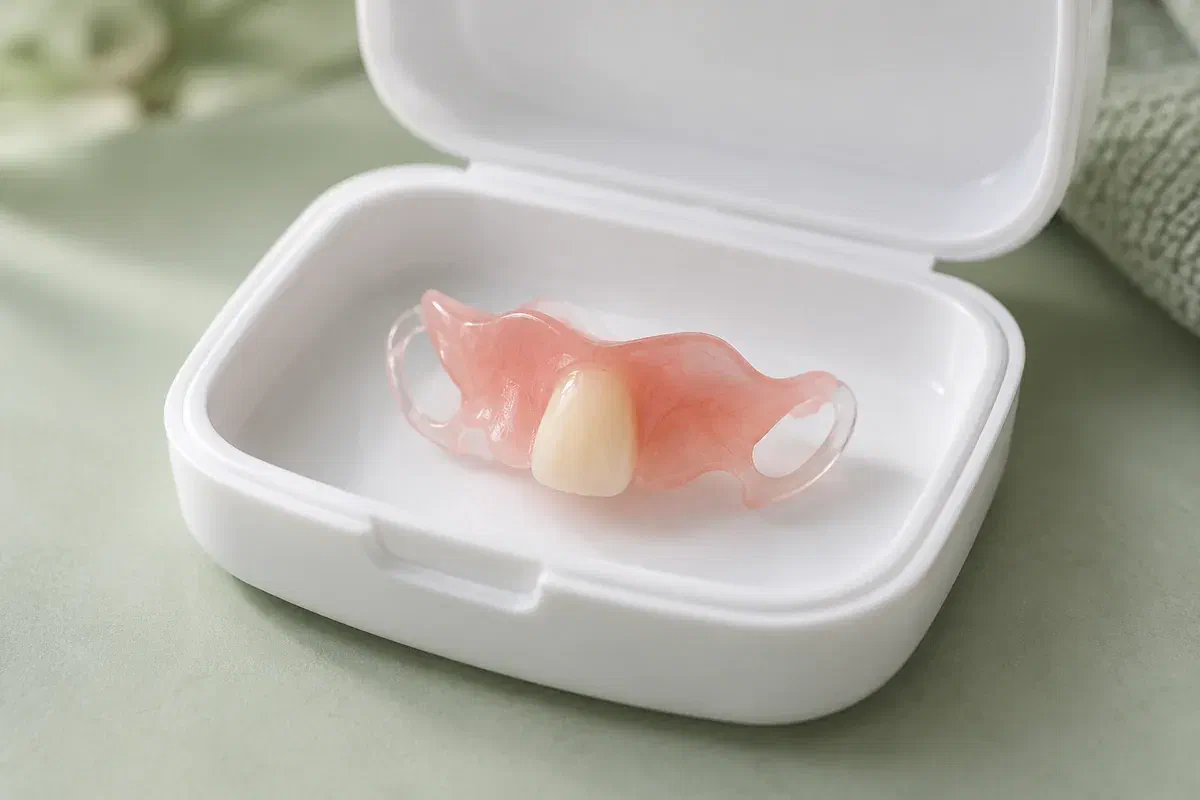
An interim tooth covers one stage of care. Whether it suits your situation depends on how your mouth is doing today and the treatment planned afterward.
Let us know where the missing tooth bothers you most, and whether a family event or work occasion is close. You will hear what kind of appearance is realistic and how much lead time a careful fitting needs.
Healing gums keep changing, and the appliance needs to be planned with that in mind. Ask when you can start wearing it and how its fit will be monitored over the coming weeks.
A flipper can tide you over during a staged plan, though the larger decision still needs a date. Agree on a likely timeframe and which visits follow.
Planning an extraction? Raise the idea of a temporary tooth well beforehand, as the appliance may need to be made from records taken in advance.
Most damage to temporary appliances happens outside the mouth: dropped in the sink, left in a pocket, stepped on or found by a pet. Inside the mouth, biting into hard foods or using the appliance to tear things can stress it. Knowing these risks lets you avoid most of them with simple habits.
Treated well, a suitable flipper fills the visible space during a pause in treatment and comes out for cleaning and appointments as instructed. Adjusting to the feel, your speech and handling takes a little time. Whether you can eat with it in place is set by the design and by how the area is healing.
Patient information: American Dental Association — removable partial dentures
A temporary replacement can be discussed when the permanent restoration is still to come. Mention the features you care about, like shade, angle and how much of the base shows.
Treating the temporary phase as one step keeps the bigger decision moving. Ask which healing milestones or findings will set the time for it.
Practising how to handle, clean and store the appliance at the clinic shows you where accidents tend to happen. Raise grip or gagging concerns before the design is complete.
Your appointments vary with whether the tooth is gone, whether it still has to come out and which permanent replacements are under discussion. Ask what to expect at each visit and how mishaps are handled.
We examine the space, neighbouring teeth, gums and any plans in place. Share why a temporary tooth matters to you and what dates are coming up.
You will learn how the appliance stays in, how it may feel and how robust it is likely to be. We also cover appearance, eating limits, cleaning, fees and other interim approaches.
Impressions or other records go to the lab to guide fabrication. When the flipper is planned for wear straight after an extraction, we outline the fitting day and what might be adjusted later.
We check how the appliance sits and teach you safe handling. Ask what to do if it is damaged before you leave, and return for the review as the gums settle.
Your instructions are written for your appliance and stage of healing. Clean it daily, handle it over a soft surface and arrange a review if it loosens or rubs.
Ask whether it should be out for meals and overnight, and keep to any post-extraction directions. Avoid biting hard foods with it unless you have been told it is suitable.
Check which brush and cleaner suit the material, and avoid very hot water unless told otherwise. Keep your natural teeth and gums clean around the space as shown.
Put it straight into its case when it comes out, and keep that case out of reach of pets and young children. A tissue or pocket is how many appliances are lost or broken.
Every appliance comes with its own instructions. These answers focus on protecting a flipper and what to do when it is damaged, lost or no longer comfortable.
Start at our Bronte Street clinic with an examination of the gap and a frank talk about whether an interim tooth suits you. If it does, we will set up fitting and reviews and make sure you know the steps to take if the appliance is ever damaged.
When booking, mention any extraction date and whether other family members need appointments, so visits can be arranged together where possible.
