

Illustrative dentist explaining a surgical guide during an implant consultation
Restorative Dentistry

Guided Implant Surgery in Milton

Your implant plan mentions a surgical guide, and you want to know what that actually means. Talk it through close to home in Milton: the scans and records involved, how fit is confirmed, where clinical judgement still leads, and how the final tooth shapes the plan.

What the guide is for

A plan on screen has to reach the jaw accurately.

Most people first hear the term when a treatment summary lists a “surgical guide” and nobody has explained it yet. It is a custom template made from your planning records. It sits on a stable surface in the mouth and helps direct certain steps so the implant ends up close to where it was planned.

That template only carries a plan; it does not create one. Before anything is designed, the team looks at the tooth you are replacing, the bone available, nearby nerves and sinus, the gums, and whether instruments can reach the site. No guide turns a poor implant site into a good one, or replaces the surgeon’s own assessment.

Here in Milton, an implant consultation is a good time to ask whether guidance makes sense for you at all. Find out which steps it would direct, how its seating would be confirmed, and what the fallback is if it cannot be used safely. Those answers tell you more than the idea that digital planning makes surgery exact.

Ask about a guided implant plan
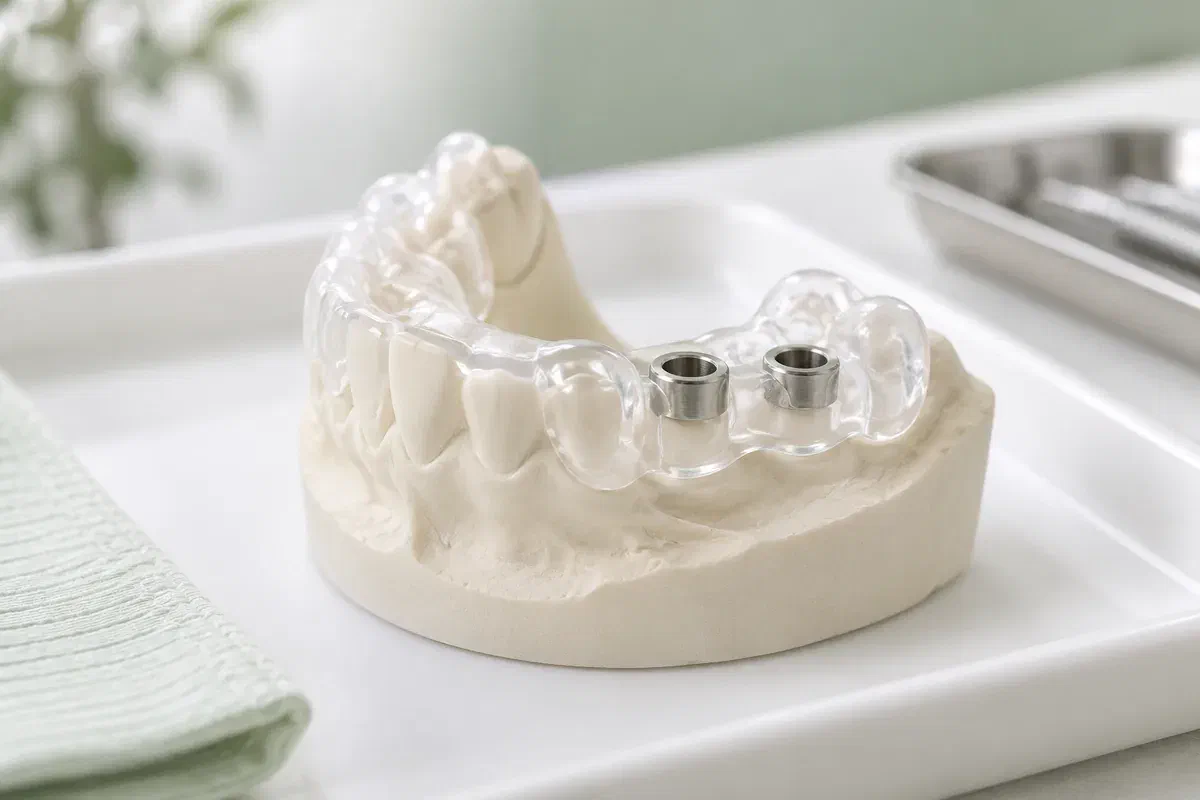
Transparent implant surgical guide with metal sleeves seated on a dental model
Before you agree to a guide

What should the guide actually accomplish for your site?

Guidance is weighed against one specific plan, not offered as a general upgrade. A useful conversation explains what the guide is meant to improve and what conditions have to be true for it to do that job.

The implant has to suit the tooth on top

Where the implant sits affects how the finished tooth looks, how it bites and how easily you can clean around it. Ask how the planned angle and depth connect to that final crown, rather than treating placement as a separate step.

Limited room or nearby anatomy

Scans and an exam show where important structures are and how much working space exists. Even with a guide, the plan needs a margin for error and a check that instruments fit as expected.

Knowing what the technology really adds

Some parts of the procedure may be guided while others are done freehand or by other methods. A clear explanation covers which is which, what the guide cannot do, the extra cost, and any added appointments or records.

A guided procedure is a way of placing the implant. On its own it does not mean no incision, teeth the same day, no soreness, or quicker healing.

Where a guide can help

A physical template, checked against your records.

When the design suits the case, a guide gives the surgeon something tangible that links the planned implant position to the real site. Its value depends on accurate scans, sound design and manufacturing, a stable fit, and careful use.

None of that removes the need for judgement. The final position can differ somewhat from the plan, and the surgeon has to react to what is found once treatment begins. Ask why guidance is suggested in your case and how its limits are built into the plan.

Patient information: International Team for Implantology — computer-guided implant surgery

Brings the crown and the implant together

Planning digitally lets the team look at the future tooth and the implant beneath it at the same time. That makes it easier to explain how the chosen position affects appearance, chewing and cleaning access later on.

Spells out which records come first

A guide is only as good as the scans and surface records behind it. Ask how those are lined up with each other, and whether a change in your mouth before surgery, such as a shifted tooth, could affect the fit.

Puts the backup plan on the table

If a guide does not sit properly, it should not be used just because it exists. Talk through how that would be judged on the day and what might change in the procedure or the schedule as a result.

How the steps fit together

Records, design, a fit check, then surgery.

Workflows vary with the plan and the guide system used. It helps to know who handles the planning, who makes the guide, who places the implant and who builds the final tooth, especially when more than one clinician is involved.

  1. Confirm implants suit you and the tooth

    The first visit covers your mouth, medical history, replacement choices and the risks that apply to you. Suitable records show whether an implant is a sensible option and what the planned crown will need from the support beneath it.

  2. Build and review the placement plan

    Scans and other records shape the planned position and the guide itself. The team considers what the guide will rest on, access to the site, nearby anatomy, and whether gum or bone work or a specialist referral is needed first.

  3. Check the fit, then treat as agreed

    Before use, the guide’s seating is confirmed in the mouth. If something prevents safe use, the surgeon moves to an alternative that has already been considered instead of pressing on simply because the guide was made.

  4. Monitor healing and move to the crown

    Follow-up visits and the timing of the replacement tooth depend on your plan. Having a guided placement does not skip the checks on healing, implant stability and whether the site is ready for the next stage.

Once the implant is in

Recovery follows the surgery that was done, not the tool.

Your instructions depend on what happened during the appointment, such as extractions, grafting or a temporary tooth. Follow the written guidance you are given rather than assuming a guided procedure means different recovery rules.

Look after the site as directed

Ask how to clean near the implant, which foods to avoid, and how to wear any temporary appliance. Feeling fine on day one is not the same as being healed.

Keep your contact plan handy

Store the instructions and phone numbers where you can find them. Call about symptoms the sheet flags, anything that feels loose, or a problem with a temporary tooth.

Settle into long-term implant care

After the final tooth is placed, home cleaning and regular professional checks still matter. Ask which surfaces need special attention and how the implant and surrounding gum will be watched over time.

Ways an implant can be placed

Match the method to the case, not the trend.

More than one approach can be reasonable, depending on the situation. Ask how the suggested method fits your diagnosis, the tooth being planned, your anatomy, access to the site and the surgeon’s overall plan.

A custom template backs up the plan

A static surgical guide

A made-to-fit guide can direct chosen drilling or placement steps when its design and support are sound. Ask whether it covers only the early preparation or more of the sequence.

Another approach suits the site better

A different planned placement method

Conventional placement, or another form of guidance, may be just as suitable. What matters is how each handles your actual case, including access and room to adjust.

The site or the choice needs a second look

More preparation, or another kind of replacement

Further assessment, preparing the site, or a bridge or denture may come first or instead. A guide is not a way around an unanswered question about whether an implant suits you.

Common questions

What a guide decides, and what stays with your clinician.

These answers separate planning tools from treatment results. For your own case, ask about the particular guide and surgical approach being proposed.

(905) 876-4488
Is the surgical guide a robot or a machine?
No. A static guide is a passive template, usually made of rigid plastic with small metal sleeves. The surgeon holds and uses the instruments, checks the fit, and makes every decision during the procedure based on what is found.
Why would my dentist suggest a guide for one implant but not another?
Guidance may be more useful where space is tight, nearby anatomy needs extra care, or the crown position is demanding. In a straightforward site, another method may be just as appropriate.
What records are usually needed before a guide can be made?
Typically some form of 3D imaging of the jaw plus a digital scan or impression of the teeth and gums. These are aligned so the planned implant and crown can be viewed together. Your team will explain which records apply to your plan.
If the guide doesn’t sit properly on the day, what happens?
The surgeon needs to work out why and whether it can still be used safely. Sometimes the approach changes; sometimes the appointment is rescheduled. It helps to discuss that possibility beforehand so it does not come as a surprise.
Does using a guide mean I won’t need a bone graft?
No. A guide cannot add bone that is missing. Whether grafting is needed depends on the site and the planned tooth. Ask whether preparation is required and how it would affect timing, healing and the final restoration.
Can I book my implant consultation close to home in Milton?
Yes. Consultations take place at our Bronte Street practice, and we can talk through records, guidance and timing there. If a specialist is involved in any stage, we will explain who does what and where.
Implant planning in Milton

Bring your questions about guided placement.

At our Bronte Street practice, we can look at your starting point and the placement options that may suit you, and explain which further records or specialist opinions might be needed before a plan is set.

If you already have scans or a plan from elsewhere, bring them along and let us know which steps you would like explained.

Visit Milton Dental Clinic
Unit 1, 342 Bronte St. S, Milton, ON L9T 5B7
Get directions Clinic hours
Monday–Thursday
11am–7pm
Friday–Sunday
By appointment only

Areas we serve

  • Milton
  • Oakville
  • Mississauga
  • Georgetown
  • Halton Hills
  • Acton
  • Campbellville
  • Brampton
  • Burlington
  • Puslinch
  • Rockwood
  • Erin
  • Caledon
  • Etobicoke
  • Old Milton
  • Bronte Meadows
  • Timberlea
  • Dorset Park
  • Dempsey
  • Clarke
  • Beaty
  • Coates
  • Harrison
  • Scott
  • Willmott
  • Ford
  • Bowes
  • Cobden
  • Walker
  • Mountain View
  • Milton Heights
  • Hawthorne Village
  • Valley View
  • Fallingbrook
  • Nassagaweya
  • Trafalgar
  • Esquesing
  • Nelson
  • Brookville
  • Moffat
  • Glen Williams
  • Norval
  • Limehouse
  • Stewarttown
  • Ashgrove
  • Hornby
  • Silver Creek
  • Speyside
  • Scotch Block
  • North Oakville
  • River Oaks
  • Glen Abbey
  • West Oak Trails
  • Palermo
  • Bronte Creek
  • College Park
  • Joshua Creek
  • Uptown Core
  • Preserve
  • Iroquois Ridge
  • Lisgar
  • Meadowvale
  • Meadowvale Village
  • Churchill Meadows
  • Erin Mills
  • Central Erin Mills
  • Streetsville
  • East Credit
  • Creditview
  • Heartland
  • Sheridan
  • Mount Pleasant
  • Credit Valley
  • Huttonville
  • Churchville
  • Springbrook
  • Northwest Brampton
  • Bram West
  • Fletcher's Meadow
  • Fletcher's Creek South
  • Alton Village
  • Orchard
  • Millcroft
  • Headon Forest
  • Tansley
  • Brant Hills
  • Tyandaga
  • Kilbride
  • Lowville
  • Aberfoyle
  • Morriston
  • Arkell
  • Hillsburgh
  • Freelton
  • Carlisle
  • Waterdown
  • Flamborough
  • Mountsberg

How can we help?

Milton Dental Clinic

Have a question about your smile? Choose the option that works best for you.

For urgent dental concerns, please call.
Messages are reviewed during clinic hours.