Does the position suit the final tooth?
The crown you will see, chew with and clean around depends on where the implant goes. Ask how the planned position was chosen with that tooth in mind, not as a separate surgical goal.


Comparing implant proposals, and one mentions a surgical guide while another does not? From Oakville, you can talk through what guidance changes, which records it relies on, how its fit is verified and why the restorative plan matters more than the label.
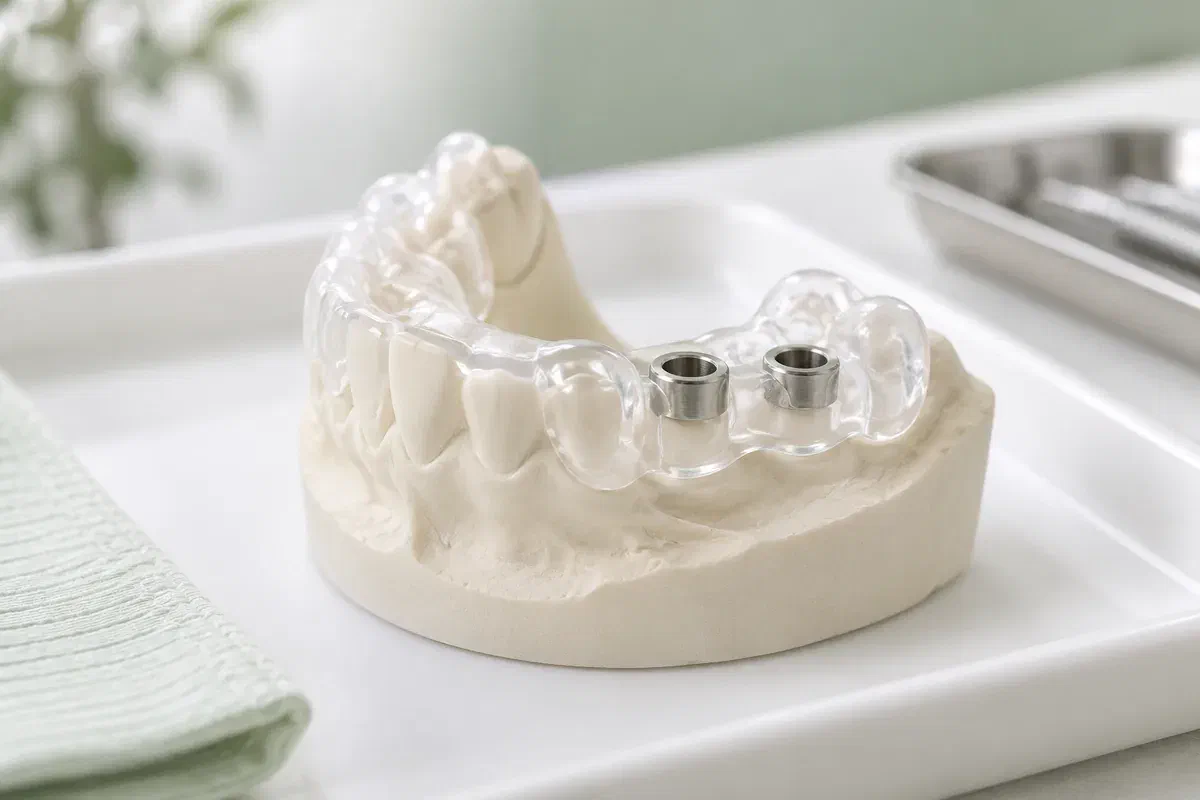
It is common to collect more than one opinion before committing to an implant, and the proposals do not always use the same method. One may include a surgical guide: a custom piece, designed from your scans, that fits over teeth or gum and helps direct parts of the drilling and placement toward a planned position.
So is the guided plan better? Not automatically. A guide transfers decisions that have to be sound in the first place. Those decisions cover the tooth to be replaced, the bone available, nerves or sinus nearby, the gum, and room to work. If the site is unsuitable, a guide does not change that, and it never replaces the surgeon’s own assessment.
If you are coming from Oakville to sit down with us, ask the same questions you would ask anywhere. Which steps will be guided? How is fit confirmed before it is used, and by whom? What is the alternative if it cannot be used as intended? Comparing those answers side by side tells you far more than checking whether the word guided appears on the estimate.
Guidance makes sense relative to a specific treatment plan. Expect a clear account of what the guide is meant to improve and what conditions have to hold for it to do so.
The crown you will see, chew with and clean around depends on where the implant goes. Ask how the planned position was chosen with that tooth in mind, not as a separate surgical goal.
Imaging and an exam reveal nearby structures and how much access there is. A guide does not remove the need for a safety margin or for checking that instruments will fit in your mouth.
Some steps may be guided while others use other techniques. A good explanation covers the guide’s limits, any added cost, and whether more records or visits are needed.
Guided refers to how the implant is positioned. It does not by itself mean no incision, a same-day tooth, a pain-free recovery or shorter healing.
Where it suits the case, a guide provides a tangible way to relate the planned implant to the real site. How much it helps depends on the accuracy of the records, the quality of design and manufacture, how firmly it is supported, and how it is used.
Clinical judgement does not step aside. Some difference between planned and final positions is possible, and the surgeon must respond to findings as they arise, sometimes by changing the approach partway through. When comparing proposals, ask each clinician why they chose their method, what it is expected to improve in your mouth, and how they account for its limits.
Patient information: International Team for Implantology — computer-guided implant surgery
Digital planning puts the replacement tooth and the implant into a single discussion. That makes it easier to see how placement affects appearance, bite and cleaning access years from now.
A guide needs reliable information about the bone and the surfaces it sits on. Ask how imaging and surface scans are matched and whether changes in your mouth could affect fit.
If a guide does not seat correctly, it should not be used on the assumption that it must be fine. Ask how that would be assessed and how the procedure or date might change.
The workflow depends on your plan and the guide system. If several clinicians are involved, ask who handles planning, guide production, surgery and the final restoration.
The dentist reviews your mouth, medical history, possible replacements and the risks that apply. Records then show whether an implant is suitable and what the future tooth requires.
Scans inform the implant position and the shape of the guide. The team considers its support, access, nearby anatomy, and whether grafting or a specialist referral should come first.
The guide’s seating is confirmed in your mouth. If it cannot be used appropriately, the surgeon follows a pre-assessed alternative instead of relying on the guide because it exists.
Follow-up and the timing of your crown depend on the plan. A guided placement still needs checks on healing, implant support and readiness for the restorative stage.
Instructions depend on what was done, including any extraction, grafting or temporary tooth. Follow the written guidance from your clinician rather than assuming a guide alters recovery.
Ask how to clean nearby, which foods and pressures to avoid, and how to wear any temporary appliance. A good first day does not mean healing is complete.
Have your instructions and clinic contact details handy. Report symptoms the sheet lists, any unexpected movement, or problems with a temporary tooth so the right person can advise.
After the final tooth is in, home cleaning and professional checks remain essential. Ask how to reach every surface and how the implant and gum will be monitored.
Use these as a checklist when you compare proposals. A tool and a result are different things, so ask each clinic how its answers apply to your own mouth.
Bring the proposal you already have to our Bronte Street practice and we will go through it with you, alongside the placement methods that could suit your case and any extra records or specialist input that may help.
Bring any existing estimates, scans or treatment plans, and tell us which parts you would like explained.
