

Illustrative consultation about maintaining gum health around a dental implant
Restorative Dentistry

Implant Gum-Care Maintenance in Brampton

Work, kids, and commuting can push an implant review well past its date. Coming from Brampton after a long gap is fine. We start where things stand today, check the gums around the implant, and build a maintenance rhythm you can realistically keep.

Back after a while?

It has been a few years. Now what?

Life gets full. The implant felt solid, the reminder card got lost, and suddenly three or four years have passed without anyone looking at it. Many people feel awkward booking after that kind of gap. There is no need. Coming back is the useful step, and the review simply begins from wherever things are now.

The main question is whether the gum is inflamed and, if so, how far that inflammation reaches. Peri-implant mucositis is confined to the soft tissue. Peri-implantitis includes loss of the bone that anchors the implant. Comfort and appearance do not separate the two, so the dentist relies on examination findings, any records available, and imaging when it would genuinely help.

For people in Brampton juggling shifts and school runs, it often makes sense to pair implant maintenance with a regular checkup at our Milton office. Bring what you know about the implant’s placement and any problems since. We will work out the current condition with you and set a schedule that respects how busy your weeks are.

Restart care for your implant
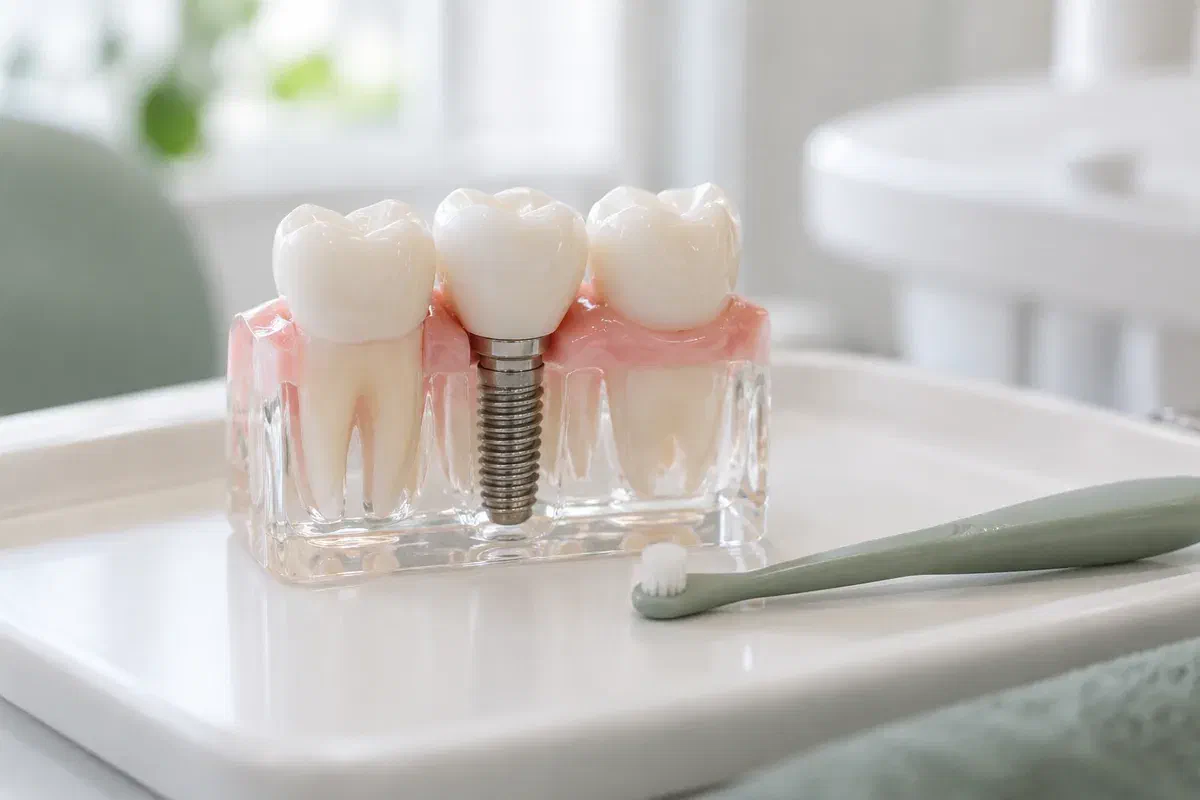
Implant teaching model beside a small brush used to illustrate targeted cleaning
Things you may have put off

Little changes you meant to mention

During a long gap, small signs tend to get filed under later. Now is a good time to raise them. Say where each one shows up, how often, and roughly how long it has been happening.

An implant that bleeds most times you clean it

Regular bleeding at one site is worth an assessment, even if it has been going on for a while. Mention whether it is sore and whether your tools changed. The bleeding cannot reveal on its own how the bone is doing.

Gum that has changed since you last looked closely

A redder or puffier edge, a gum line that seems different, or a taste that lingers can all be discussed. The dentist will consider inflammation and other explanations instead of assuming one cause for everything.

A spot you gave up trying to clean

When a site is uncomfortable or awkward to reach, it is easy to skip it. Show us where that is so we can look at both your routine and the restoration’s shape.

If you have new swelling, discharge, increasing pain, or the implant seems to move, call before booking a routine visit. Tell us the symptoms and we will set up an assessment that matches them.

Why the rhythm matters

Regular reviews turn guesswork into comparison.

With no recent records, today’s visit becomes a fresh baseline. From then on, each review can be measured against the last, and the team can tell you whether the implant site is steady or shifting. Asking what is being tracked is always reasonable.

Your plan accounts for what makes care harder or riskier: a past of gum disease, smoking, health conditions, or simply limited time and energy for cleaning. Those factors help the team tailor support. They are not a reason to feel judged about a missed appointment or a routine that slipped.

Patient information: American Academy of Periodontology — peri-implant diseases

Find out if more than maintenance is needed

Coming back from a break, the review may show findings that call for a treatment plan rather than ordinary maintenance. You should know what the concern is, what is proposed, and how improvement will be checked.

Make cleaning quicker to do well

A routine that fits into a busy evening is more likely to happen. If one site stays hard to reach, the team can suggest different aids or assess whether the restoration is contributing.

Bring the rest of your mouth up to date

Natural teeth and other implants may also be due for attention. Looking at everything together avoids focusing on one implant while gum problems elsewhere go unnoticed.

Your first visit back

A fresh baseline in four parts

By the end, you should understand the state of the tissue around the implant and the reason for whatever comes next. If the area is sensitive, or past exams were uncomfortable, say so early.

  1. Catch up on the past few years

    We ask when the implant was restored, whether it has had problems or treatment, and what has changed in your health or medicines during the gap. Old records, if you have any, are a bonus.

  2. Examine the gum and support

    The clinician checks the implant site and may record gentle measurements. Bleeding, cleaning access, and other findings are weighed together. After a long interval, an X-ray may be suggested to assess the bone.

  3. Tell you plainly where things stand

    We explain whether findings suggest routine maintenance, focused treatment, or further investigation. Recommended cleaning, care, or referral should come with a reason, a purpose, and an estimate where relevant.

  4. Pick a schedule you can keep

    We agree on home priorities and a recheck date that works around your calendar. A follow-up after treatment can serve a different purpose from the long-term interval.

Making it stick

Short, gentle, every day

A few focused minutes done consistently beat a long routine you abandon. Ask us to show you how to clean your own implant, and be honest about what time and practical limits you are working with.

Keep the right tools within reach

Store the recommended brush and interdental aids where you will actually use them. Pick the size that suits your gap rather than forcing a larger one, and avoid scrubbing harder after bleeding.

Keep a quick log on your phone

A two-word note when bleeding, swelling, soreness, or a bad taste appears is enough. If it persists or worsens, contact us rather than waiting for the next review. Little pain does not mean all is well.

Flag health changes as they happen

Tell us about new medicines, diabetes care changes, smoking, or anything affecting cleaning. Ask about help with risk factors and stay on prescribed medical care unless your treating professional says otherwise.

What the review may lead to

After a gap, any of these is possible.

Ongoing maintenance and active treatment overlap, but neither replaces the other. The dentist should explain which situation your findings point to and what still needs to be confirmed before suggesting more care.

If the implant site is stable

Back to routine maintenance

Resume a personal plan of professional reviews and daily home care. Discuss the interval, what is being watched, and which symptoms mean you should come in sooner.

If the soft tissue needs attention

Focused care for inflamed gum

Treatment may involve professional cleaning, changes to your routine, and tackling contributing factors. A later recheck shows whether the gum has responded well.

If bone loss or persistent disease is suspected

Investigating deeper problems

More advanced disease needs its own plan and may require a specialist. Ask about the diagnosis, options, limitations, and follow-up rather than relying on maintenance alone.

Patient information: European Federation of Periodontology — peri-implant disease treatment

Common concerns

Returning to implant care after time away

Ask about anything you have noticed, the measurements, or follow-up. Your implant and its history are what matter, not how someone else’s problem was described.

(905) 876-4488
Will I be told off for missing years of implant checkups?
No. Gaps happen, and the team’s job is to understand the current condition and help you plan from here. Being open about your routine and any symptoms helps more than worrying about the past.
How long does an implant gum-care appointment usually take?
It varies with what is being checked and whether other dental care is booked the same day. Mention the implant when you call so enough time is allowed, especially for a first visit after a long gap.
Can I combine implant maintenance with my family’s appointments?
Often, yes. Many households book back-to-back visits to save trips. Let the front desk know who needs what so the schedule allows time for the implant review alongside other care.
My implant bleeds but does not hurt. Is it still a concern?
It can be. Inflammation around implants often causes little pain. Bleeding that keeps returning should be examined so the dentist can tell whether the soft tissue alone is involved or the bone needs assessment too.
Why might I need an X-ray at this visit?
When there are no recent records, imaging can help establish the current bone level around the implant. It should be recommended for a clear clinical reason, so ask what the dentist hopes to learn from it.
What if the inflammation has not cleared by the follow-up?
Then the area is looked at again. The team may revisit how you clean, other contributing factors, the diagnosis, and whether additional treatment or a specialist referral makes sense.
For Brampton households

No lecture. Just a clear starting point.

Book at our Bronte Street clinic in Milton to have the gums around your implant reviewed after time away. We will listen to what you have noticed, explain the findings, and agree on home priorities and a review date that fits your life.

When you call, tell us roughly when the implant was last checked and whether you have noticed bleeding, swelling, or soreness.

Visit Milton Dental Clinic
Unit 1, 342 Bronte St. S, Milton, ON L9T 5B7
Get directions Clinic hours
Monday–Thursday
11am–7pm
Friday–Sunday
By appointment only

Areas we serve

  • Milton
  • Oakville
  • Mississauga
  • Georgetown
  • Halton Hills
  • Acton
  • Campbellville
  • Brampton
  • Burlington
  • Puslinch
  • Rockwood
  • Erin
  • Caledon
  • Etobicoke
  • Old Milton
  • Bronte Meadows
  • Timberlea
  • Dorset Park
  • Dempsey
  • Clarke
  • Beaty
  • Coates
  • Harrison
  • Scott
  • Willmott
  • Ford
  • Bowes
  • Cobden
  • Walker
  • Mountain View
  • Milton Heights
  • Hawthorne Village
  • Valley View
  • Fallingbrook
  • Nassagaweya
  • Trafalgar
  • Esquesing
  • Nelson
  • Brookville
  • Moffat
  • Glen Williams
  • Norval
  • Limehouse
  • Stewarttown
  • Ashgrove
  • Hornby
  • Silver Creek
  • Speyside
  • Scotch Block
  • North Oakville
  • River Oaks
  • Glen Abbey
  • West Oak Trails
  • Palermo
  • Bronte Creek
  • College Park
  • Joshua Creek
  • Uptown Core
  • Preserve
  • Iroquois Ridge
  • Lisgar
  • Meadowvale
  • Meadowvale Village
  • Churchill Meadows
  • Erin Mills
  • Central Erin Mills
  • Streetsville
  • East Credit
  • Creditview
  • Heartland
  • Sheridan
  • Mount Pleasant
  • Credit Valley
  • Huttonville
  • Churchville
  • Springbrook
  • Northwest Brampton
  • Bram West
  • Fletcher's Meadow
  • Fletcher's Creek South
  • Alton Village
  • Orchard
  • Millcroft
  • Headon Forest
  • Tansley
  • Brant Hills
  • Tyandaga
  • Kilbride
  • Lowville
  • Aberfoyle
  • Morriston
  • Arkell
  • Hillsburgh
  • Freelton
  • Carlisle
  • Waterdown
  • Flamborough
  • Mountsberg

How can we help?

Milton Dental Clinic

Have a question about your smile? Choose the option that works best for you.

For urgent dental concerns, please call.
Messages are reviewed during clinic hours.