

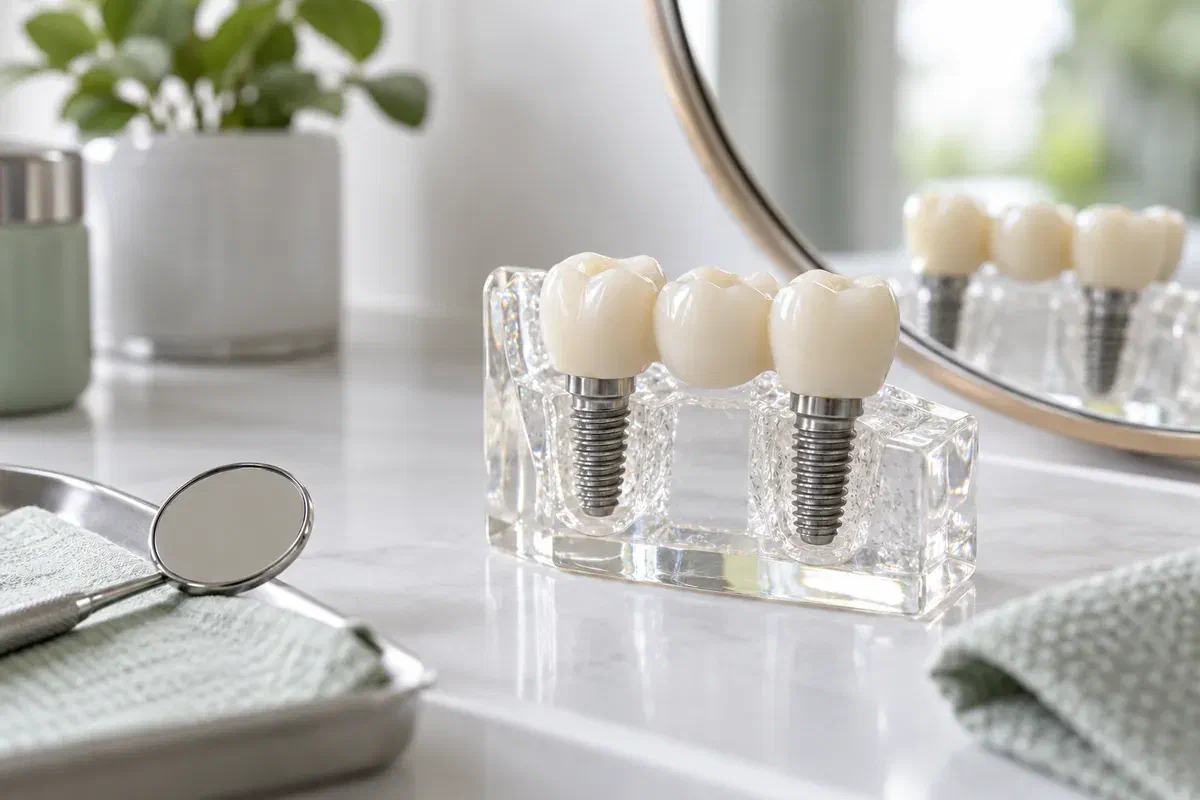
Illustrative consultation about replacing neighbouring teeth with an implant-supported bridge
Restorative Dentistry

Implant-Supported Dental Bridges

Several neighbouring missing teeth can sometimes be replaced with a connected bridge supported by dental implants. Explore implant-supported dental bridges in Milton, including suitability, the treatment sequence, appearance, cleaning access, and future maintenance.

A closer look at implant-supported dental bridges

Plan the missing teeth and their support together.

An implant-supported bridge replaces a group of missing teeth with a connected restoration anchored to implants in the jaw. The implants provide support, while the bridge supplies the visible replacement teeth. Unlike a conventional tooth-supported bridge, the restoration does not rely on neighbouring natural teeth as its main anchors.

The number and position of implants are determined by the proposed restoration and the mouth that will support it. A suitable plan considers the available bone, the gap, the bite, appearance, and access for cleaning. It is not simply a matter of choosing one implant for each tooth or copying a design used for somebody else.

At Milton Dental Clinic, we can help you explore whether an implant bridge deserves a place among your replacement options. Tell us how the missing teeth affect meals, speech, and your smile, and whether you already use an appliance. The assessment should connect those concerns with a clear explanation of the treatment and care commitment.

Discuss an implant-supported bridge
Teaching model of a three-tooth bridge supported by two implants in a clear base
When an implant bridge may enter the discussion

Several missing teeth can raise more than one planning question.

The location of the gap and the condition of the surrounding mouth shape the options. Bring your priorities to the assessment so function, appearance, timing, and practical care are considered together.

You want a fixed replacement for a neighbouring gap

A bridge may be considered when several adjacent teeth are missing and suitable implant support can be planned. Ask what fixed means for daily care and how the proposed restoration would be maintained.

You want to understand the effect on nearby teeth

An implant-supported design can avoid using natural teeth as bridge supports. Those teeth still need assessment, and their condition may influence the overall plan and comparison with other replacement options.

You are replacing an appliance that no longer suits you

Explain what is difficult about the current replacement, such as movement, bulk, or cleaning. An implant bridge should be evaluated against those concerns rather than assumed to solve every problem automatically.

If teeth are still present in the proposed area, their diagnosis and reasonable retention options should be discussed before any extraction is included in a bridge plan.

What the design is intended to offer

A connected replacement with its own planned support.

For a suitable mouth, an implant bridge offers a fixed way to restore a span of missing teeth. It can be designed around the space and bite while allowing the neighbouring natural teeth to remain separate from the bridge's support. Discuss what improvement is realistic in your specific situation.

The benefits come with treatment stages and maintenance responsibilities. Implant surgery has risks, healing must be assessed, and the bridge or its components may need care later. Ask how those considerations compare with a removable appliance, another fixed option, or a decision to defer treatment.

Patient information: American Academy of Periodontology — multiple-tooth implant replacement

Consider the replacement as one planned span

The relationship between the teeth, supports, and biting forces is evaluated together. Ask why the proposed number and arrangement of implants suit the gap instead of judging the plan only by how many are used.

Discuss appearance before the final bridge

Tooth size, shade, gum contours, and the visible transition to surrounding tissues matter. Ask which features can be reviewed during planning or provisional stages and what limitations the existing tissues may impose.

Include cleaning access in the design discussion

A fixed bridge still needs daily cleaning around its supports and beneath the connected teeth. Understanding that routine before treatment helps you assess whether the proposed arrangement is practical for your hands and habits.

Your implant bridge treatment sequence

Agree on the restoration before moving through the stages.

The sequence varies with the site, any preparatory care, and the healing response. Ask for the anticipated appointments, temporary replacement arrangements, clinicians involved, and costs to be explained as one coordinated plan.

  1. Assess the gap and compare replacement choices

    The dentist examines the teeth, tissues, bite, and relevant health history. Records and imaging are selected to support planning. Discuss the alternatives, expected limitations, and whether another clinician's assessment is needed.

  2. Plan and carry out the implant stages

    The team explains the proposed implant positions, any additional preparation, and the surgical approach. Timing depends on the clinical situation; suitable healing and support must be established before progressing with the planned restoration.

  3. Record and evaluate the bridge design

    Impressions or other records guide the bridge's fabrication. The restorative stages assess fit, tooth arrangement, bite, and tissue relationships, with provisional work or additional checks when appropriate to the case.

  4. Fit the bridge and organize continuing care

    The finished restoration is assessed and attached using the planned system. You receive cleaning guidance, information about adaptation, and arrangements for review of the bridge and its implant supports.

Living with an implant-supported bridge

Care for the spaces beneath as well as the teeth you see.

Instructions change across treatment stages, so distinguish surgical healing advice from the routine for a completed bridge. Follow the treating team's guidance on eating, cleaning, and when to return for review.

Learn how to reach beneath the connected teeth

Ask for a demonstration using tools suited to the bridge's contours. Practise the route rather than assuming ordinary floss can pass through every connection in the same way it does between separate natural teeth.

Report changes in the bridge or bite

Movement, a new clicking sensation, a chipped area, or a bite that feels altered should be checked. Avoid testing the restoration repeatedly or using household glue if a component becomes loose.

Keep reviews even when the bridge feels comfortable

The replacement teeth, connections, and surrounding tissues need ongoing assessment. Ask about the recommended maintenance interval and how any previous gum problems or cleaning difficulties affect the plan.

Choosing how to replace the missing span

Compare the support, treatment, and daily care of each option.

The preferred choice depends on the condition of the mouth and your priorities. A useful comparison includes the surgical commitment, effect on other teeth, removability, maintenance, and total treatment estimate.

When suitable independent support can be planned

An implant-supported bridge

Implants anchor a connected fixed restoration across the gap. The plan must address placement, healing, restoration design, cleaning access, and the continuing health of the supporting tissues.

When the adjacent teeth are appropriate supports

A bridge supported by natural teeth

A conventional bridge may be another fixed option. Discuss the condition of the support teeth, the preparation required, and the implications for their long-term care before comparing it with implants.

When a removable approach suits the situation

A removable partial denture

A partial denture may replace the missing teeth without the same implant sequence. Its support, handling, appearance, and maintenance should be explained alongside the fixed options available to you.

Questions about implant-supported bridges

Understand the plan behind the connected replacement.

An implant bridge involves decisions about both support and the visible teeth. These questions can help you discuss the design and treatment sequence without assuming that one standard arrangement fits every gap.

(905) 876-4488
Does an implant bridge need an implant beneath every replacement tooth?
Not necessarily. A bridge can connect replacement teeth across planned implant supports. The number and distribution depend on the span, available bone, bite, and restoration design. Ask why the proposed arrangement is appropriate for your mouth rather than comparing counts alone.
Will an implant-supported bridge come out for cleaning at home?
A fixed implant bridge is not removed by you for daily cleaning. You clean around and beneath it using methods suited to the design. Professional removal may be considered for a particular maintenance or repair need, depending on the attachment arrangement.
Can I have an implant bridge if I have been missing the teeth for years?
Possibly, but the current tissues and available bone need assessment. The time since tooth loss is only part of the picture. Additional preparation may be discussed, or another replacement option may be more appropriate after the findings are reviewed.
What will replace the missing teeth while an implant bridge is being made?
Temporary arrangements vary with the treatment sequence and the site. Ask whether a temporary appliance or restoration is suitable, how it can be used during healing, and whether there will be periods when wearing it needs to be limited.
Can a chipped implant bridge be repaired without replacing all of the implants?
Sometimes the problem is confined to the restoration or a component, but it needs examination. The repair options depend on the material, damage, and overall condition. The implants should be assessed rather than assumed to need replacement because a bridge tooth has chipped.
What should an implant bridge estimate include?
Ask which assessment, imaging, preparation, surgical, temporary, and final restoration stages are included. Clarify likely maintenance and what would happen if the plan changes during treatment. If you have benefits, confirm coverage separately rather than assuming the entire sequence is covered.
Implant-supported dental bridges in Milton

Start with the gap. Leave with a clearer set of choices.

Arrange an assessment at our Bronte Street clinic to discuss replacing neighbouring missing teeth. We can review your priorities, explain the support an implant bridge would need, and compare it with other suitable options.

Bring information about previous extractions, implants, or appliances affecting the area when available.

Visit Milton Dental Clinic
Unit 1, 342 Bronte St. S, Milton, ON L9T 5B7
Get directions Clinic hours
Monday–Thursday
11am–7pm
Friday–Sunday
By appointment only

How can we help?

Milton Dental Clinic

Have a question about your smile? Choose the option that works best for you.

For urgent dental concerns, please call.
Messages are reviewed during clinic hours.