

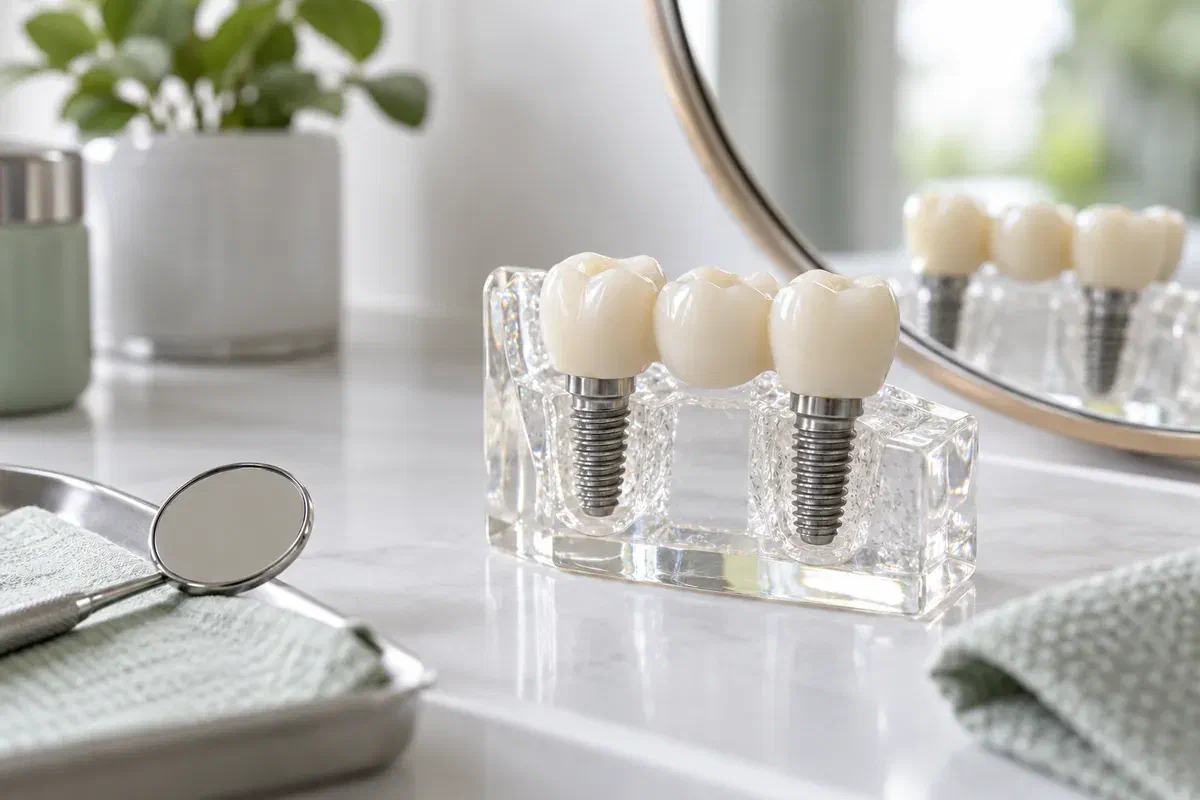
Illustrative consultation about replacing neighbouring teeth with an implant-supported bridge
Restorative Dentistry

Implant-Supported Dental Bridges in Milton

When two or more teeth side by side are gone, a single connected bridge resting on dental implants may be one way to fill the space. Learn how our Milton team assesses suitability, sequences the stages, and plans the look, cleaning and upkeep of an implant bridge.

Implant bridges, explained for Milton

One gap, several teeth, a single plan.

Many people first notice the problem at dinner. Food gets steered to one side, a favourite crusty bread is skipped, and chewing starts to feel like a workaround. An implant-supported bridge is a fixed row of replacement teeth joined together and held by implants placed in the jaw, rather than hooked onto the natural teeth beside the space.

How many implants a bridge uses, and where they sit, comes from the restoration being designed and the mouth receiving it. Bone volume, the width of the space, the way your teeth meet, the visible result and how easily you can clean underneath all feed into that decision. A plan borrowed from a friend or a website rarely fits someone else’s jaw.

Because you are close to our Bronte Street practice, an assessment can slot into an ordinary week. Tell us where the missing teeth make life harder, whether it is eating, speaking or smiling in photos, and whether you already wear a partial. We will link those concerns to a plain account of the treatment and the care it asks of you afterward.

Ask about an implant bridge
Teaching model of a three-tooth bridge supported by two implants in a clear base
Reasons Milton adults ask about this

Where does a row of missing teeth leave you?

The spot in the mouth and the health of everything around it shape what is possible. Come with your own priorities so that chewing, appearance, schedule and daily practicality are weighed side by side.

You would rather not take your replacement teeth out

A connected bridge may suit a span of adjacent missing teeth when implants can be positioned to carry it. Ask what a fixed option changes about brushing and cleaning, and how the bridge would be looked after over time.

You are wary of filing down healthy neighbours

Implants can take the load so the teeth on either side are not used as anchors. Those teeth still get examined, and what is found may affect the plan and how it compares with other choices.

Your current partial is bulky or loose

Describe what bothers you about it, whether that is rocking, food trapping or the feel of the plate. An implant bridge should be measured against those specific complaints, not treated as an automatic fix.

Where teeth still remain in the area being planned, their condition and any realistic way of keeping them should be talked through before extraction becomes part of a bridge plan.

What a fixed span can give you

Replacement teeth that rest on their own foundation.

In a mouth that suits it, an implant bridge restores a stretch of missing teeth in a way that stays put. The design can follow the shape of the gap and your bite, and the natural teeth nearby are left out of the support system. We will be honest about the degree of improvement that is likely for you.

That fixed result arrives through several stages and carries ongoing duties. Placing implants is surgery with its own risks, healing has to be checked, and parts of the bridge may need attention down the road. Weigh this against a removable partial, a tooth-supported bridge, or simply waiting.

Patient information: American Academy of Periodontology — multiple-tooth implant replacement

Look at the span as a whole

Teeth, supports and chewing forces are planned as one unit. Ask why a particular number and spacing of implants fits your gap, rather than assuming more implants automatically means a better plan.

Settle the look before the final piece

Tooth proportions, colour, gum shape and the way the bridge meets surrounding tissue all show when you smile. Find out what can be previewed in planning or with a provisional, and what the existing gums may limit.

Plan how you will clean it

A fixed bridge needs daily cleaning around each support and under the joined teeth. Knowing that routine in advance helps you judge whether the design suits your hands and your habits.

From first visit to finished bridge

Agree on the end result, then work toward it.

The order and pace depend on the site, any groundwork needed first, and how you heal. Ask for the expected appointments, the temporary tooth arrangements, who will be involved and the costs, presented together as one plan.

  1. Examine the space and weigh the options

    Your dentist looks at the teeth, gums, bite and medical history, then chooses the records and imaging the plan needs. Alternatives, limits and any need for another clinician’s opinion are covered here.

  2. Place the implants

    You hear where the implants are proposed to go, whether any preparatory work is needed, and how the surgery will be done. The timeline depends on your situation, and adequate healing and support must be confirmed before moving on.

  3. Capture and test the design

    Impressions or digital records guide how the bridge is made. Fit, tooth position, bite and the gum relationship are checked during the restorative visits, with a provisional or extra try-in when the case calls for it.

  4. Attach the bridge and set up reviews

    The completed bridge is checked and secured with the planned connection. You leave with cleaning instructions, a sense of what adjusting to it feels like, and a schedule for reviewing the bridge and implants.

After the bridge is in

The hidden side needs cleaning too.

Healing advice after surgery differs from the everyday routine for a finished bridge, so keep the two separate. Follow your team’s guidance on food, cleaning and return visits at each stage.

Practise threading under the bridge

Ask to be shown which tools fit the bridge’s shape, then try the route yourself. Regular floss often cannot slide between joined teeth the way it does between separate ones.

Speak up about anything that shifts

A sense of movement, clicking, a chip or a bite that feels different deserves a look. Resist pressing on the bridge to test it, and never use household glue on a loose part.

Come to reviews when nothing hurts

Replacement teeth, joins and the gums around the implants all need regular checks. Ask how often maintenance visits should happen and whether past gum disease or cleaning trouble changes that.

Other ways to fill the space

Three routes, each with its own trade-offs.

The right choice rests on your oral health and what matters most to you. A fair comparison covers surgery, impact on other teeth, whether it comes out, maintenance and the overall estimate.

When implants can be placed to carry it

An implant-supported bridge

Implants hold a fixed, joined restoration across the space. The plan has to cover placement, healing, bridge design, cleaning access and the long-term health of the tissue around the supports.

When the teeth beside the gap can serve as anchors

A bridge held by natural teeth

A traditional bridge is another fixed choice. Ask about the health of the anchor teeth, how much they would be shaped, and what that means for their care before setting it against implants.

When taking the teeth out suits you

A removable partial denture

A partial can fill the space without implant surgery. How it is supported, how it feels to handle, how it looks and how it is maintained should all be explained next to the fixed options.

Milton questions, answered

Before you decide on a connected bridge.

An implant bridge involves choices about what holds it and what you see. These answers can help you talk through design and timing without assuming one layout suits every space.

(905) 876-4488
Can three missing teeth be replaced with only two implants?
In some cases, yes. A bridge can span replacement teeth between planned supports. Whether that layout works depends on the length of the gap, the bone available, your bite and the design. Ask your dentist to explain why the proposed layout fits your mouth.
Is chewing different with an implant bridge than with natural teeth?
Many people find a well-fitted bridge feels steady, but it is not identical to natural teeth, and there is usually an adjustment period. Ask what to expect in the first weeks and which foods to approach carefully while you get used to it.
Do I need to stop wearing my partial during treatment?
It depends on the stage and the site. Some partials can be adjusted to sit over a healing area, while at other times wear may need to be limited. Your team will explain what applies to you at each step.
Will my other teeth be checked before an implant bridge is planned?
Yes. Decay, gum health and the condition of existing fillings or crowns elsewhere all matter, because problems there can affect the plan. Some care may be recommended first so the bridge is placed into a healthier mouth.
How do I know if a bridge problem is urgent?
Swelling, significant pain, bleeding that does not settle or a bridge that has come loose should be reported promptly. Call the clinic and describe what is happening so the team can advise how soon you should be seen.
What questions should I ask about the cost of an implant bridge?
Ask which stages the estimate covers, from imaging and any preparation to surgery, temporaries and the final bridge. Check how changes would be handled and what upkeep may cost later. If you have benefits, confirm coverage with your plan directly.
Your next step in Milton

Bring the gap, and your questions about it.

Book an assessment at our Bronte Street clinic to talk about replacing several neighbouring teeth. We will listen to what you want, explain the support an implant bridge would require, and set it beside the other options that fit your mouth.

If you have records of past extractions, implants or appliances in that area, bring them along.

Visit Milton Dental Clinic
Unit 1, 342 Bronte St. S, Milton, ON L9T 5B7
Get directions Clinic hours
Monday–Thursday
11am–7pm
Friday–Sunday
By appointment only

Areas we serve

  • Milton
  • Oakville
  • Mississauga
  • Georgetown
  • Halton Hills
  • Acton
  • Campbellville
  • Brampton
  • Burlington
  • Puslinch
  • Rockwood
  • Erin
  • Caledon
  • Etobicoke
  • Old Milton
  • Bronte Meadows
  • Timberlea
  • Dorset Park
  • Dempsey
  • Clarke
  • Beaty
  • Coates
  • Harrison
  • Scott
  • Willmott
  • Ford
  • Bowes
  • Cobden
  • Walker
  • Mountain View
  • Milton Heights
  • Hawthorne Village
  • Valley View
  • Fallingbrook
  • Nassagaweya
  • Trafalgar
  • Esquesing
  • Nelson
  • Brookville
  • Moffat
  • Glen Williams
  • Norval
  • Limehouse
  • Stewarttown
  • Ashgrove
  • Hornby
  • Silver Creek
  • Speyside
  • Scotch Block
  • North Oakville
  • River Oaks
  • Glen Abbey
  • West Oak Trails
  • Palermo
  • Bronte Creek
  • College Park
  • Joshua Creek
  • Uptown Core
  • Preserve
  • Iroquois Ridge
  • Lisgar
  • Meadowvale
  • Meadowvale Village
  • Churchill Meadows
  • Erin Mills
  • Central Erin Mills
  • Streetsville
  • East Credit
  • Creditview
  • Heartland
  • Sheridan
  • Mount Pleasant
  • Credit Valley
  • Huttonville
  • Churchville
  • Springbrook
  • Northwest Brampton
  • Bram West
  • Fletcher's Meadow
  • Fletcher's Creek South
  • Alton Village
  • Orchard
  • Millcroft
  • Headon Forest
  • Tansley
  • Brant Hills
  • Tyandaga
  • Kilbride
  • Lowville
  • Aberfoyle
  • Morriston
  • Arkell
  • Hillsburgh
  • Freelton
  • Carlisle
  • Waterdown
  • Flamborough
  • Mountsberg

How can we help?

Milton Dental Clinic

Have a question about your smile? Choose the option that works best for you.

For urgent dental concerns, please call.
Messages are reviewed during clinic hours.