You want nothing to shift when you speak
If several neighbouring teeth are gone and implants can be positioned to hold a span, a fixed option may suit you. Ask how that would feel compared with a removable plate, and what cleaning it needs.


A gap of several teeth can change how words sound and how food feels, and a removable plate does not always help. An implant-supported bridge is a fixed option some mouths can take. Readers from Rockwood can learn how comfort, speech, suitability, stages and long-term care are considered.
It can be subtle: an S that whistles a little, a tongue that keeps finding the empty space, a partial that clicks when you laugh. Missing teeth in a row affect more than chewing. An implant-supported bridge fills that span with joined replacement teeth fixed onto implants in the jaw, so there is no plate across the palate and no clasp gripping the teeth next door.
The design is worked out from your mouth outward. Your dentist studies the available bone, how wide the gap is, the way your jaws close, what shows when you talk and smile, and whether a cleaning aid can reach underneath. From that, the number of implants and their positions are proposed, which is why no template suits everyone.
Making the trip from Rockwood to our Bronte Street practice, use your first visit to describe the everyday moments that bother you. Mention sounds that have changed, foods you avoid, and any appliance you already have. We will explain what a fixed bridge might change, what it would not, and what caring for it involves.
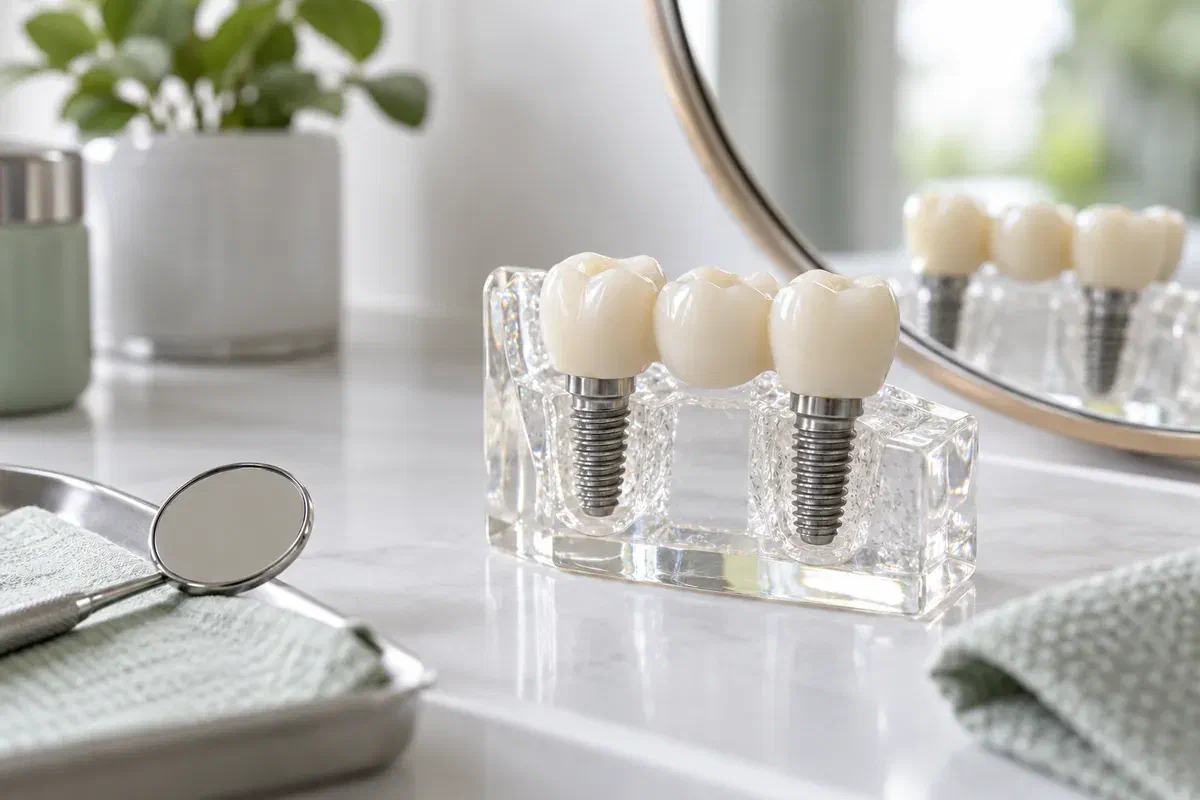
Where the missing teeth were, and how healthy everything nearby is, shapes the realistic choices. Bring your own list, and we will weigh comfort, speech, appearance, timing and daily upkeep together.
If several neighbouring teeth are gone and implants can be positioned to hold a span, a fixed option may suit you. Ask how that would feel compared with a removable plate, and what cleaning it needs.
With implants doing the supporting, the adjoining teeth carry no hooks or crowns for the bridge. They are still examined, since their health can alter the plan or tilt the comparison.
Some people find a plate crowds the tongue or affects taste and temperature sensation. Describe it precisely, so an implant bridge is assessed against your actual complaint rather than an assumed one.
If any teeth are still in place within the planned span, their condition and any reasonable chance of keeping them deserve discussion before extraction is part of the proposal.
In a mouth that can support it, the bridge stays fixed and occupies roughly the space the original teeth did, without a palate plate or clasps. For some people that makes speech and chewing feel more natural. Your dentist should tell you honestly how much change to expect, since adaptation varies.
Reaching that point takes treatment and ongoing effort. Implant surgery has risks, healing is assessed before the bridge is made, and the restoration may need servicing over time. Compare those demands with an improved partial, a tooth-supported bridge, or leaving things as they are for now.
Patient information: American Academy of Periodontology — multiple-tooth implant replacement
Tooth position and the contour of the bridge influence how the tongue moves. Ask whether a provisional can help you test speech and comfort before the final version is made.
What people see when you talk matters as much as the smile. Find out which visible details can be refined during planning, and where your existing tissue may limit the result.
The joined teeth form a span that needs threading or brushing beneath every day. Practising before treatment shows whether the routine will be comfortable for your hands.
How long each part takes depends on the site, any preliminary care and how well you heal. Ask for one clear outline of the visits, what fills the gap meanwhile, who is involved and the estimated cost.
Your dentist hears what bothers you, then checks teeth, gums, bite and health history, ordering imaging where planning requires it. Alternatives, limits and possible referrals are covered openly.
You learn where the implants would sit, whether groundwork comes first, and how the surgery proceeds. The restorative phase starts only after healing is confirmed and the supports are stable.
A lab crafts the bridge from your impressions or scan. During try-ins the team checks seating, tooth position, bite, speech and the gum contour, sometimes using a temporary first.
The final bridge is secured with the chosen connection. You get a cleaning lesson, tips for the adjustment period and dates for reviewing both the bridge and the implant supports.
Recovery advice after surgery is distinct from long-term care of the finished bridge. Follow your team’s written instructions for each phase, including food, cleaning and recall visits.
Reading aloud can help your tongue adapt. For cleaning, ask which threaders or small brushes fit your bridge, since floss cannot slip between its joined teeth as it would with separate ones.
Some unfamiliarity at first is common, but persistent soreness, a lisp that does not fade, clicking or movement should be checked. Avoid pressing on the bridge, and do not attempt home repairs.
Implants, joins and the surrounding gum need routine checks. Ask what recall interval suits you and whether past gum trouble means visits should be closer together.
A fixed bridge on implants changes how your mouth feels as well as how it looks. These answers can help you raise the right points without assuming one design suits every gap.
Set up an appointment at our Bronte Street practice to talk about replacing several neighbouring teeth. We will listen to how the gap affects comfort and speech, describe what implant support would involve, and go through the alternatives with you.
If you wear a partial, bring it, along with any records of previous extractions or implants in the area.
