

Illustrative patient and dentist reviewing an implant denture teaching model
Restorative Dentistry

Implant-Supported Dentures in Milton

A lower denture that lifts while you chew or talk is one of the most common reasons people ask about implants. Here in Milton, we look at why your appliance moves, then compare removable and fixed implant designs, the treatment stages, and the care each one asks of you.

When a denture won’t stay put

Start with the moment it lets you down

Maybe it happens halfway through a sandwich, or when you laugh at the kitchen table. A conventional denture rests on the gums, and some mouths, especially the lower jaw, give it little to hold on to. Implants placed in the jaw can add retention or support so the appliance has something firmer to connect with.

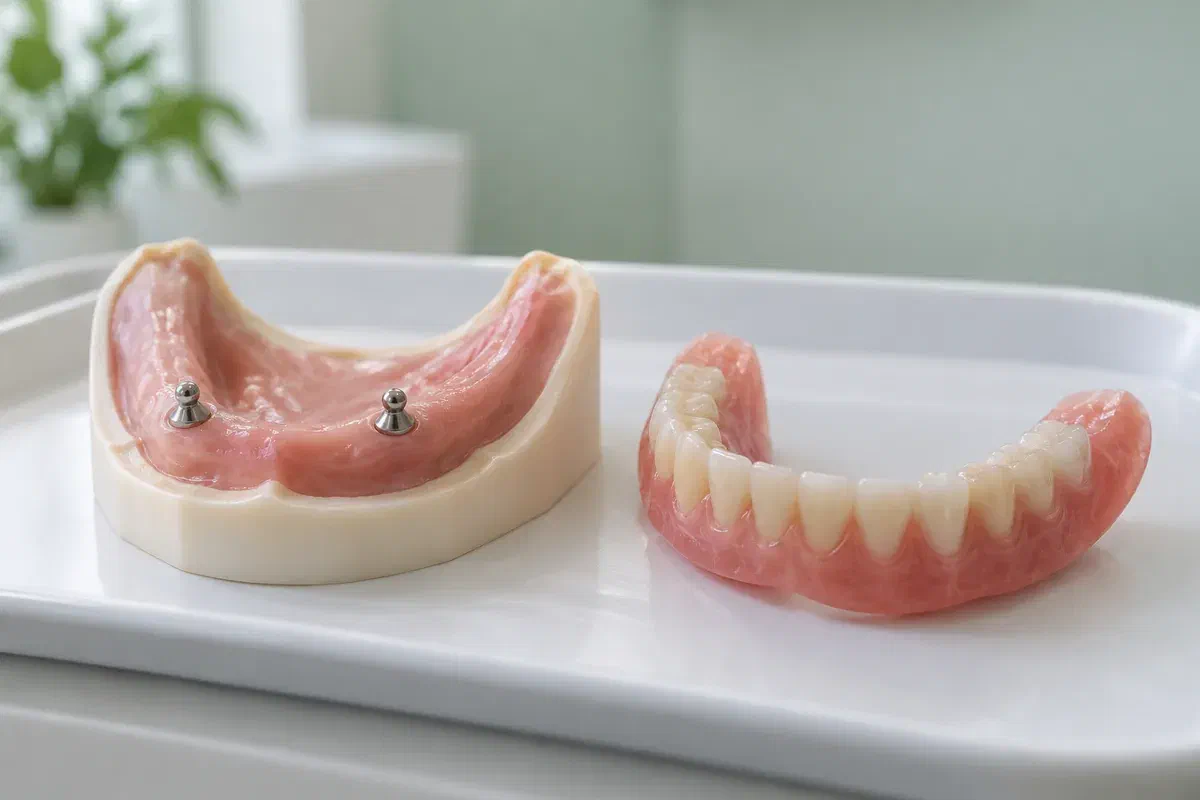
There is more than one way to make that connection. A removable overdenture clips onto implant attachments yet still rests partly on the gum tissue, and you take it out to clean it. Other designs depend more fully on the implants and stay in place until a clinician removes them. Each feels, cleans and wears differently.

Your first visit in Milton is a conversation about what bothers you most. It might be movement, sore spots, trouble taking the denture out, or planning ahead for teeth you may lose. We weigh those priorities alongside your bone, gum tissue, general health and the daily care you can realistically manage.

See how the implant denture options compare
Lower removable overdenture beside a teaching model with two implant attachment heads
What is behind the question

Name the problem before picking the fix

Implants can help with some denture problems, but not every one. The current appliance and the tissues under it still need a careful look, because a loose fit, a worn denture and a changing jaw can each call for a different answer.

The lower denture shifts when you eat or speak

Tell us which foods or words cause trouble and what relines or adjustments you have already had. We can then judge whether a refitted conventional denture, implant attachments or something else would deal with the cause.

You are unsure about clip-in versus fixed

A fixed design is not automatically the easier one. Talk through taking an appliance in and out, reaching under it to clean, the strength in your hands, how each design feels, and the professional upkeep each requires.

Several remaining teeth are on borrowed time

Before any extractions, ask how long those teeth are likely to last and what else could be done for them. A good plan also covers how you will manage between stages, including any temporary appliance, and what follows the first fitting.

Implants are not right for every person or every part of the jaw. Your examination should set out the limits that apply to you and compare the options that make sense for your health and situation.

What implant support can change

A steadier denture shows up at mealtimes

When implants suit your mouth, attaching a denture to them can make it more retentive or stable than one held by gum tissue alone. Ask us to describe the expected gain in plain terms: how the appliance should sit, how long you may need to get used to it, and which of your current complaints it is likely to help.

Even then, the appliance still needs looking after, and it cannot promise you will eat anything without limits. Surgery, healing time, ongoing maintenance and the chance of later repairs are part of the picture. Weigh those commitments against the benefits so the plan suits both your mouth and the life you lead.

Patient information: Cleveland Clinic — removable and fixed implant-supported dentures

Know why one design was recommended

Clip-in attachments and a fixed bridge-style restoration handle support in different ways. Ask what makes the suggested arrangement a fit for you, and what you would gain or give up with the alternative.

Talk about your smile and your speech

Where the teeth sit, how much pink material replaces lost gum and bone, and how the lips are supported all shape the look and feel. Ask which details can be checked at try-in and where some adjustment period is still likely.

Think ahead to the years after fitting

Picture what you can handle now and what help you might want later on. Access for cleaning, replacement of worn parts and regular professional checks should all be explained before you agree to treatment.

From first visit to final denture

How the stages fit together

Implant denture treatment usually takes several visits and may involve more than one clinician. Ask for a clear outline of each stage, from any preparatory work and temporary denture through healing checks, final fitting and regular reviews.

  1. Look closely at your mouth and your goals

    The dentist checks your remaining teeth, gums, health history and present denture. Records and imaging help show whether implants are suitable, and your concerns about chewing, speaking, handling and cost steer the discussion.

  2. Weigh the designs and settle on a plan

    Where both suit you, compare removable and fixed options, the proposed implant layout and any alternatives. Make sure surgical risks, extra treatment, interim teeth and the parts of the estimate that could change are all clear.

  3. Move through the implant and denture work

    The treating team follows the agreed order and confirms healing before moving on. Impressions, lab work and try-in visits shape the appliance around the implant support, and the timeline depends on your clinical situation.

  4. Fit the denture and practise the routine

    At the fitting, the team checks the bite and explains how to use the appliance. Practise taking it out and putting it in if your design requires it, learn how to clean it, and book your early review and future maintenance.

Living with your new appliance

Care that matches your design

Guidance for the first weeks of healing differs from care of the finished denture. Keep your written instructions and ask whenever you are unsure about wear time, cleaning, what to eat, or who to call.

Follow the routine for your type

A removable overdenture comes out as directed so you can clean it and the gums beneath. A fixed restoration stays in and is cleaned around and underneath; never try to loosen its connections yourself.

Choose products that suit the materials

Ask which brushes, cleansers and storage suit your denture and its attachments. Skip boiling water, household cleaners and makeshift tools, even if they seem to work on other appliances in the house.

Book regular fit and attachment checks

Let us know about sore spots, movement returning, difficulty removing the appliance or a bite that feels different. Attachments and denture materials wear over time, so upkeep may be needed even when the implants are sound.

Your denture options side by side

Picture an ordinary day with each one

These approaches differ in how they are supported, whether you remove them, what treatment they need and how they are maintained. The right choice is the one that suits you clinically and practically, with its limits explained up front.

When you are comfortable taking it out

A removable implant overdenture

Attachments hold the denture in place, and you remove it for cleaning as instructed. Ask how much it rests on the gums, how easy it is to unclip, and how often the attachments need servicing.

When a fixed design suits your mouth

A fixed implant restoration

The teeth stay attached through meals and cleaning. Planning has to consider the implant support, how you will clean beneath the restoration, and professional maintenance or removal when it is needed.

When you would rather not have implants

A conventional denture

A new denture, or a reline or repair of your current one, may still be sensible. Ask what improvement to expect, what limits would remain, and how it measures up against an implant approach.

Implant denture questions we hear

Common questions, plain answers

Ask about anything, even if you have worn a denture for decades. Adding implants brings new choices about treatment, everyday handling and the support you will need after the appliance is fitted.

(905) 876-4488
Why does my lower denture seem looser than my upper one?
The lower jaw usually offers less surface to rest on, and the tongue and cheeks move around the appliance, so it often feels less secure. Your exam can show whether the fit, the denture itself or changes in the jaw are contributing, and whether implants could help.
Is a clip-in implant denture the same thing as fixed teeth?
No. A clip-in overdenture is removed by you for cleaning, while a fixed design stays in place until a clinician takes it off. Ask to see a model of the proposed appliance and have its support and daily care explained.
Can my existing denture be fitted with implant attachments?
Sometimes, depending on its condition, design and fit, and on where the implants would go. In other cases a new denture is the better route. Have your current appliance assessed before counting on a conversion.
Will I need to stop wearing a denture while the implants heal?
Plans vary. Some people wear an adjusted or temporary denture during healing, with instructions to protect the implant sites. Ask what you will wear at each stage, and how it may affect eating and speaking in the meantime.
How often will the attachments need to be replaced?
It depends on the system, how the appliance is used and how it fits. Retentive parts do wear, and you may notice the denture feels less snug. Ask what servicing your design usually needs and what signs to report.
Can my appointments fit around a busy week in Milton?
We see patients Monday to Thursday from 11am to 7pm, with Friday to Sunday by appointment only. Ask us to map out the stages ahead of time so you can plan work, family commitments and recovery around them.
Implant dentures close to home

Let’s find what fits your daily life in Milton.

Book a consultation at our Bronte Street practice to talk about the denture you wear now or plans to replace several teeth. We will go over suitable designs, walk through the treatment steps and explain the care each option involves.

Please bring your current dentures and any records of past implants or restorative work.

Visit Milton Dental Clinic
Unit 1, 342 Bronte St. S, Milton, ON L9T 5B7
Get directions Clinic hours
Monday–Thursday
11am–7pm
Friday–Sunday
By appointment only

Areas we serve

  • Milton
  • Oakville
  • Mississauga
  • Georgetown
  • Halton Hills
  • Acton
  • Campbellville
  • Brampton
  • Burlington
  • Puslinch
  • Rockwood
  • Erin
  • Caledon
  • Etobicoke
  • Old Milton
  • Bronte Meadows
  • Timberlea
  • Dorset Park
  • Dempsey
  • Clarke
  • Beaty
  • Coates
  • Harrison
  • Scott
  • Willmott
  • Ford
  • Bowes
  • Cobden
  • Walker
  • Mountain View
  • Milton Heights
  • Hawthorne Village
  • Valley View
  • Fallingbrook
  • Nassagaweya
  • Trafalgar
  • Esquesing
  • Nelson
  • Brookville
  • Moffat
  • Glen Williams
  • Norval
  • Limehouse
  • Stewarttown
  • Ashgrove
  • Hornby
  • Silver Creek
  • Speyside
  • Scotch Block
  • North Oakville
  • River Oaks
  • Glen Abbey
  • West Oak Trails
  • Palermo
  • Bronte Creek
  • College Park
  • Joshua Creek
  • Uptown Core
  • Preserve
  • Iroquois Ridge
  • Lisgar
  • Meadowvale
  • Meadowvale Village
  • Churchill Meadows
  • Erin Mills
  • Central Erin Mills
  • Streetsville
  • East Credit
  • Creditview
  • Heartland
  • Sheridan
  • Mount Pleasant
  • Credit Valley
  • Huttonville
  • Churchville
  • Springbrook
  • Northwest Brampton
  • Bram West
  • Fletcher's Meadow
  • Fletcher's Creek South
  • Alton Village
  • Orchard
  • Millcroft
  • Headon Forest
  • Tansley
  • Brant Hills
  • Tyandaga
  • Kilbride
  • Lowville
  • Aberfoyle
  • Morriston
  • Arkell
  • Hillsburgh
  • Freelton
  • Carlisle
  • Waterdown
  • Flamborough
  • Mountsberg

How can we help?

Milton Dental Clinic

Have a question about your smile? Choose the option that works best for you.

For urgent dental concerns, please call.
Messages are reviewed during clinic hours.