A lower denture that never settles
Say when it moves and what has been tried before. We can then judge whether a refitted conventional denture, implant attachments or another approach addresses what is happening in that arch.


Often it is just the lower denture that causes trouble, while the upper sits well or natural teeth remain. For people from Rockwood, our Milton dentist looks at each jaw on its own terms and explains how an implant denture in one arch works with whatever meets it in the other.
Upper dentures can cover the palate and often gain some suction; lower ones have far less to grip and share space with a busy tongue. That is why many people feel the bottom appliance is the problem. Implants placed in the jaw can add retention or support to a denture, and the plan for each arch may differ.
In either jaw, the choice is broadly between a removable overdenture, which clips to attachments and still rests partly on the gums, and a fixed restoration, which depends more fully on implants and is removed only by a clinician. What sits opposite, natural teeth, a partial or a full denture, affects the bite and the design.
From Rockwood, you may want to know whether treating one arch now and the other later is reasonable. We begin with what bothers you, examine both jaws, bone, gums and health, and then explain how options for one side would work with the other.
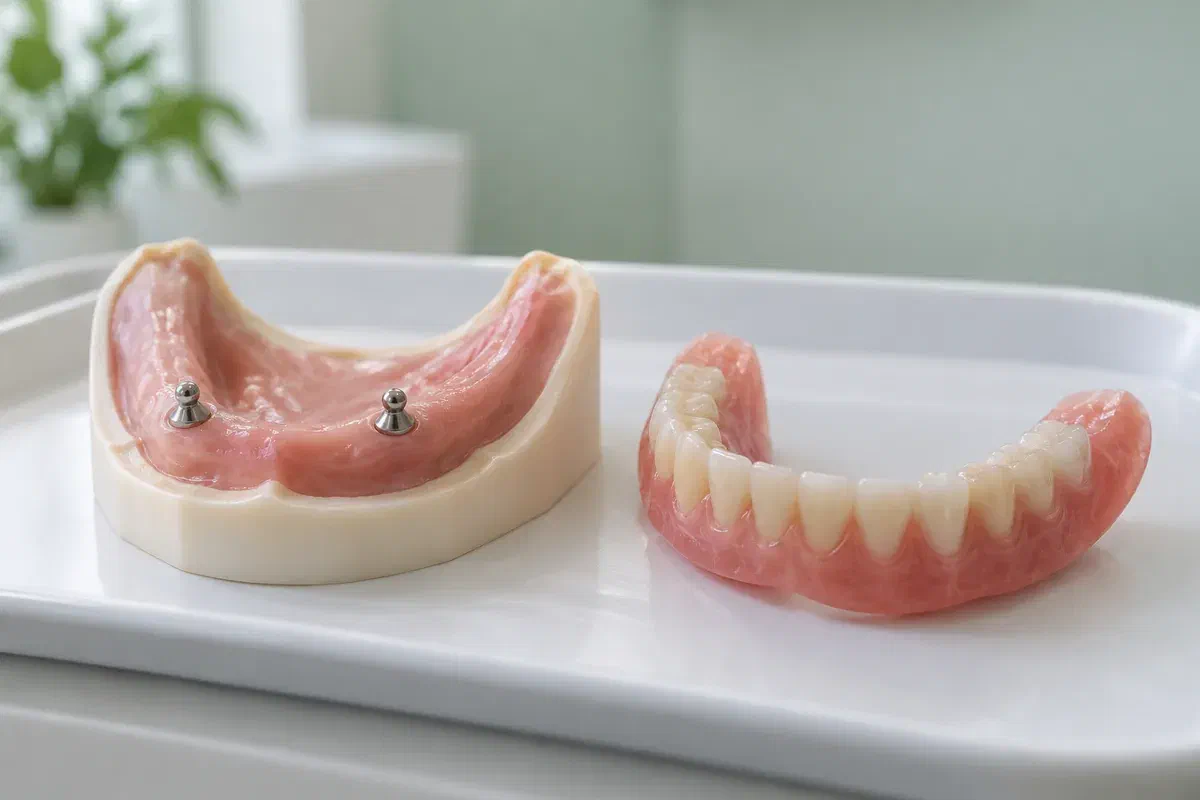
Implants may help with some denture problems but not every one, so both arches and the current appliances need assessment. Knowing which jaw is causing the instability or soreness helps target treatment correctly.
Say when it moves and what has been tried before. We can then judge whether a refitted conventional denture, implant attachments or another approach addresses what is happening in that arch.
Each design asks something different of you, and the answer may not be the same top and bottom. Compare handling, cleaning access, feel and professional servicing for each arch separately.
Before removal, ask about their outlook and whether keeping them is reasonable. Any plan should show how both arches will work together during the transition and after the first fitting.
Implants are not suitable for every person or every site. Your exam should explain the limits for each arch and compare the options that are realistic for your health and circumstances.
In a suitable jaw, connecting the denture to implants can improve its retention or stability over gum support alone, and that may be most noticeable in the lower arch. Ask what the change is expected to feel like, how adapting may go and which concerns it is meant to address.
Treating one arch does not end the need for care in either, and no plan promises unlimited chewing. Surgery, healing, maintenance and potential repairs come with implant treatment. Weigh those alongside the benefits so the plan fits your mouth and the way you live.
Patient information: Cleveland Clinic — removable and fixed implant-supported dentures
A removable attachment denture and a fixed restoration distribute support differently. Ask why a particular design is recommended for each arch and what would change if you chose otherwise.
Tooth position, replacement of lost tissue and lip support need to work with the opposite jaw. Ask which features are reviewed at try-in so the upper and lower look and feel coordinated.
Think about what you can manage now and what help may be needed later. Cleaning, part replacement and reviews for each appliance should be understandable parts of the plan.
Treatment often takes several visits, sometimes with more than one clinician, and both arches may not be treated at once. Ask for the sequence, including preparation, interim teeth, healing checks, final fittings and reviews.
The dentist assesses each arch, the natural teeth or appliances present, gum tissue and your health history. Imaging and records help gauge suitability, and your concerns about chewing, speech, handling and cost guide the plan.
Removable and fixed designs are compared for each jaw where suitable, along with implant layout, timing and alternatives. Surgical risks, extra treatment, temporary teeth and changeable estimate items are clarified.
The treating team carries out the agreed stages and confirms healing before moving on. Impressions and try-ins develop the appliance so it meets the opposing teeth properly, with timing set by your situation.
At fitting, the team checks how the new appliance meets the other arch and explains its use. Practise any removal and insertion, learn to clean it and arrange early and ongoing reviews.
Healing-period instructions differ from long-term care of the finished appliance. Keep the written guidance, and if you wear different types top and bottom, ask how each should be cleaned and stored.
Take a removable overdenture out as advised so you can clean both the appliance and your gums. Fixed teeth are cleaned in place around and beneath, and must not be released at home.
Ask what brushes, cleansers and containers are right for each denture and its attachments. Avoid very hot water, household chemicals or tools improvised from the kitchen drawer.
Report sore spots, renewed looseness, difficulty removing an appliance or teeth that meet differently. Attachments and materials wear, and the opposing arch can change too.
Ask about design and staging, however long you have worn dentures. Implants bring choices about which arch, which design and what support you will need afterwards.
Book a visit to our Bronte Street practice to discuss your upper or lower denture, or both. We will review suitable designs for each jaw, explain how treatment could be staged and describe the care involved.
Please bring both upper and lower dentures, even if only one is causing trouble.
