

Illustrative consultation about movement in an implant crown
Restorative Dentistry

Loose Implant Crown Repair in Milton

An implant tooth that shifts when you chew can be moving at the crown, at a connecting part, or deeper in the support. Our team in Milton works out which layer is involved first, then talks you through a repair that fits what we actually find.

Implant crowns in Milton

Something shifted at dinner. Here is what might be moving.

Most people first notice it mid-meal: the implant tooth gives a little, or sits differently once you close. That replacement tooth is only the top layer. Beneath it there may be a connecting component, and below that the implant itself, held in the jawbone. Movement you feel can start at any one of those levels.

So a wobble is a symptom, not an answer. It does not prove the implant has failed, and it is not safe to assume a quick tighten will settle it either. Our dentist needs to find the part that is moving, look at the gum and bone around it, and check whether anything has worn, cracked or bent.

Call our Bronte Street office soon after you notice rocking, clicking or a bite that feels off around the implant. If you kept an implant card or a treatment summary, bring it along. Knowing which system you have, and what was done before, helps the team judge which parts will fit and what should happen next.

Book an implant crown check
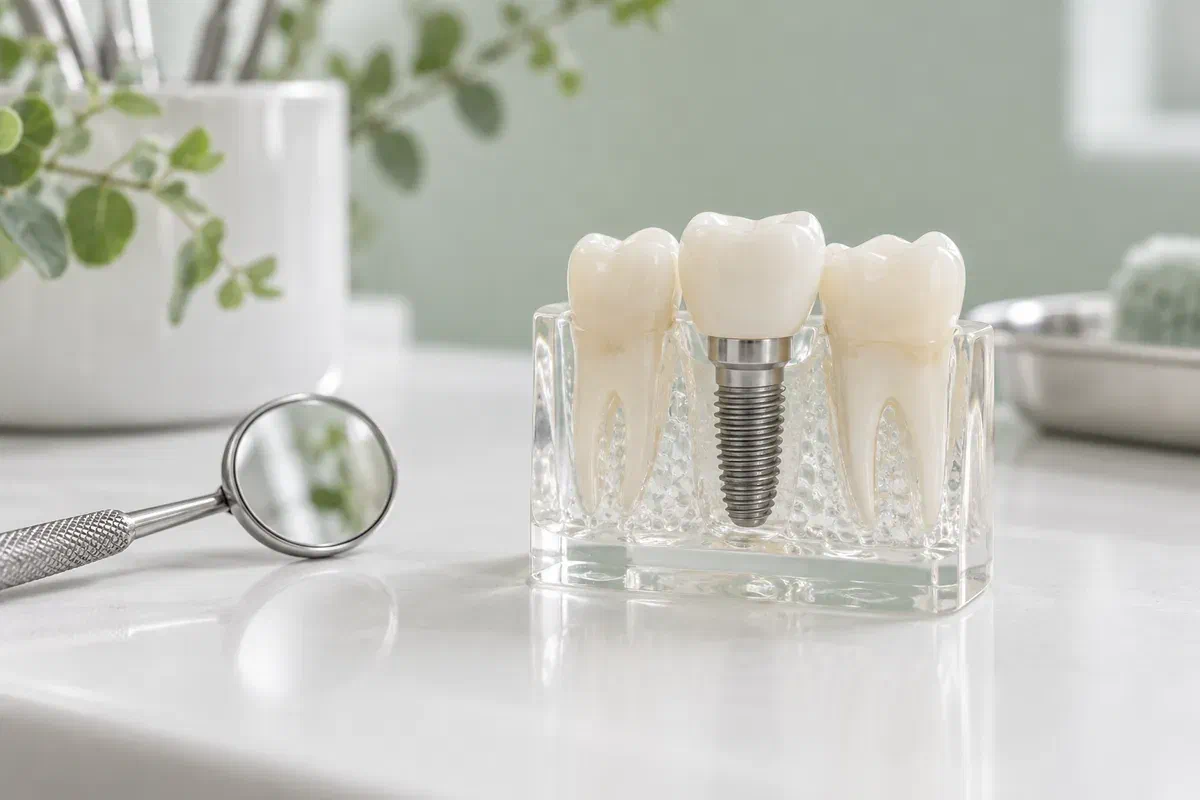
Single implant crown teaching model beside a mirror on a white counter
Useful details for your call

Tell us what you felt, and leave the testing to us.

A short history helps us prepare for your appointment. Let us know when the crown was placed, whether it has come loose before, and whether the change followed a hard bite, a fall or a knock.

The tooth tips, twists or lifts

Try not to push it around to see how loose it is. Several different parts can create the same feeling, and repeated pressure can make the situation harder to repair. Simply describe what happened while you were eating or talking.

A click, or teeth meeting differently

A new sound or an unfamiliar contact point matters even when you can barely see movement. Note when you hear or feel it, and whether it appeared all at once or crept in over a few days.

The gum around it is unhappy

Bleeding, puffiness, soreness or any discharge near the implant is worth mentioning. A mechanical fault and a tissue problem can occur together, and fixing the crown on its own may leave part of the issue untreated.

Phone us promptly if an implant tooth is moving. If it comes out, place it and any small pieces in a closed container, and please do not try to put it back in yourself.

Finding the right layer

A repair aimed at the actual fault

If the implant is still firm and the trouble sits in the crown or its connection, it is often possible to repair things without replacing the implant. The examination tells us whether that route is realistic, and which parts or extra steps it would involve.

We also want to understand why it loosened. Fit, the way the connection was made, how your teeth meet, and any earlier repairs can all shape the plan. Feel free to ask how a recommendation deals with what was found, and how we will confirm the result afterwards.

Patient information: Cambridge University Hospitals — implant restorations and complications

Know which piece is the problem

Your dentist can show you which part is involved and which parts still look sound. That keeps the conversation grounded, rather than treating every wobble as either total implant failure or a simple loose fitting.

Match the parts to your system

Implant brands and their components differ. Records help confirm what is in your mouth, whether suitable parts can be sourced, and whether another clinician should be consulted or more visits planned.

A plan for the tooth in the meantime

Ask whether the crown can stay in use, should come out, or needs a temporary solution. The answer depends on the findings, and it should weigh appearance and everyday chewing honestly.

What the appointment involves

Diagnosis comes before any tools come out.

We start by assessing the whole implant restoration. How the crown is attached and what we find decide how it is reached, whether existing parts can be kept, and how much can be done in the same visit.

  1. Talk through the history and the system

    Your dentist asks about the original implant work, any earlier loosening, what changed recently, and what records you have. When the crown was made at another office, details from that provider can clarify the design.

  2. Examine crown, connection and gum

    Hands-on checks, plus imaging when it is called for, help pinpoint the movement and show the condition of the surrounding support. If the crown needs to come off for a closer look, that is explained first.

  3. Agree on the work and carry it out

    Treatment may focus on the attachment, a connecting part, or the crown itself. Nothing starts until you have heard what is proposed, what it cannot do, and what it is expected to cost, along with any part orders, lab steps or referral.

  4. Test the bite and set a review

    The repaired tooth and your bite are rechecked as needed, then home care and any restrictions are explained. Ask which signs should prompt a call, and when stability and gum health will be looked at again.

Looking after it, before and after

Go easy on that side until the plan says otherwise.

Instructions vary with the part involved and the repair done. Ask clearly about chewing, cleaning, caring for any temporary crown, and whether to keep wearing a night guard or other bite appliance.

Rest a crown that moves

Keep hard and sticky foods away from it while you wait to be seen. Resist checking it with your finger or tongue, and call if the movement grows or the crown feels ready to come away.

Skip pharmacy cement and home tools

Kits sold for ordinary crowns are not designed for implant restorations. Glue, makeshift screwdrivers and parts of unknown origin can damage the system or make it harder for us to reach.

Speak up if it returns

After the repair, let us know about any new looseness, clicking, soreness or bite change. Keep your review appointment even if all feels fine, especially if this has happened before.

Possible repairs

Three directions, depending on where the fault lies

“My implant is loose” describes a feeling, not a diagnosis. Options make sense only once the team knows which part is affected and has checked everything else around it.

If the crown and implant are still usable

Re-establishing the connection

The right component or attachment work may bring back stability. How it is done depends on your system and whether the crown is screw-retained, cemented or of another recorded design.

If damage or poor fit rules out reuse

Fixing or remaking the crown

A worn or cracked crown or connector may need replacing. Ask whether new records, a temporary tooth or lab work will be required, and which existing parts can stay.

If the support itself is uncertain

A closer look at the implant

An implant that moves, or notable gum and bone findings, calls for its own diagnosis and plan. A specialist opinion may be sensible before any crown repair is considered.

Common questions

What people ask about a shifting implant tooth

Every answer depends on the system, the restoration and what the examination shows. These cover why records and a proper assessment come before any promise about a specific repair.

(905) 876-4488
Does a wobbly implant crown mean the implant has failed?
Not necessarily. Often the problem sits in the crown or its connection while the implant stays firm, but only a clinical examination can confirm that. Have it checked soon, since chewing on it can wear the parts involved.
How soon should I book after noticing movement?
Contact us within a few days at most, and sooner if it is getting worse, sore or swollen. Early assessment usually leaves more options open, because the parts have had less time to wear against each other.
What if I have no idea which implant brand I have?
We can still examine it. A definitive repair may need the system identified, so think back to who placed it and whether you received a card or summary. Our team can help request records from that office.
Can I keep eating on that side until my appointment?
It is best not to. Chew on the other side, choose softer foods, and avoid anything hard or sticky near the implant tooth. If it feels like it is about to come away, call us rather than waiting.
Will I leave with a finished repair after one visit?
Sometimes, but not always. If parts need ordering, a crown needs remaking at a lab, or a specialist should weigh in, the work happens in stages. The dentist will outline the expected steps after the examination.
Is it normal for a repaired implant crown to feel different at first?
Some awareness can be expected as you get used to it, but a bite that feels high or uneven should be reported. Contact is adjusted with function in mind, so let us know if anything still feels off.
Book in Milton

Let’s find out what is loose and keep the tooth protected.

Get in touch with our Bronte Street practice about an implant tooth that no longer feels steady. We will examine the crown and the support beneath it, explain realistic repair options, and tell you which records or parts may be needed.

Please phone about active movement, pain, swelling or a piece that has come out, and bring any implant records you have.

Visit Milton Dental Clinic
Unit 1, 342 Bronte St. S, Milton, ON L9T 5B7
Get directions Clinic hours
Monday–Thursday
11am–7pm
Friday–Sunday
By appointment only

Areas we serve

  • Milton
  • Oakville
  • Mississauga
  • Georgetown
  • Halton Hills
  • Acton
  • Campbellville
  • Brampton
  • Burlington
  • Puslinch
  • Rockwood
  • Erin
  • Caledon
  • Etobicoke
  • Old Milton
  • Bronte Meadows
  • Timberlea
  • Dorset Park
  • Dempsey
  • Clarke
  • Beaty
  • Coates
  • Harrison
  • Scott
  • Willmott
  • Ford
  • Bowes
  • Cobden
  • Walker
  • Mountain View
  • Milton Heights
  • Hawthorne Village
  • Valley View
  • Fallingbrook
  • Nassagaweya
  • Trafalgar
  • Esquesing
  • Nelson
  • Brookville
  • Moffat
  • Glen Williams
  • Norval
  • Limehouse
  • Stewarttown
  • Ashgrove
  • Hornby
  • Silver Creek
  • Speyside
  • Scotch Block
  • North Oakville
  • River Oaks
  • Glen Abbey
  • West Oak Trails
  • Palermo
  • Bronte Creek
  • College Park
  • Joshua Creek
  • Uptown Core
  • Preserve
  • Iroquois Ridge
  • Lisgar
  • Meadowvale
  • Meadowvale Village
  • Churchill Meadows
  • Erin Mills
  • Central Erin Mills
  • Streetsville
  • East Credit
  • Creditview
  • Heartland
  • Sheridan
  • Mount Pleasant
  • Credit Valley
  • Huttonville
  • Churchville
  • Springbrook
  • Northwest Brampton
  • Bram West
  • Fletcher's Meadow
  • Fletcher's Creek South
  • Alton Village
  • Orchard
  • Millcroft
  • Headon Forest
  • Tansley
  • Brant Hills
  • Tyandaga
  • Kilbride
  • Lowville
  • Aberfoyle
  • Morriston
  • Arkell
  • Hillsburgh
  • Freelton
  • Carlisle
  • Waterdown
  • Flamborough
  • Mountsberg

How can we help?

Milton Dental Clinic

Have a question about your smile? Choose the option that works best for you.

For urgent dental concerns, please call.
Messages are reviewed during clinic hours.