You have the crown, maybe a screw
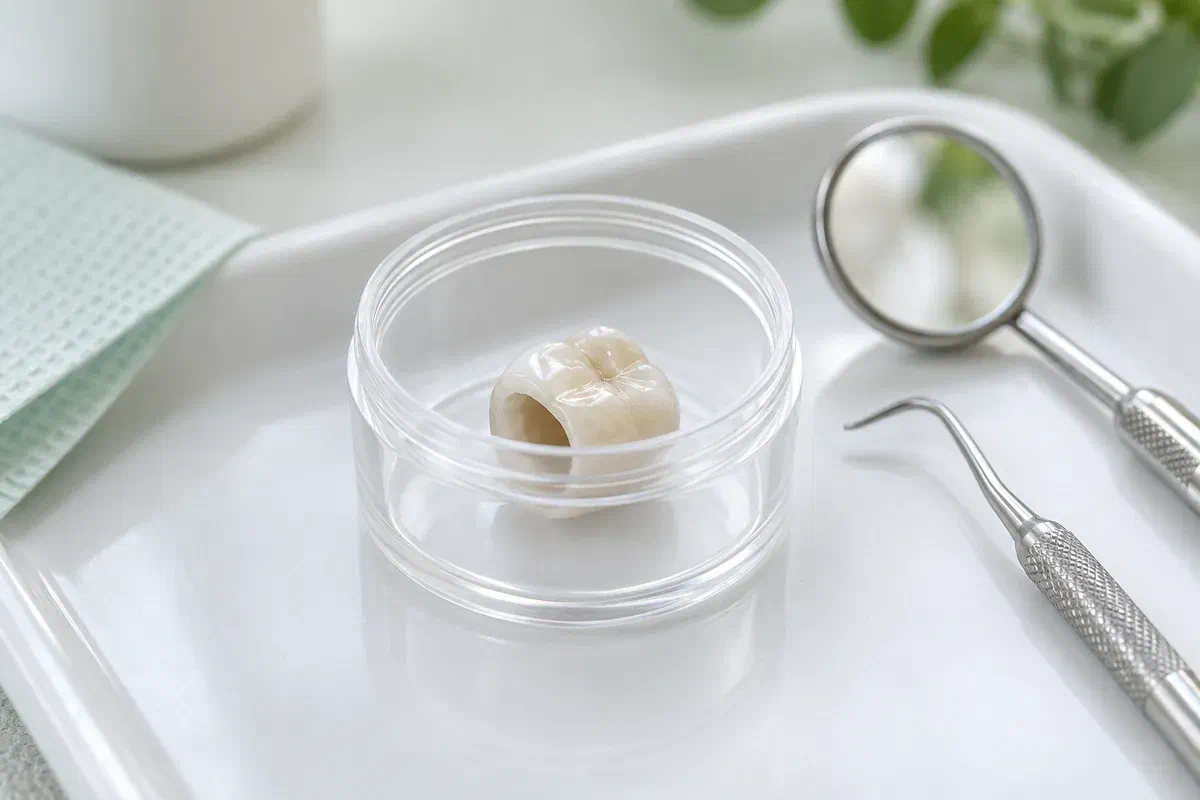
Store all of it in a closed container. Don't separate attached parts, clean out the inside, or glue anything back; the dentist needs to see each piece together with the tooth or implant it came from.


Was it a crown on your own tooth, or one on an implant? The answer changes what happens next. For Puslinch households, our lost dental crown treatment identifies what came off, examines what remains, and plans suitable protection and restoration.
Crowns sit on two very different foundations. Some cover a natural tooth that was shaped to receive them; others attach to an implant through a connecting piece and sometimes a tiny screw. If you're not sure which you have, that's common. Look at what is left: a short, often discoloured tooth, or a small metal or ceramic post.
On a natural tooth, crowns usually come away because of cement breakdown, a change in fit, or decay or fracture beneath. On an implant, a screw or connector may have loosened or broken. Either way, the crown may or may not be reusable, and the foundation needs checking first. Save every part that came out, however small.
When you contact us from Puslinch, describe what you see in the gap, whether you kept the crown and any screw, and how the area feels. Mention any injury and any root canal or implant history on that spot. We'll use that to arrange the right assessment and avoid treating an implant problem as if it were a tooth, or the reverse.
We won't ask you to identify everything. Share what happened, keep every part that came loose, and describe your symptoms so the visit can be set up appropriately.
Store all of it in a closed container. Don't separate attached parts, clean out the inside, or glue anything back; the dentist needs to see each piece together with the tooth or implant it came from.
An assessment can go ahead without every part. Let the team know whether it came off while eating or after a knock, and keep any fragments; small pieces can show which component failed.
Note what you feel, what sets it off, and whether it's increasing. Gum soreness or swelling around an implant or tooth can affect timing. Colour or appearance alone isn't a reliable measure of health.
Please call after any lost crown, painful or not. Choking, trouble breathing, or concern that a crown or screw was inhaled needs urgent medical attention.
For a natural tooth, the dentist checks how much healthy structure remains, the condition of the old crown, and signs of decay or cracking. For an implant, the focus shifts to the connection, the components, and the gum and bone around it. Either assessment shows whether reuse, replacement, or other care is appropriate.
The visit also separates temporary arrangements from the finished restoration. If parts need ordering or lab work is required, ask what will protect the area meanwhile and what that interim solution is able to cope with.
Patient information: NHS Wales — advice after losing a filling or crown
A crown that looks intact may still not fit or connect properly. Its seating and the foundation's strength determine whether reuse is sensible.
A broken screw, a loose connector, or tooth material inside the crown all point to different repairs. Identifying the failure avoids a fix that doesn't address the cause.
Discuss how many visits are likely, protection in between, appearance concerns, and the estimate. If something can't be confirmed at the first appointment, ask what will be needed and how to manage until then.
Bring the crown, any screws or fragments, and any records of implant or root canal work. If you feel nervous, or the area is uncomfortable to examine, mention it and the team will explain each step.
After hearing how it came off, the dentist determines whether the crown belonged to a natural tooth or an implant and examines the area, the surrounding gum, your bite, and symptoms. Imaging may be recommended.
Recovered pieces are checked for damage and fit. Any post, screw, decay, fracture, or attached material is considered before the dentist discusses reuse.
The diagnosis, options, and costs are explained. Reattachment may be possible at the visit, or the area may be protected while replacement parts, a new crown, or further treatment are organized.
Once agreed work is done, fit and bite are checked. Confirm whether the result is temporary, what care it needs, and how many visits remain.
Instructions may differ for an implant crown, a temporary crown, and a crown on a natural tooth, so ask for guidance that fits your situation and stage of treatment.
Keep hard, sticky, or tough foods away from the area and choose meals you can manage comfortably. If temperature causes sensitivity on a natural tooth, avoid that trigger rather than testing it.
Brush the area softly, including around any exposed implant part, and ask for advice if cleaning is painful. Don't poke, scrape, or try to cover the area with household materials.
If you receive interim cover, follow its instructions and keep the follow-up. Feeling comfortable doesn't mean the restoration is complete.
It's unsettling to find a gap and not know what was holding the crown. The examination shows whether you have a simple exposed tooth or implant, or a problem needing more extensive care.
Contact our Bronte Street team after a crown or implant crown comes off or goes missing. We'll identify what's underneath, check any parts you saved, and explain interim protection and lasting treatment.
Keep the crown, screws, and fragments in a closed container, and phone us if pain, swelling, or a part you can't account for is a worry.
