

Illustrative consultation about an existing metal filling
Restorative Dentistry

Metal Filling Replacement in Halton Hills

Worried about the mercury in your silver fillings? You deserve a calm, evidence-based conversation. From anywhere in Halton Hills, talk with our dentist about what current guidance says and what your own teeth show.

Questions about mercury

What you read online, and what your teeth need

An article, a podcast or a friend's experience can leave you uneasy about the amalgam in your mouth. Silver fillings do contain mercury bound with other metals, and it is reasonable to want to understand what that means. The useful starting point is the guidance from health regulators and the actual state of each filling.

The FDA does not recommend removing intact amalgam fillings without a clinical reason, partly because drilling them out sacrifices healthy tooth and briefly increases mercury vapour exposure. Replacement remains a good option when there is decay, a fracture, a failing margin, or a carefully considered cosmetic goal.

Households across Halton Hills, from Georgetown and Acton to Glen Williams and the smaller hamlets, are welcome to bring their questions to our Milton practice. Share what prompted your concern and any medical advice you have received. The exam then shows whether there is a dental reason to act.

Discuss concerns about amalgam
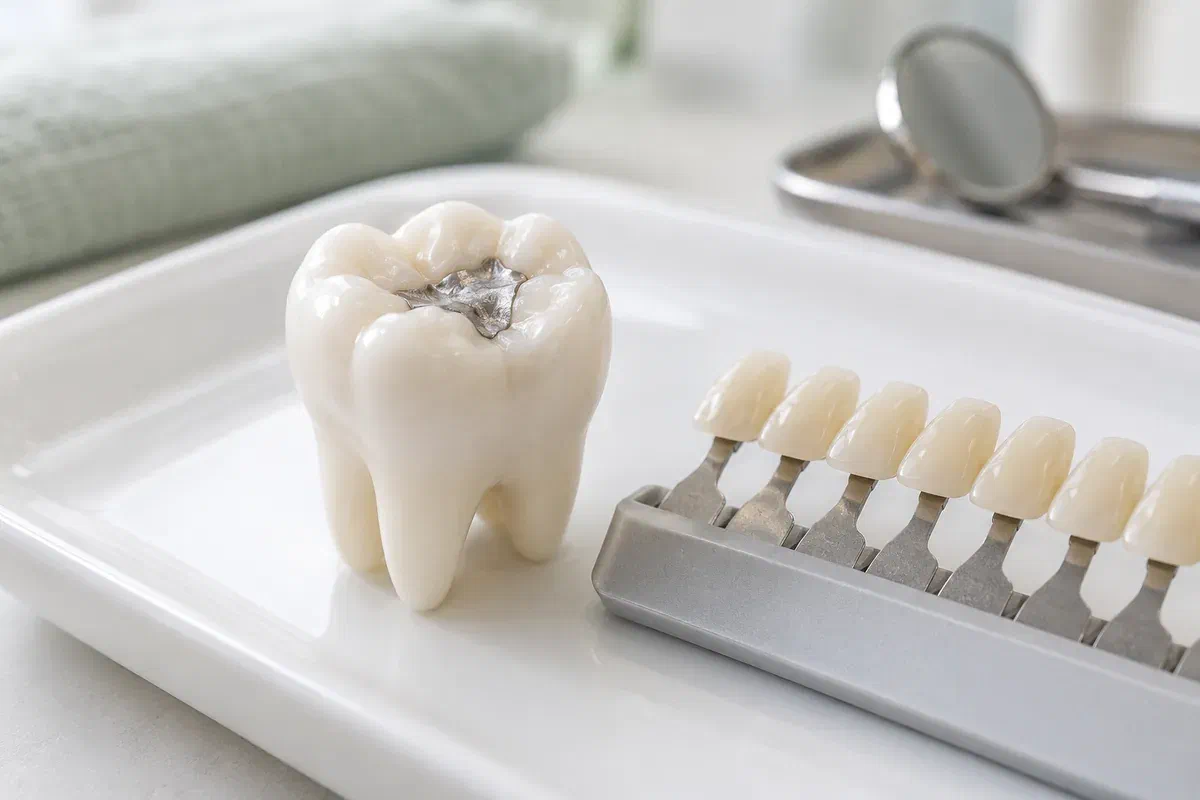
Teaching model of an intact silver filling beside a tooth shade guide
Sorting worry from findings

A concern deserves facts, not fear.

Health worries and dental problems can overlap, but they are not the same thing. Separating them helps you make a choice you feel settled about.

A filling that has changed

If you notice a broken edge, a rough patch or floss that catches, the filling may need attention for straightforward dental reasons. Tell us when you first felt it. A contained defect might be repaired without replacing everything.

Symptoms you are linking to fillings

Tooth pain or sensitivity needs a dental diagnosis, and the cause could be a crack, the nerve, the gums or another tooth. For general health symptoms, talk with your physician as well. Removing fillings is not a substitute for a medical assessment.

Wanting a metal-free smile

Some people simply prefer tooth-coloured restorations. That is a valid personal choice. We will explain the likely appearance and how much healthy tooth would be removed, so the decision rests on a clear understanding.

An intact, decay-free amalgam filling does not need to come out because it contains mercury, looks dark or has been there a long time. Ask what specific finding supports any recommendation to remove it.

When change is justified

Replace for a reason you can name.

If a filling has a real problem, replacing it can remove decay, seal leaking edges and restore a cleanable shape. The restoration chosen should suit the amount of tooth remaining and the bite forces on that tooth.

A tooth-coloured composite may suit smaller cavities, while larger or heavily loaded teeth may need an onlay or crown. Every material has its own ingredients and limits, and none is the right answer for every tooth, so ask how the recommendation balances preserving tooth, strength, appearance and your personal concerns.

Patient information: CDA — tooth-coloured filling materials

A clear clinical or personal purpose

You should know whether the plan treats decay, a broken filling, a weakened cusp, or a preference you have chosen after weighing the trade-offs. That clarity lets you compare replacement with monitoring.

Honest information about materials

Ask what the alternative materials contain and how they behave. The dentist can explain which ones suit this cavity, and why a choice that suits another tooth may not suit this one.

Coordinated care when needed

If a physician is involved in managing a health concern, it can help to share relevant information. Coordinating advice keeps dental decisions consistent with your overall care.

A considered approach

Talk it through before anything is removed.

There is time for questions at every stage. Let us know if worry about mercury, comfort, appearance or cost is most on your mind.

  1. Listen and examine

    We start with your concerns, then check the fillings, surrounding enamel, gums and bite. X-rays may be suggested if they would help. The dentist will explain each finding in plain terms and show you the area if possible.

  2. Review the guidance and options

    You will discuss whether there is a dental reason to replace anything, what the FDA guidance says, and the material, fee and alternatives. Removing old metal can reveal more decay than expected, which may change the plan.

  3. Remove with care, if chosen

    If replacement goes ahead, the tooth is numbed and isolated, and water spray and high-volume suction are used while the amalgam is removed. The tooth is checked, then restored or temporarily protected if further planning is needed.

  4. Confirm the fit

    Shape, contacts and bite are checked before you leave. Ask about eating and cleaning, and if more work is planned, confirm the next step and how to look after the tooth meanwhile.

Once the work is done

Expect a little adjustment, then routine care.

How you care for the tooth depends on the depth of the repair and the material placed. Call if eating or cleaning becomes difficult.

Allow sensation to return

Wait until the numbness wears off before chewing, and be careful with hot food and drinks. With a temporary in place, follow the specific instructions for that stage.

Report a bite that feels wrong

Let us know if the tooth seems to hit first or remains sore during meals after a day or two. Avoid testing it on hard foods. A description of the sensation helps the team decide whether an adjustment is needed.

Keep up daily cleaning

A fluoride toothpaste twice a day and daily flossing or interdental brushing keep the new margins healthy. Mention if floss catches or food gets trapped in a new spot, so the restoration and its neighbour can be checked at your next visit or sooner if it bothers you.

Finding a balanced path

Your choices, weighed honestly

Each option has benefits and limits. Your preferences and concerns are part of the decision, alongside what the exam shows.

When there is no dental need

Leave sound fillings in place

Monitoring intact amalgam fillings is consistent with FDA guidance. Agree on what will be checked at regular visits and what changes to report. This avoids removing healthy tooth unnecessarily, and the decision can always be revisited if the filling or your circumstances change.

For decay or damage

Replace a filling with a defect

A new direct filling or a partial repair may be appropriate when there is a specific problem. Ask why that extent of treatment fits, which material is proposed, and whether it can be completed in one visit.

When more support is needed

Restore a weakened tooth

A larger restoration such as an onlay or crown may be discussed for thin walls, and nerve involvement may need root canal treatment. A different material alone does not address those problems.

Halton Hills questions about mercury

Straight answers about amalgam and health

It is fine to ask detailed questions about the materials in your mouth. Good answers balance regulatory guidance with the condition of your own teeth.

(905) 876-4488
Should I worry about the mercury in my silver fillings?
Amalgam releases small amounts of mercury vapour, and the FDA has reviewed this carefully. Its guidance is that intact fillings in good condition should generally not be removed without a clinical reason. If you have a specific health concern, discuss it with your physician and dentist together.
Does drilling out amalgam increase mercury exposure?
Removing an amalgam filling can temporarily increase mercury vapour exposure, which is one reason the FDA advises against removing intact ones without need. When removal is necessary, measures such as water spray, isolation and high-volume suction are used.
I am pregnant. Should I have my amalgam fillings replaced?
Removing intact fillings is not recommended during pregnancy without a clinical reason. If a filling has a problem, the dentist can discuss the safest timing and materials with you, and coordinate with your physician or midwife when appropriate.
Will replacing my fillings improve my general health?
Removal of intact fillings is not recommended as a way to treat general health symptoms. If you are experiencing symptoms, a physician is the right person to assess them. Your dentist can address any dental problems the exam reveals.
Are tooth-coloured fillings completely free of concerns?
No material is perfect for every person. Composites and other restorative materials have their own ingredients and properties, and rare sensitivities can occur. Tell the dentist about any known allergies or reactions so the choice can take them into account.
Who should I talk to about a medical worry linked to my fillings?
Start with both your dentist and your physician. The dentist can assess the fillings and teeth, while your physician can evaluate health symptoms and any testing that may be relevant. Sharing information between them helps keep advice consistent.

Patient information: FDA — decisions about existing amalgam fillings

Serving Halton Hills

Ask your questions. We'll answer them plainly.

Arrange an appointment at our Bronte Street office to talk about amalgam fillings, a new symptom or a wish for a metal-free smile. You will hear what the exam shows and what the guidance suggests before anything is decided.

Call the clinic for serious pain or swelling. Online booking is intended for non-urgent questions and visits.

Visit Milton Dental Clinic
Unit 1, 342 Bronte St. S, Milton, ON L9T 5B7
Get directions Clinic hours
Monday–Thursday
11am–7pm
Friday–Sunday
By appointment only

Areas we serve

  • Milton
  • Oakville
  • Mississauga
  • Georgetown
  • Halton Hills
  • Acton
  • Campbellville
  • Brampton
  • Burlington
  • Puslinch
  • Rockwood
  • Erin
  • Caledon
  • Etobicoke
  • Old Milton
  • Bronte Meadows
  • Timberlea
  • Dorset Park
  • Dempsey
  • Clarke
  • Beaty
  • Coates
  • Harrison
  • Scott
  • Willmott
  • Ford
  • Bowes
  • Cobden
  • Walker
  • Mountain View
  • Milton Heights
  • Hawthorne Village
  • Valley View
  • Fallingbrook
  • Nassagaweya
  • Trafalgar
  • Esquesing
  • Nelson
  • Brookville
  • Moffat
  • Glen Williams
  • Norval
  • Limehouse
  • Stewarttown
  • Ashgrove
  • Hornby
  • Silver Creek
  • Speyside
  • Scotch Block
  • North Oakville
  • River Oaks
  • Glen Abbey
  • West Oak Trails
  • Palermo
  • Bronte Creek
  • College Park
  • Joshua Creek
  • Uptown Core
  • Preserve
  • Iroquois Ridge
  • Lisgar
  • Meadowvale
  • Meadowvale Village
  • Churchill Meadows
  • Erin Mills
  • Central Erin Mills
  • Streetsville
  • East Credit
  • Creditview
  • Heartland
  • Sheridan
  • Mount Pleasant
  • Credit Valley
  • Huttonville
  • Churchville
  • Springbrook
  • Northwest Brampton
  • Bram West
  • Fletcher's Meadow
  • Fletcher's Creek South
  • Alton Village
  • Orchard
  • Millcroft
  • Headon Forest
  • Tansley
  • Brant Hills
  • Tyandaga
  • Kilbride
  • Lowville
  • Aberfoyle
  • Morriston
  • Arkell
  • Hillsburgh
  • Freelton
  • Carlisle
  • Waterdown
  • Flamborough
  • Mountsberg

How can we help?

Milton Dental Clinic

Have a question about your smile? Choose the option that works best for you.

For urgent dental concerns, please call.
Messages are reviewed during clinic hours.