

Illustrative discussion of denture retention with a patient and dentist
Restorative Dentistry

Mini Dental Implants in Brampton

Helping a parent with a loose lower denture? Families from Brampton can come together to learn whether mini implants might suit, who would manage daily cleaning, and what follow-up care would involve.

A decision families often share

Who will care for the attachments every day?

Often it is a son, daughter or spouse who first notices that someone has stopped wearing a lower denture at meals. Mini dental implants may then come up in conversation. These are very slim implants used for particular restorative tasks, including helping to keep a complete lower denture in place. They are not a smaller edition of every implant treatment.

A good plan looks at more than the jaw. The dentist reviews the denture, the bone, the bite and, importantly, whether the person wearing it, or the person helping, can take it out and clean the attachments each day. That practical question can shape the recommendation as much as the X-rays do, and it is far easier to answer honestly before surgery than after it.

Relatives coming from Brampton are welcome to join the consultation at our Bronte Street practice, with the patient’s permission. Bring the denture, a medication list and your questions. We will explain the assessment, describe alternatives and suggest specialist planning when that would serve the patient better.

Plan a family consultation
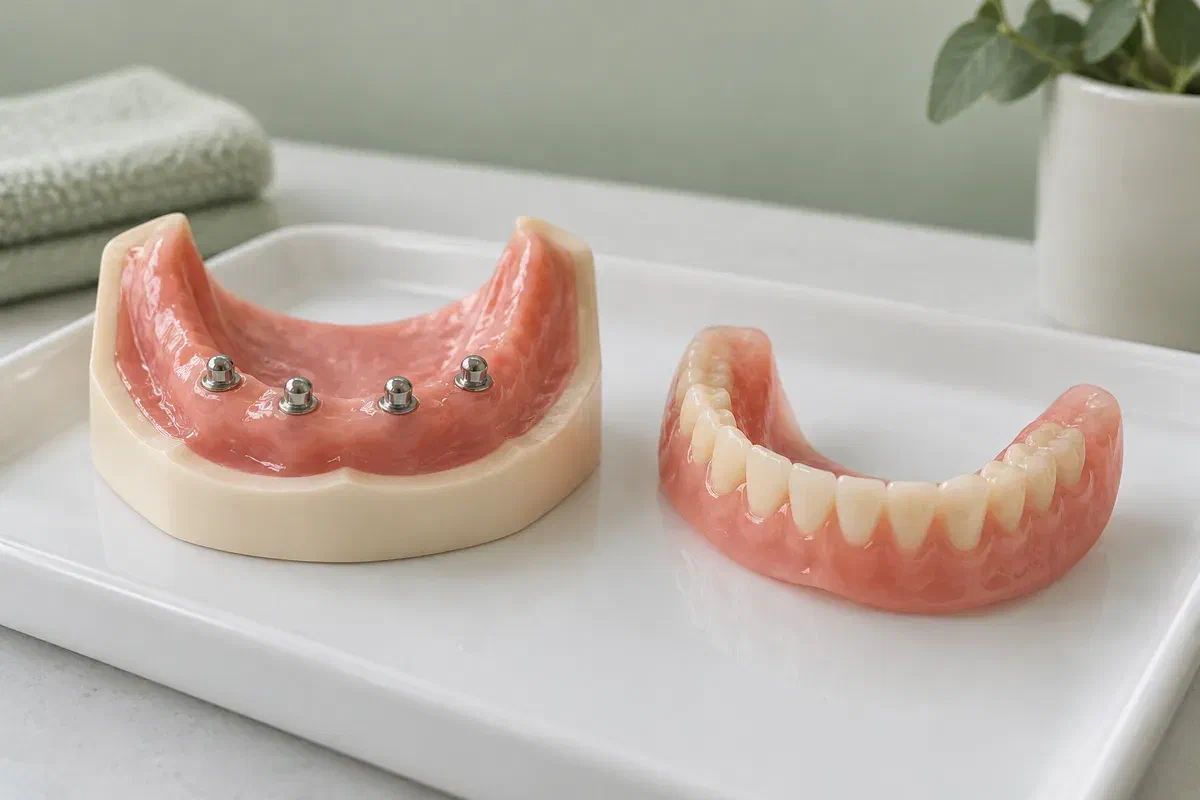
Illustrative lower-jaw model with four small attachment heads and a removable denture
What families tend to notice

Small changes at the table can say a lot.

There are several reasons a denture stops working well. Attachments can add retention, yet the appliance still needs a good fit, an even bite and a care routine someone can manage.

Meals eaten without the denture

Note whether it is left out for certain foods, for whole meals or all day. Bring it to the visit regardless. The dentist can check its age, fit and wear to tell whether the denture needs attention or whether implant retention could be worth exploring.

A ridge described as narrow

Thin bone can make implant planning more involved. In some cases a mini implant might be considered, but enough bone and a safe position are still essential. A slimmer implant does not shortcut the review of the surrounding anatomy.

Unclear paperwork

Families sometimes collect several estimates that use the same terms for different designs. Bring them along and ask each provider what the implants are meant to retain, how the denture is removed and what repairs might be needed. Those details, not the headings on the page, guide a fair comparison.

Mini implants are not automatically suitable for an upper denture, a back-tooth crown or a fixed full-arch restoration. Each proposed use needs separate assessment and evidence.

Practical value for the wearer

More hold, if the whole plan fits daily life

When a lower overdenture is chosen with care, attachments on mini implants may help it stay down during eating and talking. The gums typically still carry part of the support. Ask what the attachments would change and which aspects of comfort would still depend on the denture base.

Narrow implants have boundaries. Their strength, the bite forces and the space available for the denture all matter. A sound recommendation explains why the design suits this restoration, rather than presenting smaller size as better by default.

Patient information: ITI — narrow implant indications and limitations

A goal everyone understands

It could be eating dinner with the family again without leaving the denture on the counter. A shared, clear goal helps the dentist say whether added retention would make that realistic.

Someone must handle the cleaning

The overdenture comes out daily so the mouth, attachments and appliance can be cleaned. Ask for a demonstration for both the patient and any helper, then judge honestly whether the routine is manageable.

Every option on the table

Compare treatment with mini implants and without, including denture work, maintenance and replacement parts. Seeing them together helps families plan for the years after surgery.

How care is organised

One plan, four appointments to understand

Ask which stages are proposed, who carries out each one and how the denture is managed between them. Timing is guided by the examination.

  1. Hear the full story

    We review denture history, medical conditions, oral health and expectations. Please share smoking, grinding, all medications and any past implants. Tell us what is hardest, whether meals, cleaning or getting the denture in and out.

  2. Assess bone and plan positions

    Imaging and records may be required to check bone and design the restoration. The dentist explains the suggested number and type of implants, risks, alternatives and whether a referral is advised. Mini implants still need this step.

  3. Surgery and the healing weeks

    If the plan proceeds, placement is surgery, with comfort and aftercare individualised. The denture may connect quickly or wait for healing. Make sure everyone involved knows what may be worn and eaten in this period.

  4. Fitting and a hands-on lesson

    The denture and attachments are checked together. The patient, and a helper if needed, practises inserting, removing and cleaning under guidance. Book the advised reviews and note whom to contact if hold or comfort changes.

Support at home

Make the routine work for whoever does it.

Instructions should cover healing and long-term wear. Keep them visible at home, especially when more than one person helps with care.

Stick to the wearing guidance

Use the denture only as instructed after surgery and during adjustment. Clicking onto the implants does not mean it is ready for ordinary chewing. Call if anyone is unsure about eating or removal.

Practise reaching every implant

Ask us to show how to clean around the implant heads and inside the denture without damaging the housings. Tell us about limited grip, eyesight or memory so we can suggest aids that fit the situation.

Watch for loosening

If the denture starts lifting again, attachments, fit or other parts may need attention. Avoid bending or repairing anything at home. Bring the denture and any piece that has come off.

Patient information: Cambridge University Hospitals — implant treatment and maintenance

Choosing together

Think about the denture and the years that follow.

Anatomy, health, the restoration wanted and the care it needs all influence the choice. Ask about the trade-offs for this particular person.

If surgery is not preferred

Improve the current denture

Adjusting, relining or remaking the denture may solve some issues without implants. The examination shows what is likely. Ask which concerns would improve and which limits would stay with a conventional denture.

In an appropriate case

Mini implant overdenture

This may be discussed for a suitable lower denture. Confirm how it will be supported and retained, the state of the base and the upkeep required. Do not decide on implant width alone.

When a different restoration fits

Another implant design

Standard implants or other arrangements may better handle the expected load. Additional procedures or a specialist could be involved. Ask why one approach suits this mouth better than another.

Questions from Brampton families

What relatives and patients want to know

Similar-sounding plans can involve different dentures, surgery and long-term responsibilities. A consultation helps everyone compare them.

(905) 876-4488
Can a family member attend the consultation?
Yes, with the patient’s agreement. A relative can help share history, ask questions and learn the cleaning routine. The patient’s own wishes and consent remain central to every decision about treatment.
What if my parent cannot remove the denture alone?
Tell us at the first visit. Handling ability affects whether an overdenture is practical and which design might suit. The team can demonstrate techniques for a helper, and the dentist may discuss alternatives if daily removal would be too difficult.
Is the lower denture fixed in permanently after mini implants?
An overdenture on mini implants is usually removable for cleaning. The implants stay in the jaw and the denture clips on. Confirm the design proposed, as the word implant alone does not show whether the teeth come out.
Do medications or health conditions matter for this surgery?
They can. Some medications and conditions affect healing or bleeding. Bring a current medication list, and the dentist may coordinate with the patient’s physician before any surgery is arranged.
What ongoing maintenance should we budget time for?
Plan for regular reviews, professional cleaning, occasional denture adjustments and replacement of worn attachment parts. Ask who supplies compatible parts and what happens if the denture needs remaking. Writing these into a shared family calendar can make the commitment easier to manage.
How can we reduce trips from Brampton?
Ask for an outline of the likely appointments at the start so you can coordinate drivers and schedules. Some visits can be planned back to back, while healing sets the timing of others. Call before travelling if a problem seems urgent.
Arranging a visit from Brampton

Come together, bring the denture.

Visit our Bronte Street practice with the current appliance, a medication list and whoever helps day to day. We start with suitability, the full restoration and your family’s questions.

Please phone us about an existing implant that is painful or moving. Online requests are for non-urgent visits.

Visit Milton Dental Clinic
Unit 1, 342 Bronte St. S, Milton, ON L9T 5B7
Get directions Clinic hours
Monday–Thursday
11am–7pm
Friday–Sunday
By appointment only

Areas we serve

  • Milton
  • Oakville
  • Mississauga
  • Georgetown
  • Halton Hills
  • Acton
  • Campbellville
  • Brampton
  • Burlington
  • Puslinch
  • Rockwood
  • Erin
  • Caledon
  • Etobicoke
  • Old Milton
  • Bronte Meadows
  • Timberlea
  • Dorset Park
  • Dempsey
  • Clarke
  • Beaty
  • Coates
  • Harrison
  • Scott
  • Willmott
  • Ford
  • Bowes
  • Cobden
  • Walker
  • Mountain View
  • Milton Heights
  • Hawthorne Village
  • Valley View
  • Fallingbrook
  • Nassagaweya
  • Trafalgar
  • Esquesing
  • Nelson
  • Brookville
  • Moffat
  • Glen Williams
  • Norval
  • Limehouse
  • Stewarttown
  • Ashgrove
  • Hornby
  • Silver Creek
  • Speyside
  • Scotch Block
  • North Oakville
  • River Oaks
  • Glen Abbey
  • West Oak Trails
  • Palermo
  • Bronte Creek
  • College Park
  • Joshua Creek
  • Uptown Core
  • Preserve
  • Iroquois Ridge
  • Lisgar
  • Meadowvale
  • Meadowvale Village
  • Churchill Meadows
  • Erin Mills
  • Central Erin Mills
  • Streetsville
  • East Credit
  • Creditview
  • Heartland
  • Sheridan
  • Mount Pleasant
  • Credit Valley
  • Huttonville
  • Churchville
  • Springbrook
  • Northwest Brampton
  • Bram West
  • Fletcher's Meadow
  • Fletcher's Creek South
  • Alton Village
  • Orchard
  • Millcroft
  • Headon Forest
  • Tansley
  • Brant Hills
  • Tyandaga
  • Kilbride
  • Lowville
  • Aberfoyle
  • Morriston
  • Arkell
  • Hillsburgh
  • Freelton
  • Carlisle
  • Waterdown
  • Flamborough
  • Mountsberg

How can we help?

Milton Dental Clinic

Have a question about your smile? Choose the option that works best for you.

For urgent dental concerns, please call.
Messages are reviewed during clinic hours.