

Illustrative discussion of denture retention with a patient and dentist
Restorative Dentistry

Mini Dental Implants in Caledon

Medications, health conditions and healing all shape whether implant surgery is right for you. From Caledon, we review your medical picture alongside your lower denture before discussing mini implant support.

Health first, from Caledon

Your medical history is part of the implant plan.

A list of prescriptions, a recent diagnosis or a history of slow healing can all affect how implant surgery is planned. That is easy to overlook when the focus is a lower denture that keeps lifting. Mini dental implants are thin implants reserved for certain restorative jobs, one of which is helping retain a complete lower denture. They are not a lighter form of every implant procedure, and their size does not make medical review less important.

The assessment therefore covers your general health as well as your mouth. The dentist looks at the denture you would wear, the bone, your bite and your ability to clean attachments, then considers medications, conditions and healing. Sometimes that leads to coordinating with your physician before any decision.

For households in Caledon, from Bolton to the smaller villages, a first visit at our Bronte Street practice can start with an up-to-date medication list and your current denture. The dentist will explain what the examination shows, the alternatives and whether a specialist would be better placed to provide part of the care.

Discuss your health and options
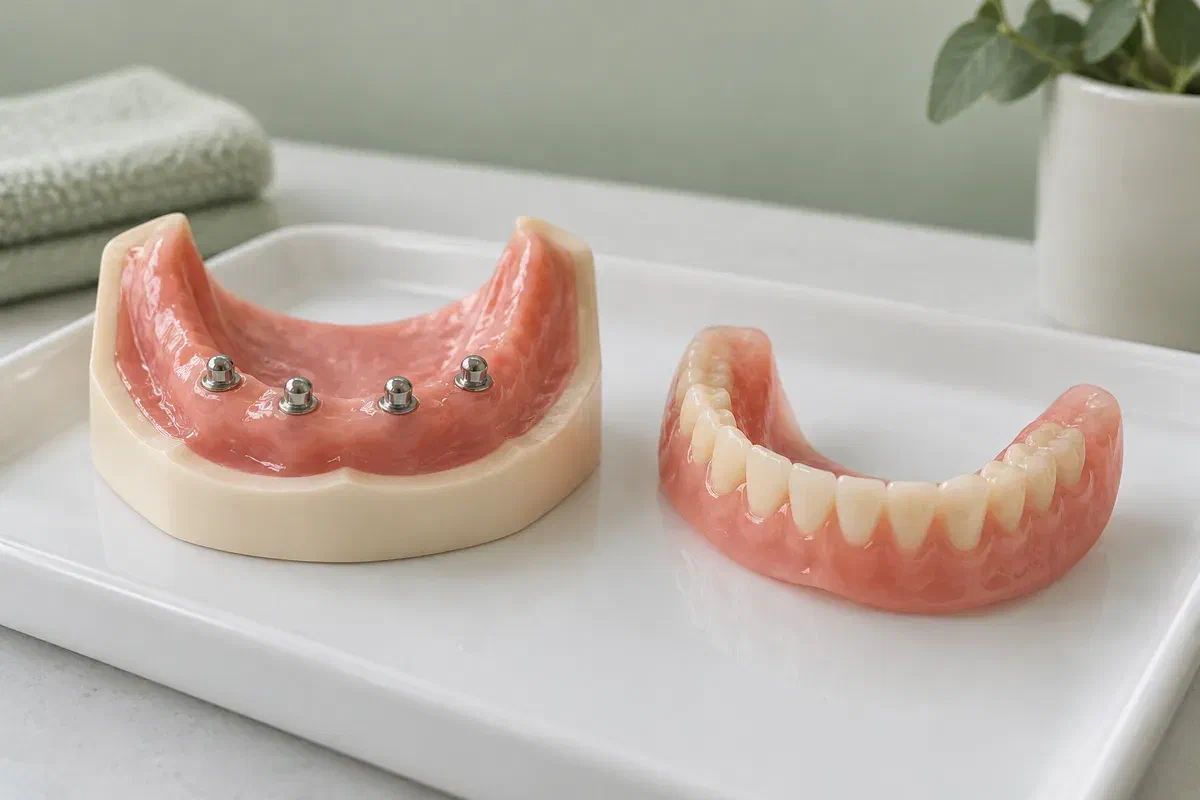
Illustrative lower-jaw model with four small attachment heads and a removable denture
Why the conversation begins

A loose denture, and a health history to consider

Denture problems have several causes. Attachments can add retention, though the appliance still needs a sound fit, a level bite and a care routine that works for you.

A lower denture that lifts

Describe when it moves and whether it changed after an illness or weight change. Bring the denture even if it is now unused. Its fit and condition help the dentist separate a denture issue from a case where implant retention might be discussed.

A narrow ridge

Years without natural lower teeth can leave the ridge thin, and that makes implant planning harder. Sometimes a slimmer implant is put forward for exactly this reason. Even so, imaging must confirm that the bone can hold it and that a safe path exists, and conditions affecting bone health are part of that judgement.

A plan that skipped medical questions

If a proposal was made without a full health review, that is worth noting. Bring it and ask what the implants would support, how the denture is removed and how your medications were considered. Those details matter.

Putting narrow implants under an upper denture, a single molar crown or a fixed bridge across the whole arch is a different proposition. Any of those would call for its own workup and a clear explanation of the evidence.

Potential gains, considered carefully

Retention can help when health and design both allow.

In a suitable lower overdenture, attachments on mini implants may help prevent unwanted lifting. The gums usually still share support. Ask what would improve for you, and which aspects would continue to depend on the base and your ridge.

Narrow implants carry limits. Strength, bite forces and space for the denture all need planning, and so does healing. A trustworthy recommendation explains why this design suits your restoration and your health rather than presenting small size as a universal benefit.

Patient information: ITI — narrow implant indications and limitations

A practical goal

It might be eating comfortably at a family gathering without the denture shifting. A specific aim helps the dentist explain whether retention would address it and whether surgery is reasonable for you.

Daily removal and cleaning

You take an overdenture out each day to clean your mouth, the attachments and the appliance. Ask for a demonstration and consider whether health or dexterity could make the routine difficult.

Options with and without surgery

Compare the complete treatment with mini implants and without them, including denture work, maintenance and parts. For some people, a non-surgical approach may be the more sensible choice.

A medically informed pathway

Check health, plan the denture, then decide.

Ask which stages are suggested, who will provide them and how your denture is handled between visits. Timing depends on your findings and health.

  1. Review medical and dental history

    We discuss your dentures, health conditions, medications, gums and goals. Mention smoking, grinding, blood thinners, bone medications and past implants. Tell us what you find hardest with eating, cleaning or handling.

  2. Imaging and coordination

    X-rays or scans may be needed to evaluate bone and plan the restoration. The dentist explains the proposed implants, risks and alternatives, and may contact your physician or suggest a referral before surgery.

  3. Placement with planned recovery

    If treatment proceeds, placement is a surgical procedure with comfort and aftercare suited to your health. The denture may attach soon or after healing. Confirm what you may wear and eat, and how to take regular medications.

  4. Fitting and ongoing reviews

    The denture and attachments are assessed together, and you practise inserting, removing and cleaning with guidance. Keep the recommended reviews, and tell us about any change in health or medications along the way.

After placement

Healing well, then maintaining well

Ask for instructions that cover healing and everyday wear. Keep them with your medication list, especially if someone helps you at home.

Follow the wearing plan

Use the denture only as instructed after surgery and while adjusting. Clipping on firmly is not a sign it is ready for regular meals. Phone us if any guidance about eating or removal is unclear.

Clean gently and thoroughly

Healing gums can be tender, so ask the team to demonstrate a gentle technique for the implant posts and the fitting surface of the denture that will not wear the housings. If grip, eyesight or a health condition makes this tiring, we can look at simpler aids together.

Keep us informed

If the denture loosens, attachments or fit may need attention. Avoid home repairs. Tell us about new diagnoses or medication changes at every visit, since they can matter for implant health.

Patient information: Cambridge University Hospitals — implant treatment and maintenance

Weighing the approaches

Surgical or not, and which design?

Your jaw, health, the restoration you want and its maintenance all shape the right choice. Ask which trade-offs matter most for you.

A non-surgical route

Improve the conventional denture

For someone managing several health conditions, a reline, an adjustment or a carefully made new denture may be the gentler first step. It avoids surgery and healing altogether. Ask how much improvement is likely and which frustrations a removable denture on its own would still leave.

For a selected lower case

Mini implant overdenture

When your health, ridge and denture all line up, this approach may be put forward. Find out how the attachments and gums would share the work, whether your existing base is sound enough and what upkeep to plan for. Slimness alone is a poor reason to pick it.

When a different design fits

Other implant arrangements

Wider implants or a different restorative layout may cope better with the forces involved, sometimes with added procedures or a specialist taking part. Ask the dentist to explain the reasoning behind whichever approach they favour for you.

Health and planning questions

Medical questions, plainly answered

Treatments with similar names can involve different dentures, procedures and long-term care. Discussing your health helps refine the plan.

(905) 876-4488
Do I need to stop blood thinners before mini implant surgery?
Never stop a prescribed medication on your own. Tell the dentist what you take, and they may consult your physician about how to plan surgery safely. Instructions depend on your medication and health.
Can I have mini implants if I have diabetes?
Diabetes can affect healing, so how well it is managed matters. Share your health details, and the dentist may discuss coordination with your physician. Each case is assessed individually.
Do bone-strengthening medications affect implant treatment?
Some medications used for bone conditions can be relevant to oral surgery. Mention any you take now or have taken before. The dentist can explain whether this affects planning or calls for specialist input.
Is a mini implant denture removable?
In the overdenture design most often used with narrow implants, it is. The posts remain anchored in bone, and you unclip the appliance to clean it and your gums. Other implant restorations can be fixed, so check which kind is actually on the table before you agree to anything.
What ongoing appointments should I expect?
Plan on periodic check-ups where the gums around the implants, the attachment parts and the denture fit are reviewed. Worn retention inserts get swapped out from time to time, and the denture may need relining or eventually remaking. Ask where compatible parts come from so maintenance stays straightforward.
How can I keep travel from Caledon manageable?
Ask for an outline of the stages at your first appointment and group visits where healing allows. Call before driving in if something changes suddenly, and seek emergency care for serious swelling.
Visiting from Caledon

Bring your medication list and your denture.

Visit our Bronte Street practice with your current appliance and health details. We will look at suitability, the complete restoration and your questions before any implant decision.

If an existing implant is painful or moving, please phone us. Online requests are for non-urgent appointments.

Visit Milton Dental Clinic
Unit 1, 342 Bronte St. S, Milton, ON L9T 5B7
Get directions Clinic hours
Monday–Thursday
11am–7pm
Friday–Sunday
By appointment only

Areas we serve

  • Milton
  • Oakville
  • Mississauga
  • Georgetown
  • Halton Hills
  • Acton
  • Campbellville
  • Brampton
  • Burlington
  • Puslinch
  • Rockwood
  • Erin
  • Caledon
  • Etobicoke
  • Old Milton
  • Bronte Meadows
  • Timberlea
  • Dorset Park
  • Dempsey
  • Clarke
  • Beaty
  • Coates
  • Harrison
  • Scott
  • Willmott
  • Ford
  • Bowes
  • Cobden
  • Walker
  • Mountain View
  • Milton Heights
  • Hawthorne Village
  • Valley View
  • Fallingbrook
  • Nassagaweya
  • Trafalgar
  • Esquesing
  • Nelson
  • Brookville
  • Moffat
  • Glen Williams
  • Norval
  • Limehouse
  • Stewarttown
  • Ashgrove
  • Hornby
  • Silver Creek
  • Speyside
  • Scotch Block
  • North Oakville
  • River Oaks
  • Glen Abbey
  • West Oak Trails
  • Palermo
  • Bronte Creek
  • College Park
  • Joshua Creek
  • Uptown Core
  • Preserve
  • Iroquois Ridge
  • Lisgar
  • Meadowvale
  • Meadowvale Village
  • Churchill Meadows
  • Erin Mills
  • Central Erin Mills
  • Streetsville
  • East Credit
  • Creditview
  • Heartland
  • Sheridan
  • Mount Pleasant
  • Credit Valley
  • Huttonville
  • Churchville
  • Springbrook
  • Northwest Brampton
  • Bram West
  • Fletcher's Meadow
  • Fletcher's Creek South
  • Alton Village
  • Orchard
  • Millcroft
  • Headon Forest
  • Tansley
  • Brant Hills
  • Tyandaga
  • Kilbride
  • Lowville
  • Aberfoyle
  • Morriston
  • Arkell
  • Hillsburgh
  • Freelton
  • Carlisle
  • Waterdown
  • Flamborough
  • Mountsberg

How can we help?

Milton Dental Clinic

Have a question about your smile? Choose the option that works best for you.

For urgent dental concerns, please call.
Messages are reviewed during clinic hours.