

Illustrative discussion of denture retention with a patient and dentist
Restorative Dentistry

Mini Dental Implants in Etobicoke

Mini implant care for a lower denture unfolds over several stages. Travelling from Etobicoke, it helps to know the sequence early, keep visits well organised and understand when nearer urgent care makes sense.

Planning treatment from Etobicoke

Map the whole journey before the first appointment.

Implant-supported dentures are rarely a single visit, so it pays to see the route in advance. Mini dental implants are very narrow implants used for selected restorative purposes. A common one is improving the hold of a complete lower denture. They are not a pared-down version of all implant work, and their size alone does not show whether they belong in your mouth.

The plan should begin with what the finished denture must do for you. Perhaps it lifts when you laugh, or you have heard a slim implant could suit a thin ridge. Either way, the dentist assesses the denture you would wear, the bone, how your teeth meet and how well you could clean attachments at home.

Because Etobicoke is the longest trip many people make to our Bronte Street practice, we try to keep appointments purposeful. Bring your denture, medication list and past records to the first visit. We will set out the likely stages, the alternatives and whether a specialist nearer home might be a better fit for part of the care.

Plan your visits with us
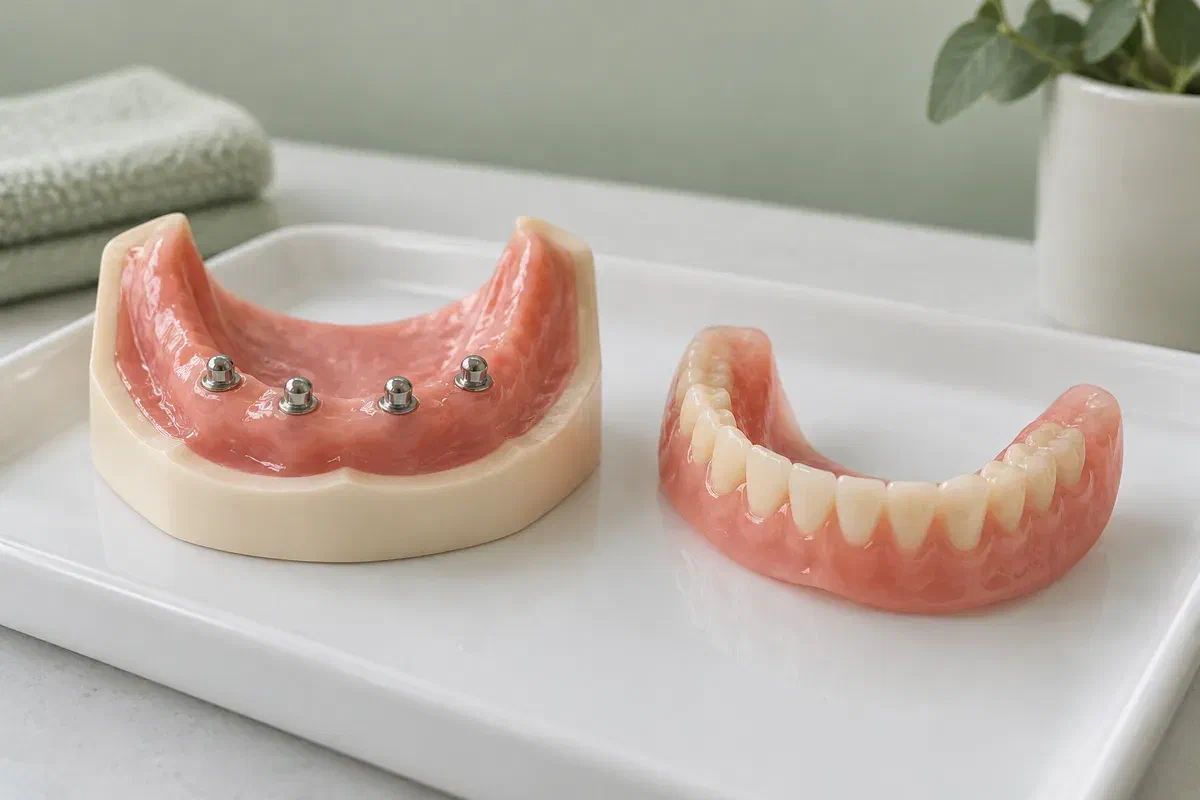
Illustrative lower-jaw model with four small attachment heads and a removable denture
Reasons to look into it

Before you travel, pin down the problem.

A denture can misbehave for several reasons. Added retention may help, but only if the appliance also fits well, meets the bite evenly and suits the cleaning you can manage.

Lifting at mealtimes or mid-sentence

Jot down when it lifts and whether it changed recently, then bring the appliance even if it lives in a case now. Its age, outline and fit let the dentist tell whether a denture correction might be enough or implant retention could reasonably be considered.

A thin ridge you were warned about

Limited width can make implants harder to place. A slim implant can be an option in particular cases, provided bone volume and a safe position are confirmed. Narrowness never removes the need to study the nearby structures closely.

A plan you cannot quite decode

Similar terms get attached to unlike systems. Bring the written plan and ask what each implant supports, how you lift the denture out and what upkeep lies ahead. Those answers are far more useful than the product name.

Mini implants are not a standard choice for an upper denture, a molar crown or a fixed full-arch bridge. Any of those would need a separate assessment and supporting evidence.

What you could gain

Steadier dentures, when the case is right

With a well-chosen lower overdenture, attachments on mini implants may help it resist being lifted by the tongue or sticky food. The gums commonly go on sharing the support. Ask which aspects of comfort the attachments would change and which would continue to rest on the denture base and ridge.

Narrow designs come with constraints. Strength, bite load and room for the denture all have to be planned. A thoughtful proposal explains why this design suits your restoration instead of assuming slimmer is better in every situation.

Patient information: ITI — narrow implant indications and limitations

One outcome to aim for

You might want to get through a restaurant meal without excusing yourself to adjust the denture. A specific aim lets the dentist explain whether more retention would actually achieve it.

A removable routine at home

Overdentures come out daily for cleaning of the mouth, attachments and appliance. Try the handling during a demonstration and decide whether it fits your dexterity, since you will be doing it far from the clinic.

A full comparison up front

Review the plan with mini implants and without them, including denture work, upkeep and part replacement. Knowing the long-term commitment helps you weigh the travel as well as the treatment.

A sequence you can schedule

Fewer trips, each with a clear job

Ask how many stages are likely, who performs them and how the denture is handled in between. Exact timing depends on what the examination finds.

  1. A thorough first visit

    We cover your denture history, health, gums and expectations in one sitting where possible. Mention smoking, grinding, medications and earlier implants. Describe what is hardest for you, from chewing to cleaning to handling the denture.

  2. Records and a written plan

    Imaging may be taken to evaluate bone and design the restoration, ideally at the same visit if practical. You will hear the proposed number and type of implants, the risks, alternatives and any referral advice. Slim implants still need this planning.

  3. Placement and healing at home

    If you proceed, placement is surgery with tailored comfort and aftercare. Depending on findings, the denture may connect soon or after healing. Before leaving, confirm what to wear and eat and whom to call if you have concerns.

  4. Fitting and spaced reviews

    The denture and attachments are assessed together, and you practise inserting, removing and cleaning under supervision. Discuss a review schedule that balances clinical needs with your travel, and clarify the contact plan if hold or comfort changes.

Managing care far from the chair

Your instructions should travel with you.

Ask for written guidance on healing and long-term use. Keep it at home where you, and anyone who helps you, can easily check it.

Hold off on normal chewing

Wear and load the denture only as advised after surgery and during adaptation. Feeling it click on does not mean it is ready for everyday meals. Phone us if you are uncertain about food or removal.

Get the cleaning technique right early

Ask the team to show you how to clean around the implant heads and inside the denture without damaging its housings. Mention hand or vision difficulties. Getting this right at the fitting saves extra trips later.

Call before driving in

If the denture loosens, the attachments, fit or other parts may need work. Avoid DIY repairs or bending parts. Phone first so we can judge whether a visit is needed, then bring the denture and any loose piece.

Patient information: Cambridge University Hospitals — implant treatment and maintenance

Comparing the approaches

Which kind of support fits your life?

Anatomy, health, the restoration you want and its maintenance all count. Ask which trade-offs are most relevant to you, including how often each option needs visits.

No surgery required

A better conventional denture

Adjusting, relining or remaking a denture can solve some issues without implants. The examination shows what is realistic. Ask which problems would ease and which would remain with a standard removable appliance.

For a suitable lower denture

Mini implant overdenture

This may be raised when the case fits. Confirm the planned support and retention, the condition of the denture base and the maintenance ahead. Diameter alone is never a sound basis for choosing.

When the plan needs more strength

Standard implants or other restorations

Wider implants or a different restorative design may suit the load better, possibly with added procedures or specialist input. Ask why one option is recommended for your mouth over the others.

Travelling from Etobicoke

Questions about stages, timing and care

Plans with similar labels can differ in the denture, the surgery and the upkeep they demand. Talking it through helps you compare.

(905) 876-4488
How many appointments does mini implant treatment usually involve?
It varies with your findings and plan. Expect at least a consultation, records, placement, fitting and reviews, though some steps may be combined. Ask for an outline at the first visit so you can plan time off and travel.
What should I do if a problem starts on a weekend?
Call us first so we can advise. If you have swelling that affects breathing or swallowing, seek emergency medical care at the nearest hospital. For other concerns, we may suggest whether you need to be seen and how soon.
Can the denture be used while the implants heal?
Sometimes, with changes or restrictions, and sometimes not in the usual way. It depends on the plan and findings. Confirm what you may wear and eat before the surgical visit, so nothing is guessed at home.
Are mini and short implants the same thing?
No. Mini refers to a narrow diameter and short to length, and each affects planning differently. Ask which design is proposed and why its dimensions suit your bone. Neither term guarantees an easier procedure.
Would heavy biting rule out mini implants for me?
Not automatically, but it matters. Tell the dentist about grinding, broken dentures or worn teeth. Heavy forces may change the number or type of implants recommended, or point toward another option.
Who supplies replacement attachment parts later?
Ask at the start. Retention parts wear and may need replacing, and they must be compatible with your implant system. Knowing the supplier and the process makes long-distance maintenance simpler.
Booking from Etobicoke

Make the first trip count.

Bring your current denture, a medication list and any past records to our Bronte Street practice. We will review suitability and the whole restoration, then map out the visits ahead.

For an existing implant that is painful or moving, please phone. Online requests are for non-urgent consultations.

Visit Milton Dental Clinic
Unit 1, 342 Bronte St. S, Milton, ON L9T 5B7
Get directions Clinic hours
Monday–Thursday
11am–7pm
Friday–Sunday
By appointment only

Areas we serve

  • Milton
  • Oakville
  • Mississauga
  • Georgetown
  • Halton Hills
  • Acton
  • Campbellville
  • Brampton
  • Burlington
  • Puslinch
  • Rockwood
  • Erin
  • Caledon
  • Etobicoke
  • Old Milton
  • Bronte Meadows
  • Timberlea
  • Dorset Park
  • Dempsey
  • Clarke
  • Beaty
  • Coates
  • Harrison
  • Scott
  • Willmott
  • Ford
  • Bowes
  • Cobden
  • Walker
  • Mountain View
  • Milton Heights
  • Hawthorne Village
  • Valley View
  • Fallingbrook
  • Nassagaweya
  • Trafalgar
  • Esquesing
  • Nelson
  • Brookville
  • Moffat
  • Glen Williams
  • Norval
  • Limehouse
  • Stewarttown
  • Ashgrove
  • Hornby
  • Silver Creek
  • Speyside
  • Scotch Block
  • North Oakville
  • River Oaks
  • Glen Abbey
  • West Oak Trails
  • Palermo
  • Bronte Creek
  • College Park
  • Joshua Creek
  • Uptown Core
  • Preserve
  • Iroquois Ridge
  • Lisgar
  • Meadowvale
  • Meadowvale Village
  • Churchill Meadows
  • Erin Mills
  • Central Erin Mills
  • Streetsville
  • East Credit
  • Creditview
  • Heartland
  • Sheridan
  • Mount Pleasant
  • Credit Valley
  • Huttonville
  • Churchville
  • Springbrook
  • Northwest Brampton
  • Bram West
  • Fletcher's Meadow
  • Fletcher's Creek South
  • Alton Village
  • Orchard
  • Millcroft
  • Headon Forest
  • Tansley
  • Brant Hills
  • Tyandaga
  • Kilbride
  • Lowville
  • Aberfoyle
  • Morriston
  • Arkell
  • Hillsburgh
  • Freelton
  • Carlisle
  • Waterdown
  • Flamborough
  • Mountsberg

How can we help?

Milton Dental Clinic

Have a question about your smile? Choose the option that works best for you.

For urgent dental concerns, please call.
Messages are reviewed during clinic hours.