

Illustrative discussion of denture retention with a patient and dentist
Restorative Dentistry

Mini Dental Implants in Oakville

“Mini” can sound quicker, cheaper or simpler. For people in Oakville comparing implant proposals, we explain what narrow implants actually do, where they may help a lower denture and where they do not fit.

Reading past the label

Small implant, same careful planning

You may have seen mini implants advertised as a lighter alternative to conventional ones. The reality is narrower than the marketing. These are very slim implants used for chosen restorative purposes, such as helping to hold a complete lower denture. They do not shrink every implant treatment into a simpler version, and the word mini says nothing about whether they suit you.

A better starting point is the denture you need to work well. Do you want it to stay put while you talk, or were you told your ridge is too thin for standard implants? Either way, the dentist must first study the planned denture, the bone, your bite and whether you can keep attachments clean before naming a design.

Coming from Oakville, you can bring the proposals you have gathered and your current denture to our Bronte Street practice. We will help you read them side by side, explain the assessment and point out alternatives. If specialist planning would serve you better, we will say so plainly.

Have your proposal reviewed
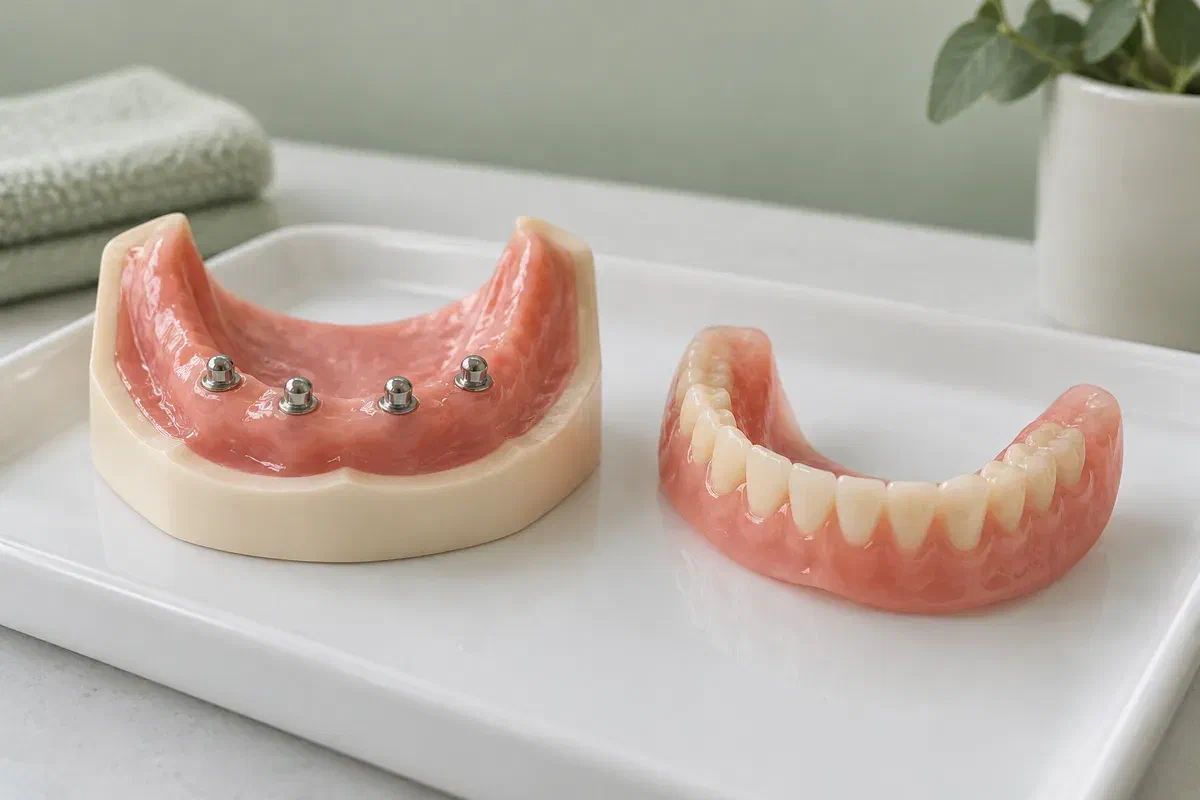
Illustrative lower-jaw model with four small attachment heads and a removable denture
Typical starting points

Three situations, more than one possible answer

Knowing why a denture misbehaves comes first. Attachments may add hold, but the appliance still has to fit properly, meet the bite evenly and be easy for you to maintain.

A lower denture that will not settle

Notice whether it moves when you speak, chew or yawn, and whether anything changed recently. Bring the denture even if you have given up on it. Its condition helps the dentist decide between a denture fix and a case where implant retention might be discussed.

Concern about limited bone width

A thin ridge can make implants harder to plan. A narrow implant may be possible in selected cases, but adequate bone and a safe angle are still non-negotiable. Reduced diameter never replaces a proper review of the anatomy around it.

Two quotes that do not match

Clinics may use the same name for quite different systems. Bring every written plan and ask what each set of implants would hold, how the denture is removed and what upkeep or repairs to expect. Comparing details is more revealing than comparing titles.

A narrow implant is not automatically suited to an upper denture, a molar crown or a fixed full-arch restoration. Each use has to be assessed separately and backed by evidence.

The honest benefit

Retention can improve when the design fits your mouth.

For a lower overdenture that has been selected with care, attachments on mini implants may reduce unwanted lifting. Your gums may still carry some of the load. Ask the dentist to spell out what the attachments would improve and what would continue to depend on the denture base and your ridge.

Choosing a slimmer implant involves compromises. Mechanical strength, the force of your bite and the room available for the denture must all be weighed. A sound proposal explains why the design fits your restoration instead of treating small size as automatically better.

Patient information: ITI — narrow implant indications and limitations

A specific goal to test against

Tell us the change you hope for, such as chatting at dinner without pushing the denture back. A clear goal lets the dentist explain whether the proposed retention would deliver it.

Daily removal and cleaning

An overdenture is taken out for cleaning of the mouth, attachments and appliance. Ask to try the handling yourself during a demonstration so you can judge whether it suits your hands and schedule.

A fair comparison

Review the full treatment both with mini implants and without them, counting denture work, maintenance and future part replacement. Seeing the whole picture helps you judge an offer on more than the surgery.

What a careful plan looks like

Restoration first, implants second

Find out the stages proposed, who performs each one and how your denture is handled between visits. Timing is set by what the examination reveals.

  1. An unhurried first consultation

    We discuss your denture history, general health, gum health and goals. Mention smoking, grinding, medications and any implants you already have. Describe the moments that frustrate you, whether eating, cleaning or simply putting the appliance in.

  2. Imaging and implant positions

    Scans or X-rays may be required to examine the bone and plan the denture. You will learn the suggested number and type of implants, the risks, the alternatives and whether a referral makes sense. Slim implants do not skip this stage.

  3. Placement, then healing

    If you proceed, the implants are placed surgically, with comfort and aftercare planned individually. The denture may connect soon or after a healing period, depending on the findings. Ask what you can wear and eat in the meantime.

  4. Fit, practise and return for reviews

    The attachments and denture are checked together. You practise inserting and removing it with support and learn the cleaning steps. Arrange the advised reviews and confirm whom to call if comfort or hold changes.

Caring for the new setup

Tiny attachments, daily attention

Ask for instructions that cover the early healing phase and long-term wear. Keep them where you and anyone who helps you can find them easily.

Respect the early limits

Wear and use the denture only as instructed after surgery and while you adapt. Snapping onto the implants does not make it ready for normal chewing. Check with us if anything about eating or removal is unclear.

Master the cleaning reach

Have the team walk you through cleaning each implant head and the denture without harming the housings. Mention any trouble with grip or vision, because choosing aids you can use is part of making the plan workable.

Report weaker hold

A looser denture can signal worn attachments, a change in fit or another component issue. Please avoid home repairs or bending parts. Bring the denture and anything that has come loose so we can find the cause.

Patient information: Cambridge University Hospitals — implant treatment and maintenance

Options to compare from Oakville

Look at the full appliance over time.

Anatomy, health, the restoration you want and the care it needs all influence the choice. Ask for the trade-offs that apply to your own mouth.

If you prefer to avoid surgery

Improve the conventional denture

Relining, adjusting or replacing the denture can settle some problems without implants. The examination shows what is achievable. Ask what would improve and what limits would remain with a standard removable denture.

For a well-selected lower case

Mini implant overdenture

This may be considered for a suitable lower denture. Confirm how support and retention are planned, the state of the denture base and future maintenance. Never decide on diameter alone.

When the load calls for more

Wider implants or a different plan

Standard-diameter implants or another restorative design may handle the planned load better. Additional procedures or a specialist may be involved. Ask why one route is recommended over the other for you.

Comparing proposals

Questions that cut through the marketing

Offers that share a name can involve different dentures, procedures and responsibilities. A consultation helps you see those differences.

(905) 876-4488
Is mini just another word for short when it comes to implants?
No. Mini describes a slim diameter, and short describes length. They influence planning differently. Ask which design is suggested and why its dimensions match your bone and restoration, rather than assuming either means less involved treatment.
What should I ask when two clinics quote different numbers of implants?
Ask each one why that number was chosen, what the implants would retain and how the forces are shared. The answer should relate to your bone, denture design and bite. Differences in count often reflect different designs, not just price.
Are mini implant dentures removable or fixed?
A mini implant overdenture is generally removable by you for cleaning. The implants stay in the jaw while the denture clips onto them. Check the exact design, because the word implant alone does not tell you whether the teeth come out.
Will the dentist tell me if a different implant would suit me better?
That is part of a fair assessment. If standard implants, a denture remake or specialist care seems more appropriate, it should be explained along with the reasons. You can ask for alternatives in writing so you can compare them calmly.
Does clenching or grinding change the recommendation?
It can. Heavy forces affect narrow components, so tell the dentist about grinding, cracked dentures or worn teeth. The plan might change in design, include protection or point toward another option altogether.
How should I plan appointments if I’m coming from Oakville?
Ask for an outline of how many visits are likely and roughly how they are spaced, then book with your schedule in mind. Our weekday hours run Monday to Thursday. Call rather than drive in if a sudden problem develops.
From Oakville to Bronte Street

Bring the quotes and the denture.

Visit our Bronte Street practice with the appliance you wear and any plans you have been given. We will discuss suitability and the complete restoration so you can decide with all the details in front of you.

Phone us about an existing implant that hurts or moves. Online requests are meant for non-urgent consultations.

Visit Milton Dental Clinic
Unit 1, 342 Bronte St. S, Milton, ON L9T 5B7
Get directions Clinic hours
Monday–Thursday
11am–7pm
Friday–Sunday
By appointment only

Areas we serve

  • Milton
  • Oakville
  • Mississauga
  • Georgetown
  • Halton Hills
  • Acton
  • Campbellville
  • Brampton
  • Burlington
  • Puslinch
  • Rockwood
  • Erin
  • Caledon
  • Etobicoke
  • Old Milton
  • Bronte Meadows
  • Timberlea
  • Dorset Park
  • Dempsey
  • Clarke
  • Beaty
  • Coates
  • Harrison
  • Scott
  • Willmott
  • Ford
  • Bowes
  • Cobden
  • Walker
  • Mountain View
  • Milton Heights
  • Hawthorne Village
  • Valley View
  • Fallingbrook
  • Nassagaweya
  • Trafalgar
  • Esquesing
  • Nelson
  • Brookville
  • Moffat
  • Glen Williams
  • Norval
  • Limehouse
  • Stewarttown
  • Ashgrove
  • Hornby
  • Silver Creek
  • Speyside
  • Scotch Block
  • North Oakville
  • River Oaks
  • Glen Abbey
  • West Oak Trails
  • Palermo
  • Bronte Creek
  • College Park
  • Joshua Creek
  • Uptown Core
  • Preserve
  • Iroquois Ridge
  • Lisgar
  • Meadowvale
  • Meadowvale Village
  • Churchill Meadows
  • Erin Mills
  • Central Erin Mills
  • Streetsville
  • East Credit
  • Creditview
  • Heartland
  • Sheridan
  • Mount Pleasant
  • Credit Valley
  • Huttonville
  • Churchville
  • Springbrook
  • Northwest Brampton
  • Bram West
  • Fletcher's Meadow
  • Fletcher's Creek South
  • Alton Village
  • Orchard
  • Millcroft
  • Headon Forest
  • Tansley
  • Brant Hills
  • Tyandaga
  • Kilbride
  • Lowville
  • Aberfoyle
  • Morriston
  • Arkell
  • Hillsburgh
  • Freelton
  • Carlisle
  • Waterdown
  • Flamborough
  • Mountsberg

How can we help?

Milton Dental Clinic

Have a question about your smile? Choose the option that works best for you.

For urgent dental concerns, please call.
Messages are reviewed during clinic hours.