

Illustrative discussion of denture retention with a patient and dentist
Restorative Dentistry

Mini Dental Implants in Old Milton

A denture you have worn for many years can loosen as your mouth changes. From Old Milton, you can talk with us about whether refitting it, replacing it or adding mini implant support makes sense.

Old Milton and the long-worn denture

An old denture, a changing jaw, and a fresh look at support

Many people keep the same lower denture for a decade or more. Over that time the ridge underneath gradually reshapes, and a denture that once sat firmly may start to rock. That is often the moment someone mentions mini dental implants. They are very slim implants with specific uses, one being to help hold a complete lower denture, and they are not a smaller form of every implant treatment.

Before any implant is discussed, it helps to separate two questions. Is the denture itself still sound, and is the bone able to support attachments safely? The dentist will look at the appliance, your bite, the width and height of the ridge and how easily you could clean small fittings each day.

Old Milton is close to our Bronte Street practice, so an unhurried assessment can be split into visits that suit you. Bring the denture, even a worn one, along with any earlier treatment notes. We will go through realistic choices, including those that do not involve surgery, and say when a specialist view would help.

Talk about your denture’s support
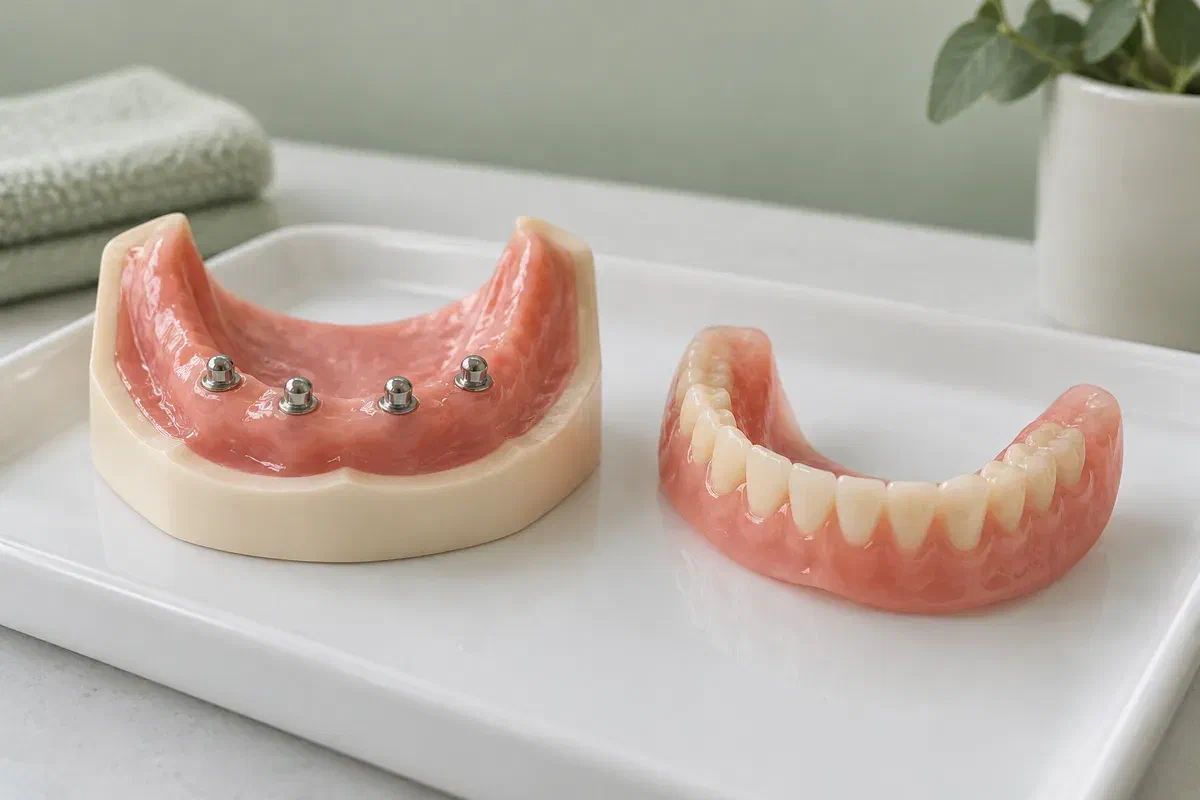
Illustrative lower-jaw model with four small attachment heads and a removable denture
Signs a denture is asking for attention

Loose after years of good service?

Movement can come from the appliance, the ridge beneath it or both. Attachments may add hold, but they cannot make up for a poor fit, an uneven bite or a routine that is hard to manage.

A denture that rocks more than it used to

Think about when the rocking began and whether it is worse with certain foods. Bring the appliance even if you now wear it only for outings. Its age and fit help the dentist decide whether a reline or new denture could help, or whether implant retention deserves a closer look.

A ridge that has thinned over time

Long periods without natural teeth can leave the jaw narrower. Mini implants are occasionally considered in that situation, yet enough bone and a safe placement path are still required. A slimmer design never removes the need to examine nerves, contours and surrounding structures.

Advice that contradicts itself

Friends and advertisements may describe very different treatments with the same words. Bring any proposal you have and ask what the implants would hold, how the denture comes out and what later repairs could involve. Those answers matter more than the label.

Mini implants are not a default answer for an upper denture, a crown on a back tooth or a fixed full-arch bridge. Each of those needs its own evaluation and evidence.

Weighing the potential gain

Steadier, yes. But only with the right denture on top.

When the case is chosen carefully, attachments on mini implants may help a lower overdenture resist lifting. The gums usually still share the work. Ask the dentist what would change for you, and which parts of comfort and chewing would continue to depend on the denture base and the shape of your mouth.

Narrow implants come with limits of their own. Strength, the load from chewing and the vertical room for the denture all have to be planned. Any recommendation should explain why this design fits your restoration rather than presenting slimness as a universal advantage.

Patient information: ITI — narrow implant indications and limitations

Start with one clear wish

You might simply want to eat a sandwich without the lower denture lifting. A specific goal like that helps the dentist explain honestly whether added retention is likely to address it.

Still removable, still cleaned daily

An overdenture is removed daily so the mouth, the attachment points and the appliance can all be cleaned. Ask the team to demonstrate this, and judge whether it suits your dexterity and habits.

Compare more than one route

Look at the whole plan with and without mini implants. Include the denture work, upkeep and replacement parts. Laying the options out together shows you the commitment beyond surgery day.

The path through treatment

Four stages, each planned around the finished denture

Ask what each stage involves, who will provide it and what you will wear in the meantime. The schedule is shaped by your clinical findings, not a set timetable.

  1. A conversation about your history

    We review how your dentures have served you, your general health, your gums and what you expect. Tell us about smoking, night-time clenching, medications and any earlier implant work. Describe what is hardest at meals, during cleaning or when handling the appliance.

  2. Records and a proposed layout

    X-rays or scans may be needed to measure bone and plan the denture. The dentist explains how many implants are suggested, which type, the risks, other options and whether a specialist referral is wise. Slim implants still go through this step.

  3. Surgery and a period of healing

    Placement is a surgical procedure with comfort and aftercare planned for you. Some dentures connect fairly soon, while others wait until healing allows. Make sure you know what you may wear and eat during that stretch.

  4. Fitting and learning the routine

    The denture and its attachments are fitted and checked as a pair. With guidance, you practise seating and removing it and cleaning the implant area. Schedule the advised reviews and note who to contact if the fit or comfort shifts.

After the attachments are in

A new routine for a familiar appliance

You should receive guidance for both the healing period and ordinary daily wear. Keep it handy, especially if a spouse or relative helps you each day.

Keep to the wearing plan

Wear the denture only in the way you were told after surgery and while you adjust. Clicking into place does not mean it is ready for full chewing. Phone us if instructions about eating or removal seem unclear.

Get shown the cleaning angles

Ask the team to demonstrate how to clean around each implant head and inside the denture without damaging the housings. Let us know about stiff fingers or weaker eyesight so we can suggest aids you can handle.

Bring in a denture that slackens

If the hold weakens, attachments, fit or other parts may need attention. Resist bending or gluing anything at home. Bring the denture and any loose piece so the dentist can find the cause.

Patient information: Cambridge University Hospitals — implant treatment and maintenance

Choices for a loose lower denture

Refit, replace or add support?

Your anatomy, health, the restoration you need and the upkeep you can manage all shape the choice. Ask which trade-offs matter most in your case.

A route without surgery

Reline or remake the denture

A reline, adjustment or new denture can resolve some looseness on its own. The examination shows what is likely. Ask which problems would ease and which would remain with a conventional removable appliance.

For a well-suited lower case

Mini implant overdenture

This may be suggested for an appropriate lower denture. Check how support and hold are planned, the condition of the base and the expected maintenance. Diameter by itself is not a reason to choose it.

For a different kind of restoration

Standard implants or another design

Wider implants or another restorative plan may suit the load and teeth better. Grafting or specialist input might be discussed. Ask why one approach is preferred for your mouth.

What long-time denture wearers ask

Questions worth settling first

Treatments that sound alike can differ in the appliance, the surgery and the care they require for years. These answers help you compare them.

(905) 876-4488
My denture is fifteen years old. Is it worth keeping for mini implants?
It depends on its fit, thickness, wear and condition. Some older dentures can be adapted, while others are better replaced. Ask whether a quote covers modifying the current one, making a new one or providing a temporary appliance during treatment.
Why does a lower denture loosen over the years?
After teeth are lost, the jawbone under the gums tends to reshape gradually. A denture made for the earlier shape may no longer sit as well. An examination can show whether a reline, a new denture or added retention is the most sensible next step.
Will narrow implants mean I can skip bone grafting?
Not necessarily. Width is only one factor. Bone height, density, contour and safe placement also count. Ask what the imaging shows, and let the grafting decision follow the assessment instead of a general claim about mini implants.
Am I too old to consider mini dental implants?
Age by itself is not usually the deciding factor. General health, medications, healing, bone and the ability to clean the attachments matter more. Share your full health history so the dentist can discuss whether surgery and long-term care are realistic for you.
Do the attachment parts wear out?
Yes, retention components can wear with daily use and may need replacing at intervals. Ask how often that tends to happen, who supplies compatible parts and what a replacement visit involves, so maintenance does not come as a surprise.
How do I keep up follow-up checks from Old Milton?
Being close by makes regular reviews at the Bronte Street practice easier to fit into a week. Plan around our hours, which run Monday to Thursday, with weekends and Fridays by appointment. Call ahead if something has changed suddenly.
Visiting from Old Milton

Show us the denture you’ve lived with.

Come to our Bronte Street practice with your current appliance and a sense of what you would like to change. We will talk through suitability and the full restoration before anyone recommends implants.

Please call if an implant you already have is painful or loose. Use online booking only for non-urgent visits.

Visit Milton Dental Clinic
Unit 1, 342 Bronte St. S, Milton, ON L9T 5B7
Get directions Clinic hours
Monday–Thursday
11am–7pm
Friday–Sunday
By appointment only

Areas we serve

  • Milton
  • Oakville
  • Mississauga
  • Georgetown
  • Halton Hills
  • Acton
  • Campbellville
  • Brampton
  • Burlington
  • Puslinch
  • Rockwood
  • Erin
  • Caledon
  • Etobicoke
  • Old Milton
  • Bronte Meadows
  • Timberlea
  • Dorset Park
  • Dempsey
  • Clarke
  • Beaty
  • Coates
  • Harrison
  • Scott
  • Willmott
  • Ford
  • Bowes
  • Cobden
  • Walker
  • Mountain View
  • Milton Heights
  • Hawthorne Village
  • Valley View
  • Fallingbrook
  • Nassagaweya
  • Trafalgar
  • Esquesing
  • Nelson
  • Brookville
  • Moffat
  • Glen Williams
  • Norval
  • Limehouse
  • Stewarttown
  • Ashgrove
  • Hornby
  • Silver Creek
  • Speyside
  • Scotch Block
  • North Oakville
  • River Oaks
  • Glen Abbey
  • West Oak Trails
  • Palermo
  • Bronte Creek
  • College Park
  • Joshua Creek
  • Uptown Core
  • Preserve
  • Iroquois Ridge
  • Lisgar
  • Meadowvale
  • Meadowvale Village
  • Churchill Meadows
  • Erin Mills
  • Central Erin Mills
  • Streetsville
  • East Credit
  • Creditview
  • Heartland
  • Sheridan
  • Mount Pleasant
  • Credit Valley
  • Huttonville
  • Churchville
  • Springbrook
  • Northwest Brampton
  • Bram West
  • Fletcher's Meadow
  • Fletcher's Creek South
  • Alton Village
  • Orchard
  • Millcroft
  • Headon Forest
  • Tansley
  • Brant Hills
  • Tyandaga
  • Kilbride
  • Lowville
  • Aberfoyle
  • Morriston
  • Arkell
  • Hillsburgh
  • Freelton
  • Carlisle
  • Waterdown
  • Flamborough
  • Mountsberg

How can we help?

Milton Dental Clinic

Have a question about your smile? Choose the option that works best for you.

For urgent dental concerns, please call.
Messages are reviewed during clinic hours.