
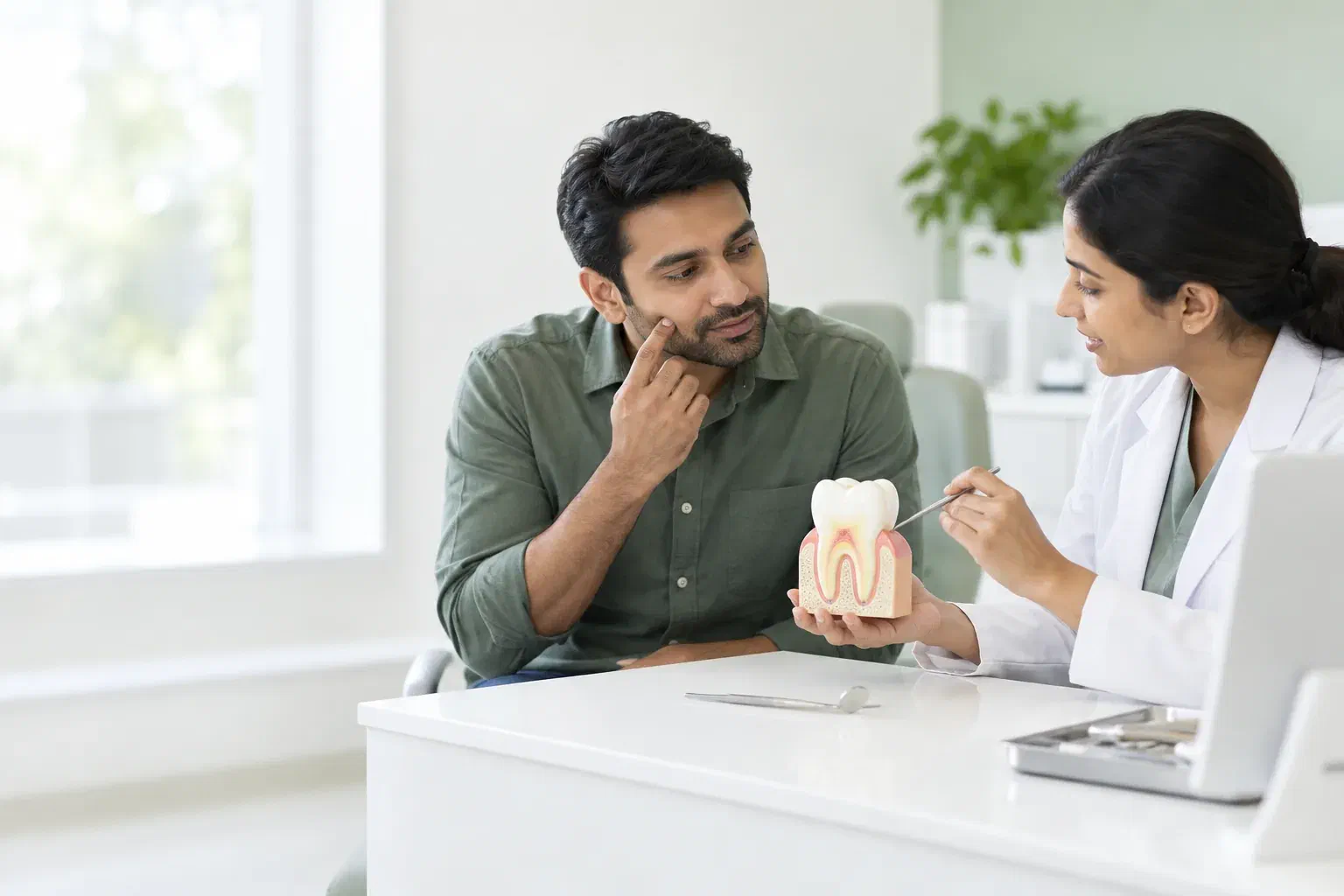
Illustrative consultation about a back tooth using a molar teaching model
Restorative Dentistry

Molar Root Canals in Oakville

Is it your sinuses, or is it a tooth? Upper back-tooth pain can be confusing. From Oakville, come in for a proper diagnosis, then a plan that covers root canal care and the repair after it.

Tooth or sinus?

Pain at the back can be hard to place

The roots of your upper molars sit close to the sinuses, so a heavy, pressured ache in the cheek can come from either one. Sometimes a cold is to blame. Other times the pulp inside a molar is inflamed or infected, and that is when a root canal might be considered to keep the tooth.

Sorting the two apart is the job of an examination. The dentist listens to how the discomfort behaves, tests the teeth involved and looks at X-rays. Even when a molar is the source, the next question is whether it can be rebuilt well enough afterward, because a root canal is only worthwhile on a tooth that can be restored.

So the first appointment for someone travelling up from Oakville tends to cover a lot: pinning down the cause, explaining what treatment inside the tooth involves, talking about the restoration that will protect its biting surface, and deciding whether an endodontist should take on any part.

Get that back-tooth ache checked
An intact molar teaching model and dental mirror on a clean tray
Describing the discomfort

Pressure, temperature, timing: tell us all of it

The story you bring shapes the exam. Share when it started, how it has changed, and what work has been done on that side before, including fillings, crowns or an old injury.

Sore when you bite

Biting pain has several possible sources, from a cracked cusp to an inflamed root. Notice whether it is worse on clenching or on release, and whether hot or cold makes a difference. Avoid tapping the tooth to test it; the dentist can check your bite properly.

An ache that stays and builds

If a hot or cold drink sets off pain that lingers well after you swallow, mention how long it lasts. Say too if it starts unprompted, throbs when you lie down or interrupts sleep. Short, sharp sensitivity is usually a different picture.

A change in the gum near a molar

A swollen patch, a small bump that drains and returns, or a broken edge around a big filling needs a look even if it hardly hurts. Mention any salty or bad taste. Feeling better for a while does not explain what is going on inside the tooth.

Phone the clinic promptly if pain is intense or your face is swelling. Swelling that makes it hard to breathe or swallow calls for emergency medical care.

What keeping the tooth offers

Your molars carry the heavy chewing

Back teeth grind food and help balance the load across your bite. When a molar’s internal problem can be treated and the tooth rebuilt on sound structure, keeping it can be a sensible aim. Cracks, how much tooth survives, gum support and other findings all go into that judgment.

The explanation you get should be clear about the benefit without putting a number of years on it. Ask why the tooth seems worth treating, what might limit how it does, and how the final restoration fits. Saving a molar takes more than the canal stage alone.

Patient information: AAE — understanding root canal treatment

A view of the entire tooth

The dentist considers whether the molar will be usable once the inside is treated. Ask to hear what looks promising and what is concerning, especially where there is already a large filling or extensive damage.

Appointments that connect

When you can see how the canals and the final repair link up, scheduling gets simpler. If another clinician is involved, ask who handles each stage and how information will be shared.

A plan for staying comfortable

Tell the team about dental anxiety, a jaw that tires easily or a past visit that was difficult. Agree on how you will signal for a break. That information helps the clinician set a pace you can manage.

From diagnosis to final repair

Each visit has a clear job

How many appointments you need, and how long they take, depends on the tooth. Ask beforehand about the diagnosis, the treatment scope, fees, alternatives and the plan for protecting the molar.

  1. Rule things in and out

    Symptoms are reviewed, the teeth and gums are examined, and suitable tests and imaging are used, which helps separate sinus pressure from a tooth problem. Discuss whether the molar is restorable and whether its canals call for an endodontist.

  2. Numb, isolate, open

    Local anaesthetic is used, then a dental dam is fitted to keep the tooth isolated and dry. The clinician makes an access opening and locates the canals. Let the team know if anything hurts so they can stop and adjust.

  3. Work inside the canals

    The canal spaces are cleaned, shaped, disinfected and filled as appropriate for that visit. Between appointments, a temporary filling may seal the opening. Ask whether the internal work is done and what comes before the permanent repair.

  4. Restore, then review

    A suitable final restoration follows, often one that protects the molar’s cusps from splitting under bite force. Confirm the timing and any precautions until then. Reviews look at the tooth and surrounding tissue rather than relying on comfort alone.

In the days that follow

Protect the tooth while it waits

Keep the instructions for your current stage handy. Guidance after the canal visit can differ from what you are told once the permanent restoration is in.

Mind what you chew

Hold off on eating until you can feel your lip and cheek again, and keep weight off the treated tooth until it is restored. Ask which foods are fine for now. A temporary is not meant to cope with ice, popcorn kernels or sticky treats.

Keep the plan moving

Comfort is welcome, but it does not mean everything has been done. If your calendar changes, call to discuss the remaining stage instead of postponing indefinitely. It also helps to know exactly what the next booking will cover.

Speak up about changes

Report pain that is increasing, swelling, a bite that feels high or a temporary that has worn or fallen out. Give us an idea of the timing and the treatment you have had so far. Follow the medication advice given to you and ask if anything is uncertain.

Comparing approaches

The diagnosis decides the direction

Ask how the recommended treatment fits what was found. It helps to understand every alternative before you choose.

For a tooth worth rebuilding

Root canal and a final restoration

The internal problem is treated, then the molar is restored so it can chew. Plan both halves at once, including the restoration type and any specialist care. A fee quoted for the canals alone may not reflect the full treatment.

When the nerve is not involved

Treating a cause outside the pulp

If the exam points to a sinus issue, a leaking filling, gum inflammation or a bite problem, the right care will look different. Ask which finding supports that conclusion. A root canal on a different tooth in the past is not a reason to repeat it here.

When the tooth cannot be kept well

Extraction with a plan for the space

Removal may be discussed if the molar cannot be restored reliably or you decide against keeping it. Ask what losing it would mean for your bite and which replacements may suit, with their own steps and costs.

Oakville questions, answered

Common questions before treatment on a back tooth

There can be several decisions involved in molar care. A short list of questions makes the appointment easier to use well.

(905) 876-4488
Could a sinus infection be making my upper molar hurt?
It can. Congestion may cause pressure that feels like toothache in the upper back teeth. A tooth problem can feel similar, which is why testing and X-rays matter. If the dentist finds no dental cause, you may be advised to see your physician.
Can antibiotics fix the problem instead of a root canal?
Antibiotics may be used in some situations, but they do not treat inflamed or infected pulp inside the tooth on their own. The dentist decides whether they are appropriate for you. Ask what would address the source of the problem.
Why is a rubber sheet placed over my tooth?
That sheet is a dental dam. It isolates the tooth being treated, keeps it dry and helps stop saliva and debris from entering. It also protects your mouth during treatment. Tell the team if you feel uncomfortable while it is in place.
How many visits does a back-tooth root canal usually take?
It differs. Some molars are treated in one appointment, while others need more, plus a separate visit for the final restoration. Ask about the proposed sequence for your tooth so you can plan your time around it.
Why does molar canal anatomy affect my treatment plan?
Molars often have several roots and canals, and their number and shape vary even between similar teeth. More complex anatomy can mean longer treatment or a referral to an endodontist. Ask what your imaging suggests.
Is the final restoration part of the root canal fee?
Often it is quoted separately. Ask whether the plan includes a build-up, crown or another restoration, and when each should happen. Knowing the full sequence early helps you check costs and any benefits coverage before starting.
Molar care for Oakville

Bring the ache, leave with a plan

Start with an assessment at our Bronte Street practice in Milton and review the complete plan for the tooth. Bring your symptoms, any earlier advice and your questions about keeping the molar and restoring how it chews.

Severe pain or swelling? Please call. Email and online requests are for non-urgent matters.

Visit Milton Dental Clinic
Unit 1, 342 Bronte St. S, Milton, ON L9T 5B7
Get directions Clinic hours
Monday–Thursday
11am–7pm
Friday–Sunday
By appointment only

Areas we serve

  • Milton
  • Oakville
  • Mississauga
  • Georgetown
  • Halton Hills
  • Acton
  • Campbellville
  • Brampton
  • Burlington
  • Puslinch
  • Rockwood
  • Erin
  • Caledon
  • Etobicoke
  • Old Milton
  • Bronte Meadows
  • Timberlea
  • Dorset Park
  • Dempsey
  • Clarke
  • Beaty
  • Coates
  • Harrison
  • Scott
  • Willmott
  • Ford
  • Bowes
  • Cobden
  • Walker
  • Mountain View
  • Milton Heights
  • Hawthorne Village
  • Valley View
  • Fallingbrook
  • Nassagaweya
  • Trafalgar
  • Esquesing
  • Nelson
  • Brookville
  • Moffat
  • Glen Williams
  • Norval
  • Limehouse
  • Stewarttown
  • Ashgrove
  • Hornby
  • Silver Creek
  • Speyside
  • Scotch Block
  • North Oakville
  • River Oaks
  • Glen Abbey
  • West Oak Trails
  • Palermo
  • Bronte Creek
  • College Park
  • Joshua Creek
  • Uptown Core
  • Preserve
  • Iroquois Ridge
  • Lisgar
  • Meadowvale
  • Meadowvale Village
  • Churchill Meadows
  • Erin Mills
  • Central Erin Mills
  • Streetsville
  • East Credit
  • Creditview
  • Heartland
  • Sheridan
  • Mount Pleasant
  • Credit Valley
  • Huttonville
  • Churchville
  • Springbrook
  • Northwest Brampton
  • Bram West
  • Fletcher's Meadow
  • Fletcher's Creek South
  • Alton Village
  • Orchard
  • Millcroft
  • Headon Forest
  • Tansley
  • Brant Hills
  • Tyandaga
  • Kilbride
  • Lowville
  • Aberfoyle
  • Morriston
  • Arkell
  • Hillsburgh
  • Freelton
  • Carlisle
  • Waterdown
  • Flamborough
  • Mountsberg

How can we help?

Milton Dental Clinic

Have a question about your smile? Choose the option that works best for you.

For urgent dental concerns, please call.
Messages are reviewed during clinic hours.