
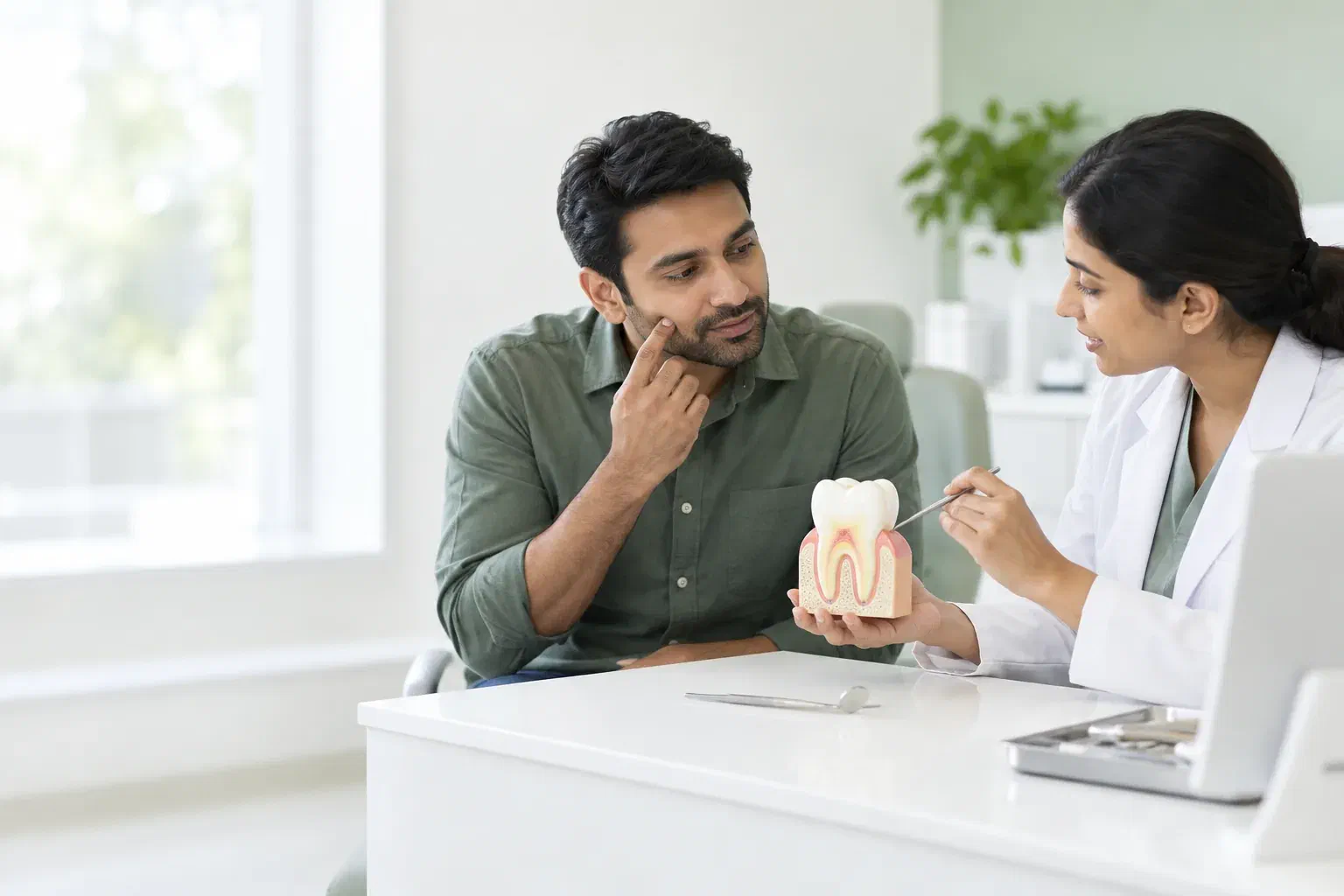
Illustrative consultation about a back tooth using a molar teaching model
Restorative Dentistry

Molar Root Canals in Puslinch

Save the molar, or take it out? It is a fair question, and the answer depends on the tooth. From Puslinch, come in for an honest assessment that compares root canal care, restoration and the alternatives.

Keep it or let it go?

A decision worth making with full information

When a back tooth has been sore for a while, the idea of simply having it out can sound appealing. Sometimes that is the right call. Often, though, there is another option worth hearing about first. Root canal treatment removes infected or irreversibly inflamed pulp from inside a molar so the tooth itself can stay.

Which way to go depends on facts that only an examination can supply. Is the pulp really the cause? Is there enough healthy tooth left to rebuild? Are the gum and bone around it sound, and is there a crack that would undermine any repair? The answers can point firmly in one direction, or leave a genuine choice.

Families in rural Puslinch, west of Milton, often weigh the time involved as well. A good first conversation sets out what saving the tooth would take, including the final restoration and any specialist care, alongside what removal and a possible replacement would involve. Then the decision is yours.

Talk through your options for a molar
An intact molar teaching model and dental mirror on a clean tray
What brings people in

Symptoms that start the conversation

Share when the trouble began, how it has changed and what treatment that side has had before. Mention previous advice about the tooth, too.

Pain on biting

A molar can hurt under pressure for several reasons, including a crack or inflammation at the root tip. Note whether biting or releasing triggers it and whether hot or cold food plays a role. Avoid poking at it; a careful bite test is part of the exam.

A slow-fading ache

Discomfort that keeps going after a hot or cold drink, arrives with no trigger, or wakes you at night is worth describing in detail. These signs help separate a pulp problem from everyday short-lived sensitivity.

Gum changes near the tooth

Swelling, a recurring bump, an unpleasant taste or a broken area around an old repair should be looked at even if pain is mild. Fewer symptoms for a while does not mean the condition inside the molar has improved.

Call without delay about severe pain or swelling. Seek emergency medical care if swelling interferes with breathing or swallowing.

The argument for saving it

Why many dentists try to keep a restorable molar

Your own molar, when it can be treated and rebuilt on sound structure, keeps its place in your bite. That can be worth a lot. It must still be balanced against fractures, how much tooth remains, gum support and anything else the exam reveals. Not every molar is a good candidate.

Nobody can promise a set lifespan for a treated tooth. What you can ask for is an honest comparison: why this molar looks worth keeping, what might limit it, and how the final restoration protects it. Keeping a tooth means rebuilding it, not only cleaning out its canals.

Patient information: AAE — understanding root canal treatment

Weighing the evidence

How well will this tooth function once treated? The dentist considers that question carefully. Ask for the positives and the risks side by side, in plain language, so you can compare them fairly with removal and with any replacement you might choose.

Understanding the commitment

Saving a molar usually means a canal stage, a restoration and follow-up. Knowing that sequence helps you plan time and travel. If a second clinician takes part, clarify which visits are theirs and how they will share your records.

Planning for comfort

Mention anxiety, trouble opening wide or a past appointment that went badly. Settle on a way to ask for a pause. Those details help the team plan a visit you can manage.

If you choose to keep the tooth

The path from diagnosis to a rebuilt molar

Every tooth is different, so appointment numbers vary. Ask beforehand about the diagnosis, the scope of work, fees, alternatives and how the molar will be restored.

  1. Examine and decide

    Symptoms are reviewed and the tooth is examined with suitable tests and imaging. This is where restorability is judged and where you can ask whether the anatomy or another finding would make an endodontist the better choice.

  2. Numb and protect

    Local anaesthetic is given, then a dental dam isolates the molar from saliva. The clinician creates a small opening to reach the canals. If something hurts, tell the team so they can pause.

  3. Treat the root system

    Infected or inflamed tissue is removed and each canal is shaped, disinfected and sealed. Where another visit is needed, a temporary covering guards the opening. Ask what was finished today.

  4. Rebuild and reassess

    The molar receives a lasting restoration, often one that covers the cusps. Confirm timing and precautions until it is placed. Follow-up looks for healing around the roots, not just an absence of pain.

Protecting your decision

A saved molar needs care while it is rebuilt

Keep instructions for each stage. The guidance after canal treatment may change once the final restoration is placed.

Soft foods, other side

Eat only after numbness wears off, and for now let the opposite side of your mouth do the chewing. Check with the team about which meals suit this stage. Hard or chewy foods can fracture an unprotected molar or crack a temporary, which could set the plan back.

Finish the plan

The canal stage alone leaves a molar vulnerable. Keep the restoration appointment, and if it must move, call to rebook promptly so the tooth is not left unprotected for longer than advised.

Report problems early

Contact us about increasing pain, swelling, a bite that feels too high or a temporary that breaks. Mention when the change started and how far through treatment you are. Take medication only as directed for you.

Laying out the choices

Save, treat differently or remove

Ask why one option is recommended over the others. A clear comparison helps you make a decision that fits you.

For a molar that can be rebuilt

Root canal treatment with restoration

The inside of the tooth is treated, then the molar is restored for everyday chewing. Look at both stages together, including any specialist care. Quotes that cover only the canals may not reflect the total.

When the pulp is healthy

A different treatment

If the pain comes from a leaking filling, the gums, the bite or a neighbouring tooth, treatment will look different. Ask what finding points there. A root canal on another tooth years ago does not mean this one needs one.

When keeping it is not wise

Extraction, then a plan for the space

Removal may be advised if the molar cannot be predictably restored, or chosen if you prefer it. Ask how a gap at the back could change your bite and what replacements, such as a bridge or implant, would involve in stages and fees.

Puslinch questions

Weighing a root canal against removal

Deciding about a molar can involve several factors. Bring a list, and a family member if it helps to talk it through.

(905) 876-4488
Why not just pull the molar and be done with it?
Removal can be a reasonable choice in some cases. It also leaves a gap that may affect chewing and neighbouring teeth, and replacing it involves its own treatment. Ask the dentist to compare both paths for your tooth.
What happens to nearby teeth if a molar is removed and not replaced?
Over time, neighbouring teeth can tip or drift toward the space and the opposing tooth may move. How much this happens varies. Ask what is likely in your mouth and whether replacement is advised.
What does it mean when a dentist says a tooth is restorable?
It means enough sound tooth and healthy support remain for a lasting restoration after treatment. A deep crack, extensive decay or bone loss can make a tooth unrestorable. Ask what the dentist sees in yours.
How do the overall costs of saving and removing a molar compare?
It depends on the treatment needed and whether the space would be replaced. Ask for estimates covering each full pathway, including restorations or replacements, rather than comparing a single stage.
Does my age affect whether a molar root canal is worthwhile?
Age alone does not decide it. The condition of the tooth, its supporting bone, your general health and your preferences matter more. Share your medical history so the dentist can give advice that fits you.
Will planning the canal stage and crown involve a specialist?
Some molars are referred to an endodontist for the canal stage, especially with complex anatomy. The restoration is often placed by your general dentist. Ask how the stages would be divided and coordinated.
Molar care for Puslinch

Make the choice with the full picture

Book an exam with our Bronte Street team to compare keeping the molar with the alternatives. Bring your symptoms, any earlier opinions and your questions about restoring the tooth or replacing it.

If pain becomes severe or swelling appears, call us. Email and online forms suit non-urgent questions.

Visit Milton Dental Clinic
Unit 1, 342 Bronte St. S, Milton, ON L9T 5B7
Get directions Clinic hours
Monday–Thursday
11am–7pm
Friday–Sunday
By appointment only

Areas we serve

  • Milton
  • Oakville
  • Mississauga
  • Georgetown
  • Halton Hills
  • Acton
  • Campbellville
  • Brampton
  • Burlington
  • Puslinch
  • Rockwood
  • Erin
  • Caledon
  • Etobicoke
  • Old Milton
  • Bronte Meadows
  • Timberlea
  • Dorset Park
  • Dempsey
  • Clarke
  • Beaty
  • Coates
  • Harrison
  • Scott
  • Willmott
  • Ford
  • Bowes
  • Cobden
  • Walker
  • Mountain View
  • Milton Heights
  • Hawthorne Village
  • Valley View
  • Fallingbrook
  • Nassagaweya
  • Trafalgar
  • Esquesing
  • Nelson
  • Brookville
  • Moffat
  • Glen Williams
  • Norval
  • Limehouse
  • Stewarttown
  • Ashgrove
  • Hornby
  • Silver Creek
  • Speyside
  • Scotch Block
  • North Oakville
  • River Oaks
  • Glen Abbey
  • West Oak Trails
  • Palermo
  • Bronte Creek
  • College Park
  • Joshua Creek
  • Uptown Core
  • Preserve
  • Iroquois Ridge
  • Lisgar
  • Meadowvale
  • Meadowvale Village
  • Churchill Meadows
  • Erin Mills
  • Central Erin Mills
  • Streetsville
  • East Credit
  • Creditview
  • Heartland
  • Sheridan
  • Mount Pleasant
  • Credit Valley
  • Huttonville
  • Churchville
  • Springbrook
  • Northwest Brampton
  • Bram West
  • Fletcher's Meadow
  • Fletcher's Creek South
  • Alton Village
  • Orchard
  • Millcroft
  • Headon Forest
  • Tansley
  • Brant Hills
  • Tyandaga
  • Kilbride
  • Lowville
  • Aberfoyle
  • Morriston
  • Arkell
  • Hillsburgh
  • Freelton
  • Carlisle
  • Waterdown
  • Flamborough
  • Mountsberg

How can we help?

Milton Dental Clinic

Have a question about your smile? Choose the option that works best for you.

For urgent dental concerns, please call.
Messages are reviewed during clinic hours.