

Illustrative consultation about a removable partial denture
Restorative Dentistry

Partial Dentures

Replace missing teeth while caring for the ones you still have. Explore partial dentures in Milton, with a design conversation that includes comfort, appearance, support, and everyday cleaning.

A closer look at partial dentures

Fill the spaces. Plan around the teeth that remain.

A partial denture is a removable appliance that replaces missing teeth when some natural teeth remain in the same arch. The replacement teeth are arranged on a base or framework designed for your mouth. Its support and retention depend on the pattern of spaces, the available teeth, and the surrounding tissues.

A useful design considers more than the gaps visible in a photograph. The teeth that help support the appliance need assessment, and the denture must work with your bite and cleaning routine. Your preferences about appearance, handling, and daily use also belong in the conversation from the beginning.

At Milton Dental Clinic, bring an existing partial denture if you have one, even if it no longer feels comfortable. Tell us what worked well and what you would change. That experience can help shape a discussion about a new appliance, an adjustment, or another way to replace the missing teeth.

Talk about replacing missing teeth
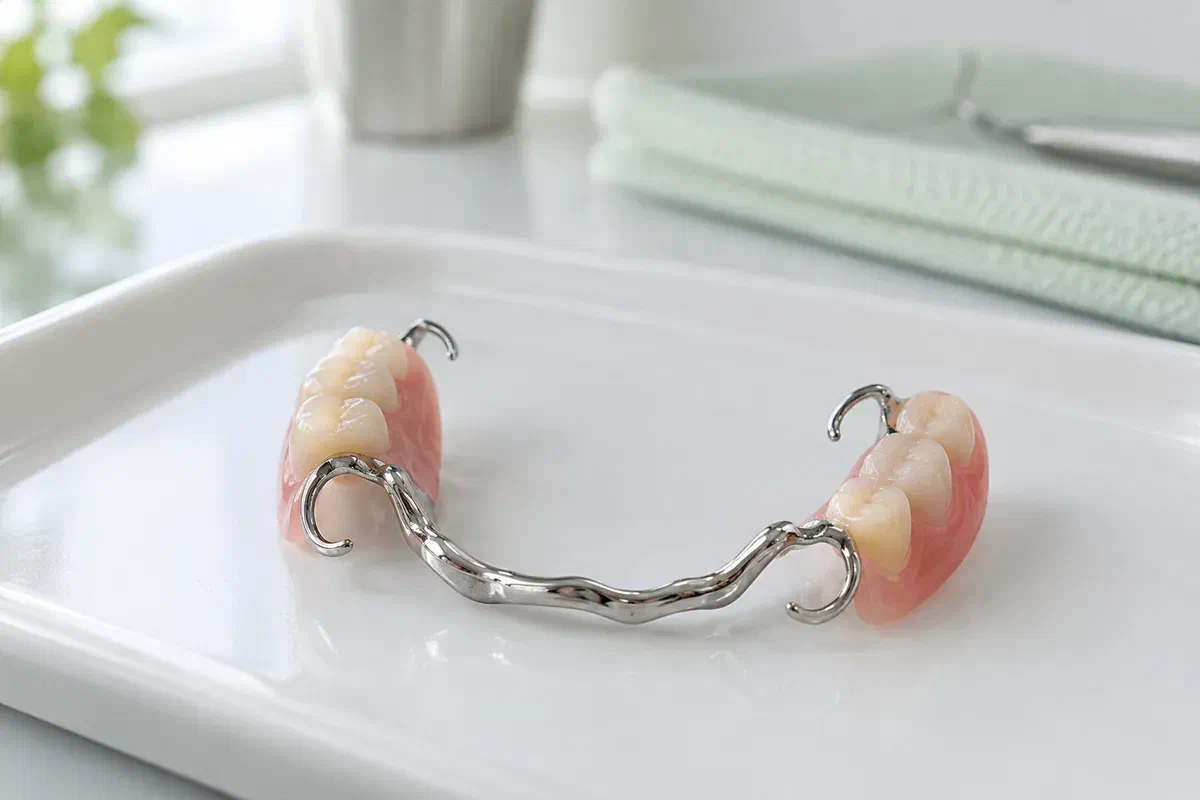
Removable lower partial denture with two tooth-bearing sections and a metal framework
When a partial denture may be considered

Start with the spaces and the way you use your smile.

Different patterns of tooth loss create different design needs. An examination helps establish which teeth can provide support and whether other care should happen before making the appliance.

Several separate gaps

A removable partial may replace teeth in more than one area of the same arch. Tell us which spaces affect you most during meals or conversation. The position of the remaining teeth helps determine how the appliance could be connected and supported.

A change in an existing appliance

A partial denture that rocks, catches, or presses differently deserves review. Bring it rather than adjusting its clasps yourself. The problem may involve its fit, a component, the bite, or a change in one of the supporting teeth.

Planning after tooth loss

If a tooth has recently been removed or an extraction is being discussed, ask how healing affects the denture plan. You may need an interim arrangement or later adjustments. Knowing the sequence helps you prepare for the period between tooth loss and a settled appliance.

The remaining teeth are part of the treatment plan. Their health, position, and ability to support a partial denture need attention before choosing its final design.

What a considered design can offer

An appliance that belongs in your everyday routine.

A partial denture can be a practical way to restore missing tooth positions while retaining natural teeth. The proposed design should explain where support comes from, how it stays in place, and what you will remove for cleaning. Ask to see an example if the description is difficult to picture.

There is an adaptation period, and the experience is different from having only natural teeth. Discuss the expected feel, any visible components, and the limits of the appliance before it is made. A realistic conversation is more useful than a promise that you will never notice it.

Patient information: ADA — removable partial denture designs

Replacement arranged for your mouth

The position, shade, and shape of the denture teeth are considered with the surrounding smile. Explain what matters to you when speaking or smiling, and ask when appearance can be reviewed during the making process.

A removable route to cleaning

Taking the appliance out gives access to its surfaces and the teeth underneath. Ask for a handling demonstration if gripping small components is difficult. The design needs to be manageable for the person who will use and clean it.

A plan that can be compared

Discuss a partial denture alongside appropriate fixed or implant options. Compare the treatment steps, effect on remaining teeth, fees, and maintenance. You can then weigh the choices against your priorities and the findings from the examination.

Making your partial denture

Give the fit, bite, and appearance their own attention.

The stages depend on the design and whether other dental treatment is required. Ask which visits are planned and when you will have an opportunity to discuss the developing appliance.

  1. Assess the supporting mouth

    The dentist examines the gaps, remaining teeth, gums, and bite. Imaging may help assess support or identify treatment needs. Bring your previous appliance and explain any difficulty with chewing, speech, cleaning, or sore areas.

  2. Agree on the design and preparation

    Discuss the proposed base or framework, visible components, and any preparation or treatment needed for supporting teeth. Ask about the estimate and alternatives. Records of your mouth and bite help guide the appliance’s construction.

  3. Review the developing fit

    Depending on the design, intermediate visits may allow parts of the framework or tooth arrangement to be checked. Use these opportunities to describe anything that feels unfamiliar. Ask what can still be changed before the appliance is finished.

  4. Fit and practise together

    At delivery, the denture’s seating and bite are checked and you learn how to insert, remove, and care for it. Confirm the review arrangement. Follow-up provides a chance to discuss pressure areas and the experience of wearing it in daily life.

Settling into a removable appliance

Build a routine for both the denture and your own teeth.

Your care instructions should identify suitable products and a wearing schedule for this particular appliance. Ask for clarification before using a cleaner intended for a different denture material.

Handle the framework gently

Follow the demonstrated insertion and removal path. Do not bite the appliance into position or reshape a clasp at home. If it no longer seats as expected, arrange advice and bring it with you so the fit can be checked.

Clean the appliance separately

Remove food and deposits using the recommended brush and compatible cleanser. Hot water and unsuitable chemicals can damage denture materials. Ask how to store the appliance when it is out, particularly if it includes metal components.

Continue care for natural teeth

Brush your own teeth with fluoride toothpaste and clean between them, including around areas that support the denture. A removable appliance does not replace routine dental examinations. Mention recurring food trapping or difficulty reaching a supporting tooth.

Patient information: Cambridge University Hospitals — looking after dentures

Choosing how to replace the gaps

The design should suit your teeth and your priorities.

No single material or appliance fits every pattern of missing teeth. Ask which choices are clinically reasonable and how each would affect everyday use.

For an appropriate removable plan

An acrylic partial denture

An acrylic design may be considered in certain interim or longer-term situations. Ask why it suits the proposed role, how it will be supported, and whether future changes are anticipated. An appliance made during healing may need review as the mouth settles.

When a planned framework is suitable

A framework partial denture

A metal framework may use rests and clasps around selected teeth. Its design depends on the available support and bite. Discuss which components might show, whether preparation is needed, and how the appliance can be maintained over time.

When you prefer teeth that stay in place

A fixed replacement approach

A bridge or implant restoration may be an alternative in suitable circumstances. These involve different requirements, procedures, and costs. Ask what the examination indicates rather than assuming that every gap can be treated with the same fixed solution.

Questions about your partial

Think about the ordinary moments as well as the fitting.

Eating, speaking, cleaning, and taking the appliance out are all part of the decision. Bring the practical questions that matter to your day.

(905) 876-4488
Will a partial denture clasp be visible when I smile?
It may be, depending on the position of the supporting teeth and the required design. Tell the dentist which areas are visible in your smile and ask to review the proposed clasp locations. Appearance needs to be balanced with support, retention, and the health of the teeth involved.
Can one partial denture replace teeth on both sides of my mouth?
A single appliance can sometimes replace gaps on both sides of the same arch. Its design depends on the remaining teeth, tissues, and bite. Ask how the two sides would connect and what that means for the feel of the appliance, cleaning, and insertion.
What if another natural tooth is lost after my partial denture is made?
An addition may be possible in some designs, but it is not guaranteed. The location of the lost tooth and its role in supporting the appliance matter. Ask about anticipated changes during planning, especially if a remaining tooth has an uncertain outlook.
Should I sleep with my removable partial denture in?
Follow the wearing schedule provided for your appliance. Dentures are generally removed for an overnight rest, but instructions can differ during an immediate post-extraction period or a planned review stage. Confirm when to remove yours and how to store it safely while it is out.
How can I prepare for speaking with a new partial denture?
Ask what changes you may notice and allow time to become familiar with the appliance. Reading aloud can help you identify sounds that feel different. Tell the dentist if the partial moves during speech or a problem persists, rather than assuming every difficulty is simply something to tolerate.
What should I bring when discussing a replacement partial denture?
Bring the current appliance, any broken pieces, and relevant treatment records if available. Think about the features you liked as well as the problems you want addressed. Mention when the fit changed and whether other dental treatment has happened since it was made.
Partial dentures in Milton

Let’s plan for the gaps and the teeth beside them.

Arrange a consultation at our Bronte Street practice to discuss a first partial denture or an appliance that needs reassessment. We can start with your experience and explain the findings that shape an appropriate replacement plan.

Call if a broken appliance is causing pain or injury. Online requests are intended for non-urgent visits.

Visit Milton Dental Clinic
Unit 1, 342 Bronte St. S, Milton, ON L9T 5B7
Get directions Clinic hours
Monday–Thursday
11am–7pm
Friday–Sunday
By appointment only

How can we help?

Milton Dental Clinic

Have a question about your smile? Choose the option that works best for you.

For urgent dental concerns, please call.
Messages are reviewed during clinic hours.