

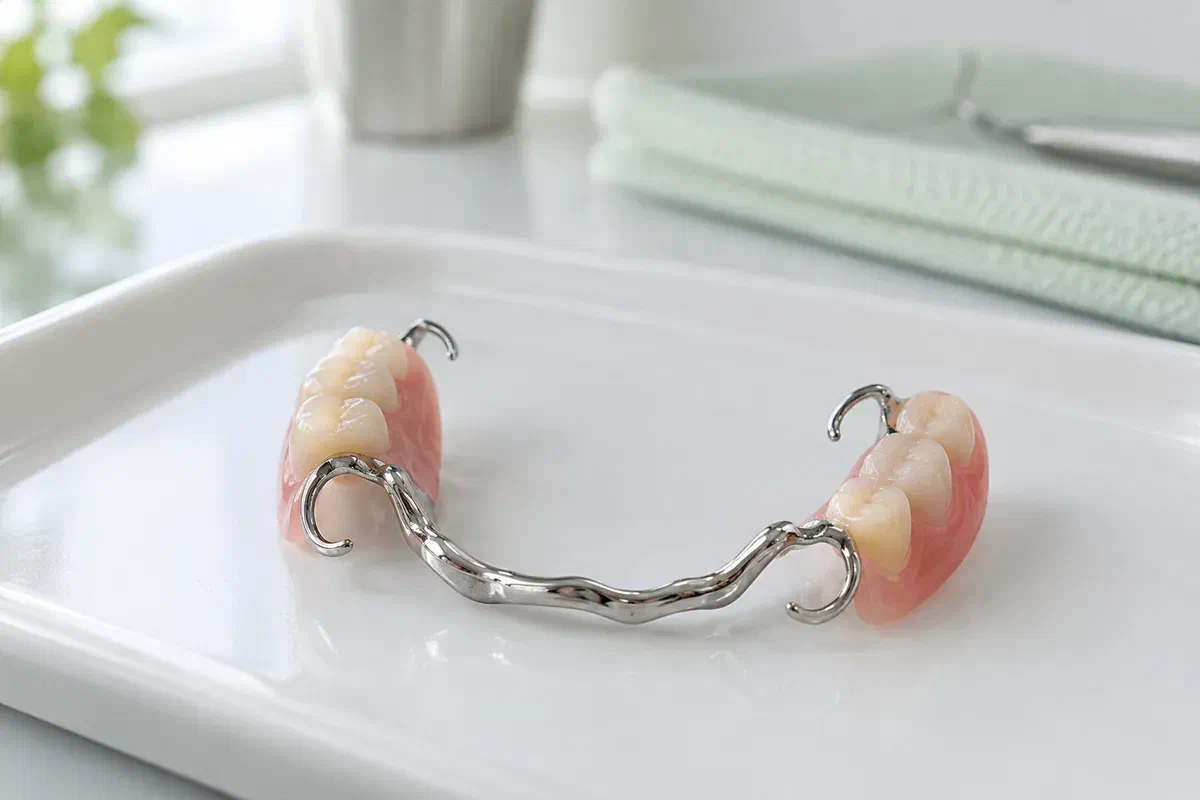
Illustrative consultation about a removable partial denture
Restorative Dentistry

Partial Dentures in Etobicoke

Making the trip from Etobicoke for a removable partial? We can organize the visits so each one does real work, and talk through fit, looks, support and cleaning before the appliance is made.

Making each trip count

Fewer appointments, each one with a clear purpose

Travelling in from the west end of Toronto means you probably want to know, before the first visit, how many more there will be. That is a fair thing to ask about a partial denture, since making one usually takes several stages. Planning them carefully is part of good care, not an afterthought.

The appliance is a removable plate or framework carrying replacement teeth, made to sit between the natural teeth that remain in one jaw. How well it stays in place depends on those teeth, the gum ridges underneath and your bite. Every element is designed for your particular mouth.

Bring everything to the first appointment: any partial you already have, broken parts, recent dental records and a list of medications. Tell us what has and hasn’t worked for you. Arriving prepared lets us cover more ground in one sitting and decide sooner whether an adjustment, a new partial or a different option suits you.

Plan your partial denture visits
Removable lower partial denture with two tooth-bearing sections and a metal framework
Why people in Etobicoke start planning

Gaps, a misbehaving appliance, or an extraction ahead

Each pattern of tooth loss calls for a different design. An examination identifies the teeth that could give support and any care needed before an appliance is started.

Several missing teeth in one arch

Separate spaces along the same jaw can sometimes be replaced by a single appliance. Mention which gaps bother you most while eating or speaking. The location of the teeth in between affects how the parts might be joined.

An existing partial that has changed

If your partial now tips, catches or digs in, have it assessed rather than bending the clasps yourself. Something may have shifted in the fit, a component, your bite or a supporting tooth. Bring it along so the visit is productive.

Healing after a tooth is removed

Ask how an extraction and the healing that follows affect the timeline, and whether a temporary appliance would bridge the gap. Later fine-tuning is common. Knowing the sequence early helps you book trips sensibly.

Healthy remaining teeth are essential. Their condition, position and ability to support a partial are assessed before the final design is chosen, so any treatment they need can be planned into the same schedule.

What a careful plan provides

A practical replacement you can maintain at home

A partial denture can restore missing tooth positions while keeping healthy natural teeth. The plan you agree to should explain which teeth anchor it, how it resists lifting and what you remove for cleaning. If you find that hard to picture, ask to look at an example during your first visit.

Expect to spend time adapting, and accept that it will feel different from natural teeth. Talk about the likely sensations, any parts that might be visible and what the appliance can’t do. Clear expectations reduce the chance of an unplanned trip back for something that was simply unfamiliar.

Patient information: ADA — removable partial denture designs

Teeth chosen for your face

Shade, shape and position of the replacement teeth are planned with your own teeth in view. Explain what matters when you smile or speak, and ask which visit will include a chance to review the appearance.

Simple to clean at home

As a removable appliance, it gives you access to every surface and the teeth beneath. Practise handling it in the chair until you feel confident, since that saves a trip later. It needs to be manageable for you.

Alternatives on the table

A partial can be compared with suitable bridge or implant options. Think about the visits each needs, their effect on remaining teeth, fees and maintenance. Your exam and your priorities guide the choice.

A schedule built around the trip from Etobicoke

Stages you can plan in advance

The number of visits depends on the design and on any treatment needed first. Ask for the full sequence at the start and whether any steps can reasonably be combined.

  1. Thorough first assessment

    The dentist reviews the gaps, remaining teeth, gums and bite, and may take X-rays to assess support. Bring your old appliance and mention problems with chewing, speaking, cleaning or sore spots.

  2. Design, preparation and estimate

    Agree on the base or framework, which parts may be visible and any preparation supporting teeth need. Ask about the estimate and alternatives. Impressions and bite records then go to guide construction.

  3. Try-in where the design needs it

    Some partials include a visit to check the framework or tooth setup. Take your time and describe anything that feels unusual. Ask what can still be adjusted, so changes happen before the final piece.

  4. Fitting and a planned review

    Seating and bite are checked, and you practise putting it in, taking it out and cleaning it. Book the review before leaving. It is the time to address pressure spots and how the partial behaves in daily life.

Between visits

Know what you can manage at home and what needs a call.

Ask for written instructions on cleaners and wearing schedule for this specific partial. Check with us before using a product designed for another denture material.

Careful insertion and removal

Follow the path you practised. Don’t bite the appliance into place or bend clasps at home. If it stops seating properly, phone first so we can advise whether you should come in and what to bring.

Cleaning outside the mouth

Remove food and deposits with the recommended brush and a compatible cleanser. Avoid very hot water and harsh chemicals. Ask how to store it safely when it’s out, especially if it has metal parts.

Ongoing care for natural teeth

Use fluoride toothpaste and clean between teeth, including around the supporting teeth. Regular dental exams are still important. Mention any food trapping or a supporting tooth that is difficult to reach.

Patient information: Cambridge University Hospitals — looking after dentures

Choosing a design

Think about the long run as well as the first fitting.

Different materials and approaches suit different mouths. Ask which are clinically sensible for you and how each would affect daily life and future visits.

Where acrylic is a reasonable choice

An acrylic partial denture

Acrylic may be considered for interim or some longer-term uses. Ask why it’s proposed, what holds it and whether further changes are likely. One made during healing may need review once the gums settle, which is worth building into your plans.

When a metal framework is suitable

A framework partial denture

A framework relies on rests and clasps on selected teeth, designed around your support and bite. Ask which components might show, whether teeth need preparation and what maintenance will involve over time.

For those who want teeth that stay in

Fixed replacement teeth

In suitable cases, a bridge or implant restoration could be an alternative. Each has different requirements, steps and costs. Ask what your examination indicates rather than assuming every gap can be filled the same fixed way.

Planning questions

What people travelling in tend to ask

Meals, speech, cleaning and handling all matter, along with the practicalities of getting to appointments. Bring the questions that affect your routine.

(905) 876-4488
Can my partial denture visits be grouped to save travel?
Some steps may be combined depending on the design and any other treatment needed. Ask for the full sequence at your first visit. The dentist can tell you which appointments must be separate and why.
What should I do if my partial breaks and I’m far from the clinic?
Stop wearing it if it is sharp or painful, keep all the pieces, and call us for advice. If you have severe pain, swelling or injury and can’t be seen quickly, seek urgent care nearer to you.
Can I eat normally on the drive home after my fitting?
It is sensible to start with softer foods and smaller pieces while you learn how the appliance behaves. Your dentist will give advice for your design. Mention any area that catches or feels unstable at your review.
Is a clasp likely to show when I smile?
It depends on which teeth provide support and where components must be placed. Tell the dentist which teeth show when you speak and ask to see the planned clasp positions before the design is finalized.
How do I know whether a sore spot can wait for my review?
Mild unfamiliarity is common at first, but rubbing that continues, bleeding or a sore that gets worse should be reported. Call to describe it, and we can advise whether to stop wearing the appliance until you’re seen.
Which items make the first visit more productive?
Pack your current appliance, any broken pieces, recent dental records and a list of medications. Note when the fit changed and any other treatment you’ve had since it was made.
Visiting from Etobicoke

We’ll plan the visits before we plan the teeth.

Arrange a first appointment at our Bronte Street practice to talk about a new partial denture or one that needs reassessment. We’ll start with your experience, map out the stages and explain the findings that guide a sensible plan.

Call if a broken appliance is causing pain or injury. Use online requests only for visits that aren’t urgent.

Visit Milton Dental Clinic
Unit 1, 342 Bronte St. S, Milton, ON L9T 5B7
Get directions Clinic hours
Monday–Thursday
11am–7pm
Friday–Sunday
By appointment only

Areas we serve

  • Milton
  • Oakville
  • Mississauga
  • Georgetown
  • Halton Hills
  • Acton
  • Campbellville
  • Brampton
  • Burlington
  • Puslinch
  • Rockwood
  • Erin
  • Caledon
  • Etobicoke
  • Old Milton
  • Bronte Meadows
  • Timberlea
  • Dorset Park
  • Dempsey
  • Clarke
  • Beaty
  • Coates
  • Harrison
  • Scott
  • Willmott
  • Ford
  • Bowes
  • Cobden
  • Walker
  • Mountain View
  • Milton Heights
  • Hawthorne Village
  • Valley View
  • Fallingbrook
  • Nassagaweya
  • Trafalgar
  • Esquesing
  • Nelson
  • Brookville
  • Moffat
  • Glen Williams
  • Norval
  • Limehouse
  • Stewarttown
  • Ashgrove
  • Hornby
  • Silver Creek
  • Speyside
  • Scotch Block
  • North Oakville
  • River Oaks
  • Glen Abbey
  • West Oak Trails
  • Palermo
  • Bronte Creek
  • College Park
  • Joshua Creek
  • Uptown Core
  • Preserve
  • Iroquois Ridge
  • Lisgar
  • Meadowvale
  • Meadowvale Village
  • Churchill Meadows
  • Erin Mills
  • Central Erin Mills
  • Streetsville
  • East Credit
  • Creditview
  • Heartland
  • Sheridan
  • Mount Pleasant
  • Credit Valley
  • Huttonville
  • Churchville
  • Springbrook
  • Northwest Brampton
  • Bram West
  • Fletcher's Meadow
  • Fletcher's Creek South
  • Alton Village
  • Orchard
  • Millcroft
  • Headon Forest
  • Tansley
  • Brant Hills
  • Tyandaga
  • Kilbride
  • Lowville
  • Aberfoyle
  • Morriston
  • Arkell
  • Hillsburgh
  • Freelton
  • Carlisle
  • Waterdown
  • Flamborough
  • Mountsberg

How can we help?

Milton Dental Clinic

Have a question about your smile? Choose the option that works best for you.

For urgent dental concerns, please call.
Messages are reviewed during clinic hours.