

Illustrative consultation about a removable partial denture
Restorative Dentistry

Partial Dentures in Halton Hills

Chewing everything on one side lately? People across Halton Hills can explore a removable partial that restores missing back or front teeth, with time spent on support, comfort, appearance and cleaning.

For Georgetown, Acton and the hamlets between

When one side of your mouth is doing all the work

Losing back teeth often goes unnoticed by everyone except you. Steak gets pushed to the other side, crusty bread becomes a project, and the teeth that are left carry more of the load. That shift in how you eat is one of the most common reasons people start asking about a partial denture.

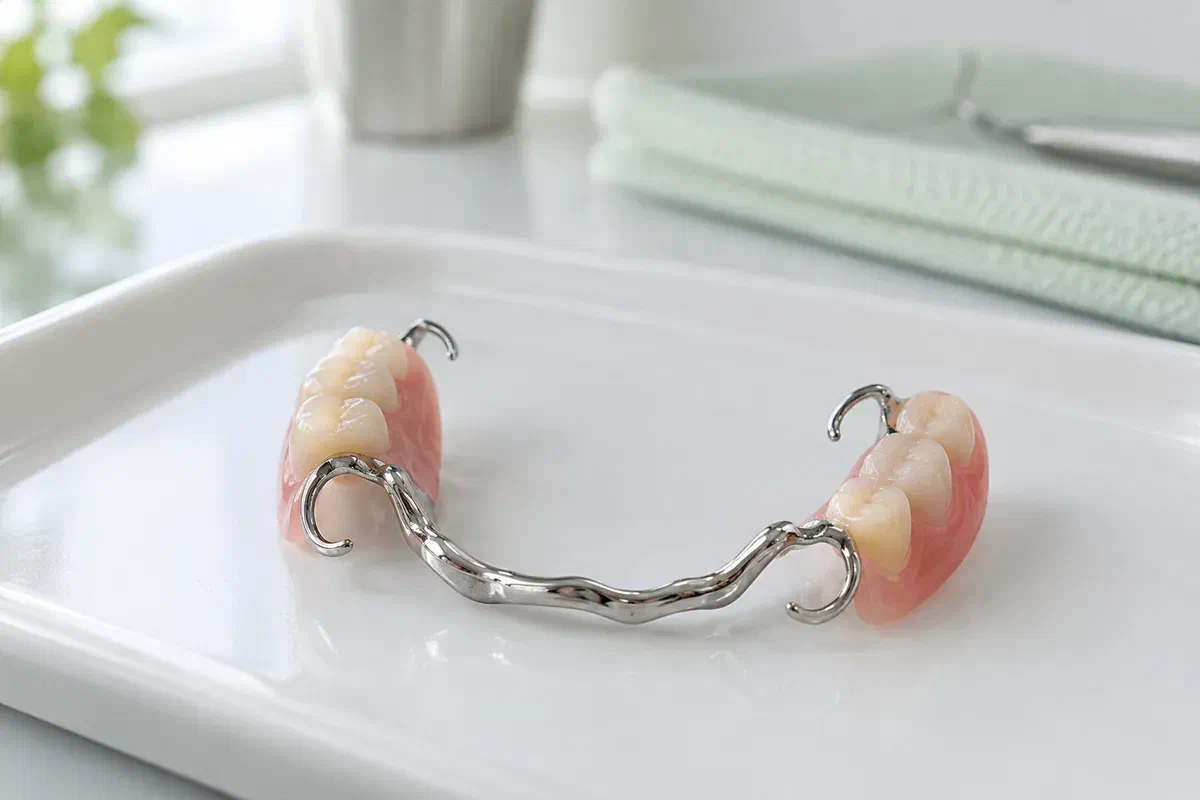
The appliance is removable. It holds artificial teeth on an acrylic base or a metal framework and fits in alongside the natural teeth that remain in one jaw. To stay steady, it relies on those neighbouring teeth, the gums beneath it and the way your upper and lower teeth meet.

Bring any appliance you have tried before, even one you gave up on. Describe where food catches, which foods you now avoid and what you would like to eat again. With that information, we can talk through adjusting what you have, making a new partial or considering a different replacement.

Ask about restoring your chewing
Removable lower partial denture with two tooth-bearing sections and a metal framework
What people in Halton Hills notice first

Where are the spaces, and what are they changing?

Every pattern of tooth loss shapes the design differently. An examination tells us which teeth could help support an appliance and whether anything else needs treating first.

Gaps on both sides of a jaw

Spaces at the back on the left and right can sometimes be filled by a single connected appliance. Let us know which side you chew on now and which gaps bother you. The arrangement of remaining teeth determines how the halves could be linked.

A partial that has lost its grip

An appliance that lifts when you chew, catches food underneath or rubs in a new place should be looked at. Don’t try to tighten the clasps. The fit, a worn part, your bite or a change in a supporting tooth could be the reason.

After a back tooth comes out

If you have recently had an extraction, or one is planned, ask how healing changes the timing. A temporary appliance or adjustments later on may be involved. Understanding the sequence makes the weeks in between easier to plan.

Your remaining teeth carry part of the work, so their health, position and suitability for supporting a partial are checked before the final design is chosen.

What a partial can restore

Balance at mealtimes, and teeth you get to keep

A removable partial can return missing positions to your bite while preserving healthy natural teeth. You should come away understanding which teeth will support it, what holds it down while you chew and which parts you’ll take out to clean. A sample appliance can help if the description doesn’t quite land.

Plan for an adjustment period. It won’t feel like natural teeth, and some foods may take practice. Talk through how it is likely to feel, which parts might show and what it can’t do. Going in with realistic expectations is more useful than hoping you won’t notice it at all.

Patient information: ADA — removable partial denture designs

Replacement teeth that suit you

The shape, colour and placement of the new teeth are chosen with your remaining teeth in mind. Tell us whether appearance or chewing matters more in each area, and ask when you can review how it looks.

Comes out for cleaning

You can lift it out to clean the appliance and the teeth it touches. If small clasps are hard to grip, ask for a demonstration and practise until it feels easy. A design is only useful if you can manage it.

Options worth comparing

Set a partial alongside suitable bridge or implant possibilities. Consider the steps, effect on remaining teeth, fees and upkeep for each. Then make your choice using your priorities and the examination findings.

From examination to first meal

Four steps, and your bite is checked at each one.

The exact sequence depends on the design and any other treatment you need. Ask which visits are planned, especially if you’re coordinating them with work or family, and when you can see the appliance in progress.

  1. Examine teeth, gums and bite

    We check the spaces, the remaining teeth and gums, and how you bite, sometimes with X-rays to assess support. Bring any previous appliance and tell us about chewing problems, speech, cleaning or sore spots.

  2. Agree on the design

    Talk through the proposed base or framework, where components would sit and whether supporting teeth need any work first. Ask about the estimate and alternatives. Impressions and bite records guide the lab.

  3. Try the setup

    Some designs allow a try-in of the framework or tooth arrangement before completion. Bite down gently and describe anything that feels uneven. Ask what can still be altered at this stage.

  4. Fit and follow up

    When it’s ready, we check how it sits and how your teeth come together, and you practise placing and removing it. Book your review. That visit is the time to discuss pressure spots and how chewing is going.

Eating at home in Halton Hills

Easing into eating with a new appliance

Your instructions should cover a wearing schedule and cleaning products suited to this partial. Check before using a cleaner meant for another denture material.

Go gently at first

Start with softer foods cut into smaller pieces while you learn how the appliance behaves. Insert and remove it along the path you were shown, and never bite it into place or bend a clasp. Call if it stops seating properly.

Clean it separately

Use the recommended brush and a compatible cleanser to remove food and deposits. Avoid hot water and harsh chemicals, which can damage the material. Ask about the best way to store it, especially if it has metal parts.

Care for the supporting teeth

Your natural teeth still need fluoride toothpaste and daily cleaning between them, particularly those holding the partial. Keep your regular checkups. Mention if food keeps getting packed in one place.

Patient information: Cambridge University Hospitals — looking after dentures

Weighing the approaches

Strength, comfort and upkeep vary by design.

Not every gap suits the same material or appliance. Ask which choices are clinically reasonable for you and what each would mean for eating and cleaning.

When acrylic suits the role

An acrylic partial denture

Acrylic may be considered for temporary or some longer-term use. Ask why it is recommended, what keeps it in place and whether later changes are expected. One made during healing usually needs reassessment as the gums settle.

When a framework is the better fit

A framework partial denture

This design uses rests and clasps on selected teeth, laid out to suit your support and bite. Ask which parts may be visible, whether teeth need preparation and how the appliance is maintained over the years.

If you want teeth that don’t come out

Fixed replacement

A bridge or implant restoration may be an option in suitable cases. Requirements, procedures and costs differ. Ask what your examination supports instead of assuming every space can be closed the same way.

Questions about chewing and comfort

What people want to know before eating with a partial

Meals, speech, cleaning and removal all play a part. Bring the questions that come up in your own kitchen and at your own table.

(905) 876-4488
Will I be able to chew on both sides again?
A partial is designed to restore missing positions so your bite can be shared more evenly, though it takes practice and won’t feel like natural teeth. Ask what to expect for your design and mention any side that still feels unbalanced.
Are there foods I should avoid with a partial denture?
Very sticky or hard foods may need extra care, especially at first. Your dentist can give advice for your appliance. Cutting food into smaller pieces and chewing slowly can help while you get used to it.
Why does food get under my partial?
Some food trapping can happen with removable appliances, but a sudden change or constant packing in one area should be checked. It can relate to fit or a change in the supporting teeth. Rinse after meals where possible and mention it at your review.
Can one appliance fill gaps at the back on both sides?
Often a single connected partial can replace spaces on both sides of the same jaw. Its design depends on your remaining teeth, gums and bite. Ask how the halves would be joined and what that means for comfort.
Do I need to remove my partial overnight?
Follow the schedule given for your appliance. Dentures are generally removed overnight, although advice may differ right after an extraction or during a review stage. Ask how and where to store it.
Can a partial denture be repaired if a tooth breaks off it?
Repairs are often possible, depending on the material and the damage. Keep all pieces and bring the appliance in. Avoid home glues, which can affect fit and may not be safe for use in the mouth.
From Halton Hills to Bronte Street

Bring the foods you miss to the conversation.

Book a visit at our Bronte Street practice to look at a first partial denture or one that isn’t working for you. We’ll start with how you eat and speak now, then explain the findings that guide a suitable plan.

If a broken partial is painful or has cut your mouth, phone the clinic. Online requests are for non-urgent appointments.

Visit Milton Dental Clinic
Unit 1, 342 Bronte St. S, Milton, ON L9T 5B7
Get directions Clinic hours
Monday–Thursday
11am–7pm
Friday–Sunday
By appointment only

Areas we serve

  • Milton
  • Oakville
  • Mississauga
  • Georgetown
  • Halton Hills
  • Acton
  • Campbellville
  • Brampton
  • Burlington
  • Puslinch
  • Rockwood
  • Erin
  • Caledon
  • Etobicoke
  • Old Milton
  • Bronte Meadows
  • Timberlea
  • Dorset Park
  • Dempsey
  • Clarke
  • Beaty
  • Coates
  • Harrison
  • Scott
  • Willmott
  • Ford
  • Bowes
  • Cobden
  • Walker
  • Mountain View
  • Milton Heights
  • Hawthorne Village
  • Valley View
  • Fallingbrook
  • Nassagaweya
  • Trafalgar
  • Esquesing
  • Nelson
  • Brookville
  • Moffat
  • Glen Williams
  • Norval
  • Limehouse
  • Stewarttown
  • Ashgrove
  • Hornby
  • Silver Creek
  • Speyside
  • Scotch Block
  • North Oakville
  • River Oaks
  • Glen Abbey
  • West Oak Trails
  • Palermo
  • Bronte Creek
  • College Park
  • Joshua Creek
  • Uptown Core
  • Preserve
  • Iroquois Ridge
  • Lisgar
  • Meadowvale
  • Meadowvale Village
  • Churchill Meadows
  • Erin Mills
  • Central Erin Mills
  • Streetsville
  • East Credit
  • Creditview
  • Heartland
  • Sheridan
  • Mount Pleasant
  • Credit Valley
  • Huttonville
  • Churchville
  • Springbrook
  • Northwest Brampton
  • Bram West
  • Fletcher's Meadow
  • Fletcher's Creek South
  • Alton Village
  • Orchard
  • Millcroft
  • Headon Forest
  • Tansley
  • Brant Hills
  • Tyandaga
  • Kilbride
  • Lowville
  • Aberfoyle
  • Morriston
  • Arkell
  • Hillsburgh
  • Freelton
  • Carlisle
  • Waterdown
  • Flamborough
  • Mountsberg

How can we help?

Milton Dental Clinic

Have a question about your smile? Choose the option that works best for you.

For urgent dental concerns, please call.
Messages are reviewed during clinic hours.