

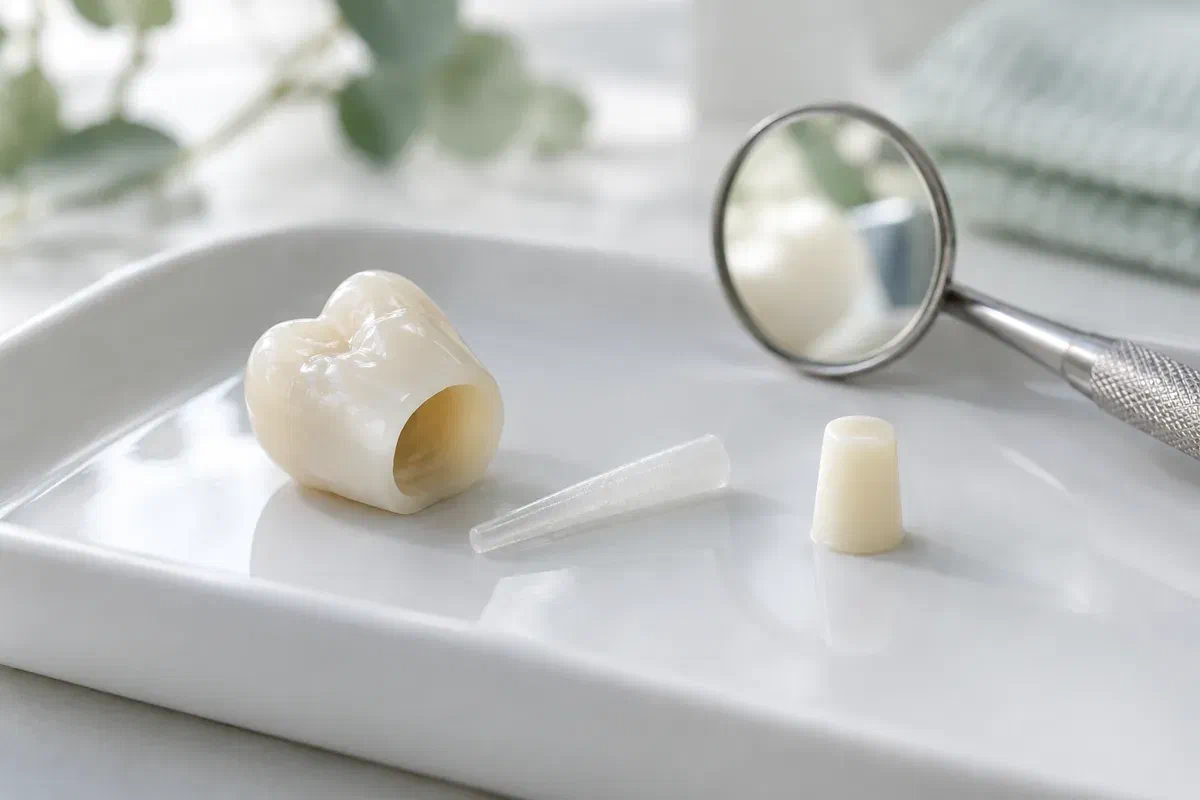
Illustrative discussion of restoring a root-treated tooth before crown placement
Restorative Dentistry

Post-and-Core Restorations

A crown needs a suitable foundation. Discuss post-and-core restorations in Milton, including when a post may help retain a build-up and why the remaining natural tooth matters.

A closer look at post-and-core restorations

Build the foundation around the tooth that remains.

When much of a tooth’s visible structure is missing, a crown may need a build-up underneath it. This build-up is called a core. In selected root-treated teeth, a post placed within part of a root canal helps retain that core when the remaining tooth cannot provide enough retention on its own.

The post, core, and crown perform different jobs. A post is not a replacement root and does not turn a badly damaged tooth into an undamaged one. The condition of the natural root, the amount of tooth above the gum, and the proposed restoration all influence whether this approach is appropriate.

At Milton Dental Clinic, the starting point is an assessment of what can reasonably be restored. Bring any information about previous root canal treatment or a crown that has come away. We can discuss the proposed foundation, alternatives, and how the remaining treatment fits together before you commit to the next stage.

Discuss a foundation for your crown
Illustrative crown, fibre post, and restorative material samples on a tray
When the foundation needs attention

Look beneath the crown proposal.

A recommendation for a post should have a specific reason. Ask what will hold the core in your tooth and which findings support the planned restoration.

Very little tooth above the gum

A heavily damaged tooth may have limited structure available for a build-up. The dentist needs to assess more than the visible opening, including root condition and surrounding support. A post is only considered if the overall restoration is still a reasonable option.

A lost crown and its foundation

If a crown comes away with material attached underneath, bring all the pieces. That material might include a core or post. The examination helps establish what has separated and whether the tooth can be rebuilt, rather than assuming the old assembly can simply be put back.

Unfinished care after root treatment

You may have completed root canal treatment and been advised to arrange a crown. Ask whether a core alone is sufficient or whether additional retention is needed. Clarify the sequence and the protection required while the final restoration is being planned.

Not every root-treated tooth needs a post. Its purpose is to retain a core when necessary, and placing one requires consideration of the tooth structure involved.

Understanding the purpose

A useful foundation has a clear reason and a realistic outlook.

For a suitable tooth, a retained core can provide the form needed for the planned crown. The goal is to restore the tooth as a functioning part of your mouth while respecting the structure that is still present. The explanation should connect each proposed component to that goal.

Ask about the overall outlook as well as the chosen material. A strong-sounding post cannot compensate for every crack or lack of natural tooth. Your decision should reflect the condition of the root, the available support, and the expected demands on the finished restoration.

Patient information: AAE — assessing whether a tooth can be restored

Separate the treatment components

Understanding which part is the post, which is the core, and which is the crown helps you follow the estimate and appointment plan. Ask the dentist to show a model or drawing if the terms are unfamiliar.

Keep preservation in the discussion

Ask how much sound tooth remains and how the proposed preparation will respect it. The appropriate restoration is not automatically the one with the most components; it is the one justified by the findings.

Plan the final crown from the start

The foundation should be considered together with the crown’s fit, shape, and role in your bite. Discuss the complete treatment rather than deciding on a post without understanding the restoration it is intended to support.

Your restoration appointments

Connect the root assessment to the finished repair.

The visits depend on the tooth and the type of restoration. Ask what will be completed at each stage and when the tooth will have its final protection.

  1. Review the tooth and previous treatment

    The dentist assesses the remaining structure, root treatment, surrounding tissues, and bite. Relevant imaging or earlier records may help. Discuss any discomfort, previous fracture, or recurring loss of a crown so those concerns are included in planning.

  2. Explain the foundation and alternatives

    You should understand why a post is proposed, which material is being considered, and what limitations remain. Ask about the full estimate, including the core, temporary protection, and final crown. Further assessment or specialist advice may be recommended before proceeding.

  3. Create the indicated build-up

    If a post is needed, an appropriate space is prepared within the previously treated canal while preserving the required root filling. The post and core are placed or fitted according to the selected design. Different approaches may involve different appointment stages.

  4. Complete the crown and review

    The crown is made and fitted as planned, with checks of its contacts and bite. Confirm the care instructions and follow-up arrangement. If the tooth remains temporarily restored, make sure you know when to return and how to protect it meanwhile.

Looking after the rebuilt tooth

Give the foundation the protection it was planned to receive.

The advice depends on whether your crown is temporary or final. Tell us if an instruction is difficult to follow so the team can help you understand the next step.

Respect the interim stage

Avoid using a temporarily restored tooth for hard or sticky foods and follow the specific guidance provided. A core that feels solid is not a reason to postpone the crown indefinitely. Contact the clinic if you cannot attend the planned completion visit.

Keep the crown margin clean

Once restored, continue daily cleaning around the tooth and between its neighbours. Ask for a demonstration if the area is difficult to reach. The crown and core do not make the remaining natural tooth immune to decay or gum problems.

Report movement or a changed bite

Call if the crown feels loose, the bite changes, or material breaks away. Do not twist or pull the restoration to identify the problem yourself. Save any detached piece and describe what happened when arranging advice.

Choosing an appropriate foundation

The amount of natural tooth helps guide the approach.

Ask what is gained and what is involved with each reasonable option. The recommendation should address your specific tooth rather than a routine preference for one system.

When existing structure provides retention

A core without a post

A build-up may be retained by the remaining tooth without extending into a root canal. Ask whether this is sufficient in your case. Avoiding an unnecessary post can preserve root structure while still providing the foundation required for the restoration.

When additional retention is justified

A post-retained core

A post may be part of the plan when the core cannot otherwise be retained appropriately. Material and design choices depend on the tooth and restoration. Discuss the benefits and risks without assuming that every post has the same role or suitability.

When the tooth’s outlook is uncertain

Reconsider the overall restoration

Additional assessment, treatment to improve the restorative situation, or removal may be discussed if the tooth cannot support a reliable repair. Ask what would be involved and whether the expected benefit justifies the complete course of care.

Post-and-core questions

Understand what is being placed, and why.

These terms can sound similar to other dental treatments. A short explanation of your own tooth is often the most helpful place to begin.

(905) 876-4488
Is a dental post the same thing as an implant?
No. A post is placed within part of an existing root-treated natural tooth to help retain a core. An implant is placed in the jaw to support replacement teeth after a natural tooth is absent. Ask which structure is being discussed if a treatment proposal uses unfamiliar terminology.
Does adding a post automatically strengthen a weak root?
No. Its role is retention of the core, and preparing space for it can involve removing tooth material. The root still needs a suitable condition and shape. Ask why the extra retention is needed and how the dentist has assessed the risks for your tooth.
What does a dentist mean by a ferrule around a crown?
The term describes the crown engaging an appropriate band of remaining natural tooth. That surrounding structure can matter to the restoration’s behaviour under load. Ask the dentist to show what is available on your tooth and whether a lack of it affects the proposed plan.
Can a post be fitted before root canal treatment is finished?
Post planning must be coordinated with the condition and treatment of the root canal. If further internal treatment is needed, that affects the sequence. Confirm that the dentist has reviewed the existing root filling and whether an endodontic opinion is appropriate before a definitive foundation is placed.
Why might a fibre post be proposed instead of a metal post?
Material selection considers the tooth, the planned crown, and the properties of the available systems. Appearance may also matter beneath some restorations. Ask for the reasons in your case rather than assuming one material is always best or that an existing post must be changed simply because it is metal.
Does a post-and-core fee include the final crown?
Not necessarily. The foundation and crown may be separate items, and earlier root treatment or temporary care may also be separate. Request a complete estimate and appointment sequence so you know which parts are included and which benefits, if any, apply to each stage.
Post-and-core restorations in Milton

Let’s understand the foundation your tooth needs.

Arrange a visit at our Bronte Street practice to discuss a damaged root-treated tooth or a proposed crown build-up. Bring previous treatment information and your questions about retaining the tooth and completing its restoration.

Please call if a crown or post has come loose or you are in significant pain. Online requests are for non-urgent enquiries.

Visit Milton Dental Clinic
Unit 1, 342 Bronte St. S, Milton, ON L9T 5B7
Get directions Clinic hours
Monday–Thursday
11am–7pm
Friday–Sunday
By appointment only

How can we help?

Milton Dental Clinic

Have a question about your smile? Choose the option that works best for you.

For urgent dental concerns, please call.
Messages are reviewed during clinic hours.