

Illustrative discussion of restoring a root-treated tooth before crown placement
Restorative Dentistry

Post-and-Core Restorations in Acton

Back teeth do the heavy chewing, so when a root-treated molar cracks apart, the rebuild has to cope with real force. From Acton, you can find out whether a core, possibly with a post, can give that tooth a dependable crown.

A back tooth under pressure

Crunch, then a hollow feeling

It often happens mid-meal. You bite on a popcorn kernel or a piece of crust, feel something give, and your tongue finds a sharp edge where a molar used to be whole. If that tooth had a root canal some time ago and never received a crown, it may have been more brittle than it looked.

Molars carry a great deal of chewing force, so rebuilding one is about more than filling a hole. Usually the missing part is replaced with a core that a crown can then cover. A post is placed into one of the treated canals only if the remaining walls cannot hold that core securely on their own. It does not reinforce the root, and a crack running down into the root may mean the tooth cannot be saved.

The first step is a careful look at what broke and what is still sound. Save any fragment and bring notes about the earlier root canal if you have them. Dr. Anjum will explain whether a rebuild is realistic, which foundation she suggests, and what alternatives exist.

Have a broken molar assessed
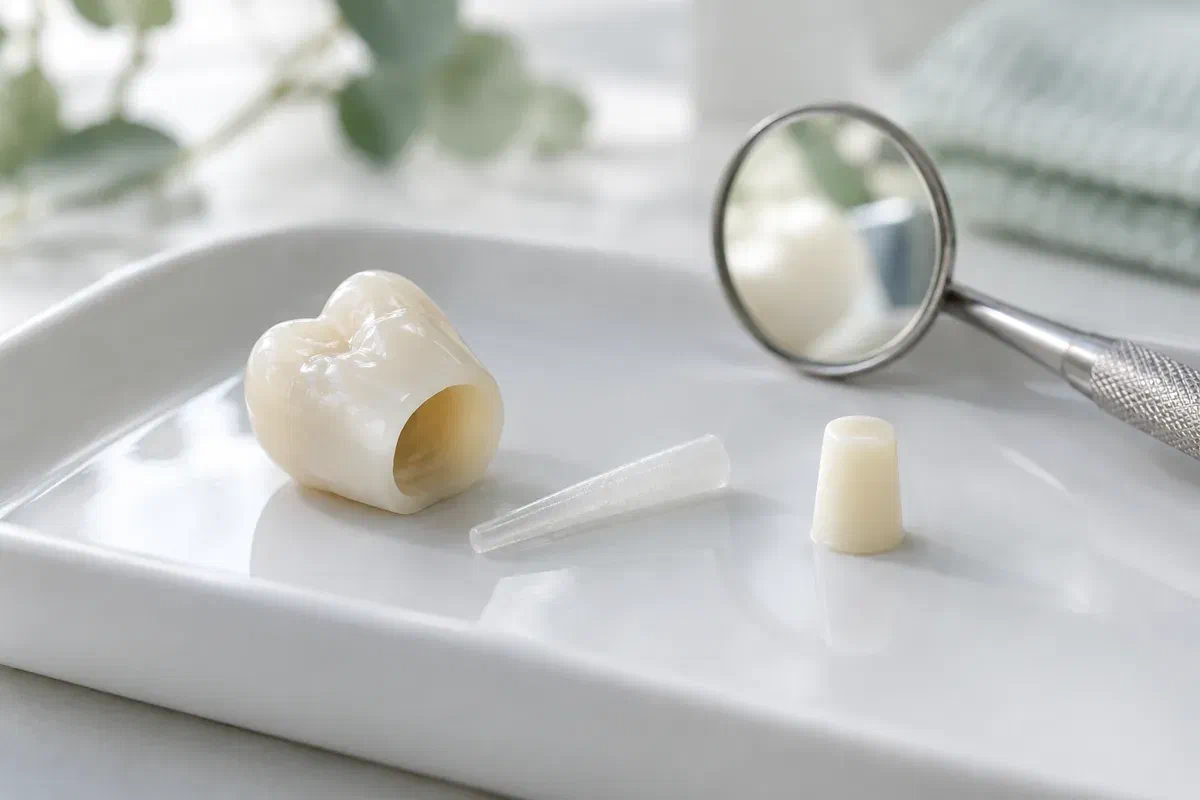
Illustrative crown, fibre post, and restorative material samples on a tray
What a broken molar can mean

Three common ways a back tooth gives out

A post suggestion should arrive with a clear explanation. Ask what will keep the core attached to your tooth and which findings support it.

A cusp has sheared away

One or more of the chewing points can break off, sometimes taking part of an old filling with it. The dentist assesses how deep the break goes, the root and the bone around it. Retention with a post is weighed only if a lasting crown still looks feasible.

A crown has lifted off a molar

When a back crown comes loose, it may bring the old core or post with it. Collect all the pieces. Examining them alongside the tooth shows whether the foundation failed or the tooth fractured, which shapes what comes next.

A root canal tooth still without a crown

Molars that have had root canal treatment but no crown are at higher risk of breaking under load. If that describes one of yours, ask whether a core alone is enough, whether a post is needed, and how soon the crown should follow.

Even a heavily broken molar may not need a post. Many have enough remaining structure to retain a core, and avoiding unnecessary post space keeps more of the root.

Built for chewing

A molar that can take a bite again

In a suitable tooth, a well-anchored core gives the crown a stable base that can stand up to the forces of chewing. The goal is to have the tooth working in your bite again without sacrificing more natural structure than necessary. Each part of the plan should earn its place against that goal.

Ask about the realistic outlook for the tooth as well as the materials. No post overcomes a vertical crack, and very thin walls limit what any crown can achieve. How the root looks, the support around it, and whether you clench or grind should all inform the decision.

Patient information: AAE — assessing whether a tooth can be restored

Learn the layers of the rebuild

Knowing which stage is the post, which is the core and which is the crown helps you follow the estimate and the visits. A model of a molar can make it easier to see.

Keep sound tooth in the plan

Ask how much healthy structure remains and how the preparation will spare it. The best foundation is the one the findings justify, not the one with the most parts.

Plan the crown and bite together

A molar crown must fit the opposing teeth and handle grinding forces. Discuss its shape, material and bite before deciding on what supports it.

Getting the molar back in use

Rebuilding a back tooth, step by step

Visits vary with the tooth and the crown design. When you book from Acton, ask which stages can be combined and how long you will wear a temporary.

  1. Check the break and the root

    Dr. Anjum examines the remaining walls, the existing root fillings in each canal, the gum and bone, and how your teeth meet. X-rays help find hidden cracks. Mention clenching, grinding or past fractures.

  2. Explain the foundation and the costs

    Expect a clear account of why a post is or is not advised, which canal it would use, the material proposed and its limitations. Ask for an estimate covering the core, any temporary and the final crown.

  3. Rebuild the core

    If a post is needed, a channel is made in the most suitable treated canal while the seal near the root tip is maintained. The core is then built up around it so the crown has a firm shape to sit on.

  4. Crown, adjust, review

    The molar crown is fitted and adjusted until your bite feels even, with contacts checked on either side. Confirm cleaning instructions and when to return. If a temporary stays on a while, ask how to look after it.

Protecting a rebuilt molar

Chew smart while the work settles

Care looks different with a temporary crown than with the final one. Tell us if any advice clashes with your routine and the team will help you adjust.

Favour the other side

Until the final crown is on, chew mostly on the opposite side and skip nuts, hard candy and sticky foods. A core that feels sturdy still needs its crown, so keep the completion visit or call to move it.

Reach the back of the mouth

Molars are hard to clean well. Brush along the gum line of the crowned tooth and floss or use small brushes between it and its neighbours. Ask us for a technique that suits your mouth.

Report a high or uneven bite

Call if the crown feels loose, your bite seems high on that side, or a piece chips away. Avoid prying at it. Keep anything that comes off and explain what you were eating when it happened.

Rebuilding options for molars

How the foundation is chosen

Ask what each realistic option involves and what it might take from the tooth. The right choice depends on your molar, not a set routine.

When enough tooth survives the break

Core held by remaining walls

Molars often have enough wall and a large enough pulp chamber to retain a bonded core without a post. Ask whether this works for your tooth. It leaves the roots undisturbed.

When the break leaves too little to grip

Core anchored with a post

If the walls are mostly gone, a post in one canal may help keep the core in place. The choice of design suits the root anatomy and the crown planned. Ask about the advantages and risks.

When the root may be cracked

Considering other paths

A deep or vertical crack can make the tooth unrestorable. In that case, further tests, specialist advice, or removal and later replacement may be discussed. Ask what each option means for you.

Molar rebuild questions

Common questions about broken back teeth

A broken molar raises many practical questions. These answers may help you prepare for the conversation about your own tooth.

(905) 876-4488
Why do root-treated molars break more easily?
Often because they have already lost structure to decay, old fillings and access for the root canal. Without a crown to cover the cusps, chewing forces can split the weakened walls. That is one reason a crown is commonly advised afterwards.
Which canal would a post go into?
In molars, the dentist usually chooses the canal with the most suitable size and shape, if a post is needed at all. Many molars are rebuilt without one. Ask how the choice was made.
Can I keep chewing on the broken tooth?
It is better not to. Sharp edges can irritate your tongue, and biting on a broken tooth may make the damage worse. Chew on the other side and call to arrange an assessment.
Will grinding at night affect the new crown?
Clenching and grinding put extra force on restorations. If you do either, tell your dentist. A night guard may be discussed to help protect the crown and your other teeth.
Does a ferrule matter for a molar crown?
It can. A ferrule is a band of natural tooth the crown wraps around, and having enough of it helps the restoration cope with chewing. Ask how much is present on your tooth and how it affects the plan.
Is it possible to fit the visits around shift work?
Often, yes. Mention your schedule when booking from Acton, and ask at the assessment how many visits are needed and which can be grouped. Our weekday hours run into the evening, and weekend visits are by appointment.
Acton post-and-core assessments

Broken molar? Let’s see what can be rebuilt.

Book an assessment at our Bronte Street practice for a cracked or broken back tooth, especially one that has had a root canal. Bring any fragments and records, and we will talk through whether and how it can carry a crown again.

If you are in significant pain or notice swelling after a tooth breaks, please call the clinic. Online requests are for non-urgent visits.

Visit Milton Dental Clinic
Unit 1, 342 Bronte St. S, Milton, ON L9T 5B7
Get directions Clinic hours
Monday–Thursday
11am–7pm
Friday–Sunday
By appointment only

Areas we serve

  • Milton
  • Oakville
  • Mississauga
  • Georgetown
  • Halton Hills
  • Acton
  • Campbellville
  • Brampton
  • Burlington
  • Puslinch
  • Rockwood
  • Erin
  • Caledon
  • Etobicoke
  • Old Milton
  • Bronte Meadows
  • Timberlea
  • Dorset Park
  • Dempsey
  • Clarke
  • Beaty
  • Coates
  • Harrison
  • Scott
  • Willmott
  • Ford
  • Bowes
  • Cobden
  • Walker
  • Mountain View
  • Milton Heights
  • Hawthorne Village
  • Valley View
  • Fallingbrook
  • Nassagaweya
  • Trafalgar
  • Esquesing
  • Nelson
  • Brookville
  • Moffat
  • Glen Williams
  • Norval
  • Limehouse
  • Stewarttown
  • Ashgrove
  • Hornby
  • Silver Creek
  • Speyside
  • Scotch Block
  • North Oakville
  • River Oaks
  • Glen Abbey
  • West Oak Trails
  • Palermo
  • Bronte Creek
  • College Park
  • Joshua Creek
  • Uptown Core
  • Preserve
  • Iroquois Ridge
  • Lisgar
  • Meadowvale
  • Meadowvale Village
  • Churchill Meadows
  • Erin Mills
  • Central Erin Mills
  • Streetsville
  • East Credit
  • Creditview
  • Heartland
  • Sheridan
  • Mount Pleasant
  • Credit Valley
  • Huttonville
  • Churchville
  • Springbrook
  • Northwest Brampton
  • Bram West
  • Fletcher's Meadow
  • Fletcher's Creek South
  • Alton Village
  • Orchard
  • Millcroft
  • Headon Forest
  • Tansley
  • Brant Hills
  • Tyandaga
  • Kilbride
  • Lowville
  • Aberfoyle
  • Morriston
  • Arkell
  • Hillsburgh
  • Freelton
  • Carlisle
  • Waterdown
  • Flamborough
  • Mountsberg

How can we help?

Milton Dental Clinic

Have a question about your smile? Choose the option that works best for you.

For urgent dental concerns, please call.
Messages are reviewed during clinic hours.