

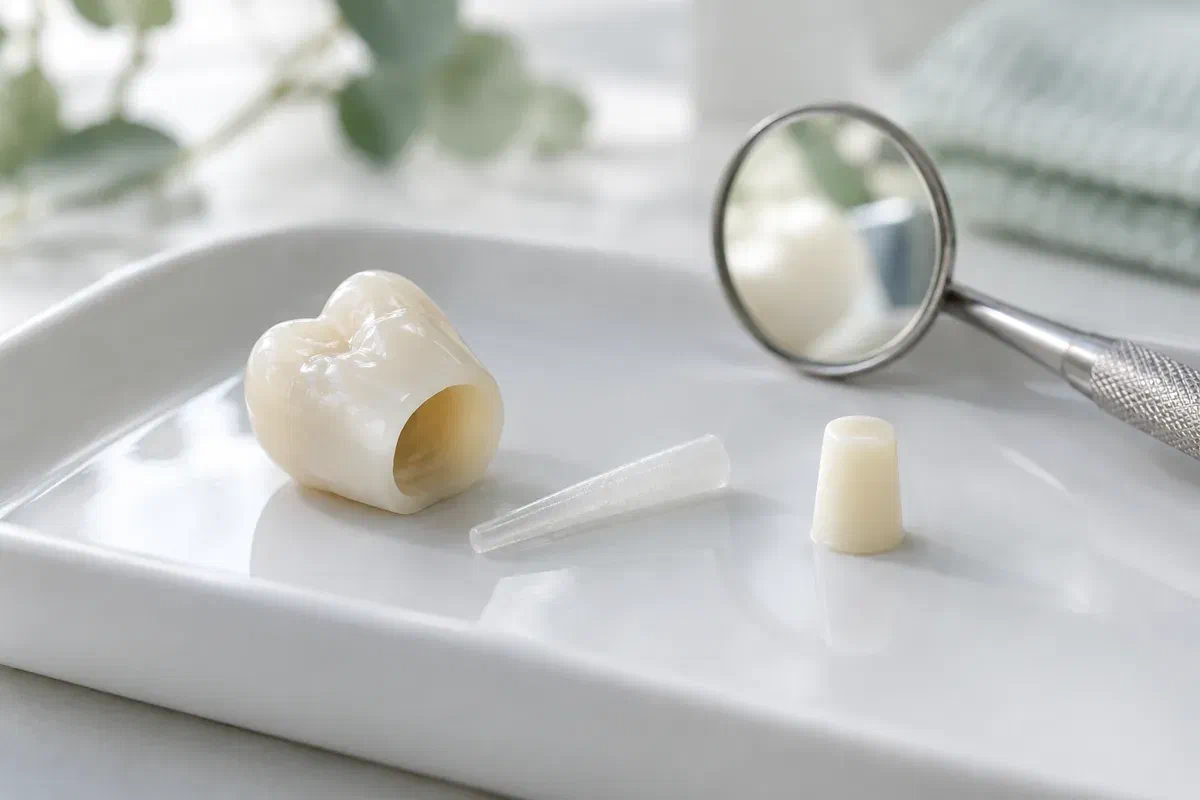
Illustrative discussion of restoring a root-treated tooth before crown placement
Restorative Dentistry

Post-and-Core Restorations in Brampton

A front tooth that snaps near the gum is hard to ignore, especially when you smile. If you are travelling from Brampton, we look at the root underneath, discuss whether a post and core can support a natural-looking crown, and explain the limits honestly.

When a front tooth breaks

A gap in your smile, a root still in place

Front teeth that have had root canal treatment can become brittle over the years, and sometimes one breaks off while you are biting into something ordinary. What is left may be a root sitting level with the gum. It looks alarming, yet in some cases that root can still anchor a new tooth-coloured crown.

To get there, the missing part of the tooth is rebuilt as a core. With so little natural structure above the gum, a post placed into the treated canal often helps keep that core in place. The post is a holder, not a substitute root. If the root is cracked, too short or poorly supported, no post will change that.

Your first visit is about learning what is possible. Bring any broken piece and records of the earlier root canal. Dr. Anjum will check the root, the gum line and your bite, and talk through the restoration options, including how each may look, before any treatment is scheduled.

Talk about a broken front tooth
Illustrative crown, fibre post, and restorative material samples on a tray
What the dentist checks

Is there enough to build on?

Suggesting a post should come with clear findings. Ask what will hold the core, and why the dentist believes the root can take it.

The break is at or below the gum

When a tooth snaps low, the amount of sound structure just under the gum becomes important. The dentist checks the root length, the gum and bone around it, and whether a crown can grip enough natural tooth. A post is considered only if a lasting restoration still looks realistic.

An old crown came off whole

Front crowns sometimes come out with a post or core attached. Keep them in a container and bring them in. The exam helps show what separated and whether the root is still suitable, instead of assuming the old assembly can simply go back in.

Discoloured or tender after root treatment

A root-treated front tooth can darken or feel tender. Ask whether the root needs review before a foundation is placed, whether a core alone is enough, and how the tooth will be protected and look while the final crown is made.

Root canal treatment on a front tooth does not mean a post is automatic. One is added only when the core needs help staying in place, and it is planned with the root’s condition in mind.

Function and appearance

A crown that looks right needs a foundation that holds.

With a suitable root, a well-retained core gives a front crown the right length and shape, so it can blend in and handle biting. The goal is to bring back a tooth that works and looks natural while protecting what remains of your own tooth. Every element of the plan should connect to that.

Ask about the tooth’s outlook as well as the colour of the crown. No post compensates for a deep crack or very little root wall. Root condition, gum and bone support, and how your front teeth meet should all shape the decision.

Patient information: AAE — assessing whether a tooth can be restored

Learn the layers

Post, core and crown each do something different. Seeing them named on a diagram makes it easier to follow the plan and the estimate, and to ask good questions about each one.

Protect the root you have

Ask how much sound tooth remains and how the post space would be prepared to conserve it. More components are not better by default. The right plan is the one the findings support.

Think about the smile from the start

The core shapes how the front crown will sit, its edge position and its colour beneath. Discuss the finished look and bite before deciding what goes underneath it.

The path to a new front crown

Assess, plan, rebuild, crown

Visit numbers vary with the tooth and the crown material. Ask how long a temporary will be in place, how it will look, and when the final crown will be fitted.

  1. Look closely at the root

    The dentist examines what is left of the tooth, the existing root filling, the gum line and your bite. X-rays help judge root length and any cracks. Mention past knocks to the mouth, pain or crowns that have loosened before.

  2. Discuss looks, limits and cost

    You should understand why a post is suggested, which material is proposed and how it may affect appearance under the crown. Ask for an estimate covering the core, temporary and final crown, and whether a specialist view would help.

  3. Place the post and core

    If a post is needed, space is made inside the treated canal while a seal of root filling is kept near the tip. With the post seated, the core is shaped around it, and a temporary crown usually covers the tooth so you are not left with a gap.

  4. Fit the final crown

    The finished crown is fitted and checked for shade, shape, contacts and bite. Confirm how to look after it and when to come back. If the temporary will stay on for a while, ask how to protect it until then.

Caring for a front restoration

Bite with care, clean with attention

Advice changes once the final crown is on. Tell us if any instruction is tricky to follow, and we will help you find a practical routine.

Do not bite into hard foods with it

With a temporary front crown, avoid biting directly into apples, crusty bread or anything hard. Cut food into pieces instead. Keep the appointment for the final crown, and call ahead if you need to change it.

Clean along the gum line

Brush gently at the gum edge and floss on both sides every day. Ask for a demonstration if the area is sensitive or hard to see. The root under the crown can still decay or develop gum problems.

Notice changes early

Phone if the crown moves, your bite feels different or a corner chips. Do not test it by pressing with your tongue or fingers. Keep any piece that comes away and describe what happened.

Ways to rebuild a front tooth

Three possible plans for a broken incisor

Ask what each option offers and what it involves. The advice should reflect your root and your smile, not a default system.

When enough tooth remains above the gum

Build-up without a post

Sometimes the remaining walls can hold a core without reaching into the canal. Ask whether that is possible for you. Avoiding an unnecessary post keeps more of the root intact.

When the core needs anchoring

Post-retained build-up

With a low break, a post may be needed to keep the core secure. Fibre and metal posts behave differently, and the choice can affect how the crown looks. Ask about the benefits and risks for your tooth.

When the root may not hold

A different restoration altogether

If the root is not likely to support a reliable crown, further assessment, treatment to improve the situation, or removal and a replacement may be discussed. Ask what each involves and whether the benefit justifies the full course of care.

Front tooth questions

What people ask when an incisor breaks

These situations feel urgent, and the terms can be confusing. A calm explanation of your own tooth is usually the best first step.

(905) 876-4488
Will I have a gap while the crown is being made?
Usually not. A temporary crown is normally placed so the tooth looks reasonably complete in between visits. It is not as strong as the final crown, so treat it gently and follow the instructions you are given.
Can the new crown match my other front teeth?
Matching shade and shape is part of planning a front crown. The core and post material underneath can influence the final appearance, which is one reason material choice matters. Ask to discuss shade before the crown is made.
Why would a fibre post suit a front tooth?
Fibre posts are tooth-coloured and may be considered under translucent crowns, among other reasons. They are not always the right choice. Ask your dentist to explain the reasoning in your case, including the root’s shape and condition.
What if the broken piece is still in one part?
Bring it in a clean container with a little water or milk. In some situations a fragment can be useful, but often the tooth needs rebuilding regardless. The exam will show what is possible.
Does the post go into the bone like an implant?
No. A post stays inside your own treated root. An implant is placed in the jawbone after a tooth is gone. Ask which one is meant if a treatment plan is unclear.
Is it worth the trip from Brampton for a front crown?
That depends on what suits you. Ask how many visits are likely, which can be combined, and how long a temporary will be worn. Knowing the sequence in advance helps you plan time away from work or family commitments.
Brampton post-and-core care

Let’s see what your front tooth can support.

Book an assessment at our Bronte Street practice for a broken or root-treated front tooth. Bring any fragment, previous records and your questions about appearance, and we will go through the options with you.

If a front tooth has broken and you are in significant pain or there is swelling, please call the clinic. Online requests are for non-urgent bookings.

Visit Milton Dental Clinic
Unit 1, 342 Bronte St. S, Milton, ON L9T 5B7
Get directions Clinic hours
Monday–Thursday
11am–7pm
Friday–Sunday
By appointment only

Areas we serve

  • Milton
  • Oakville
  • Mississauga
  • Georgetown
  • Halton Hills
  • Acton
  • Campbellville
  • Brampton
  • Burlington
  • Puslinch
  • Rockwood
  • Erin
  • Caledon
  • Etobicoke
  • Old Milton
  • Bronte Meadows
  • Timberlea
  • Dorset Park
  • Dempsey
  • Clarke
  • Beaty
  • Coates
  • Harrison
  • Scott
  • Willmott
  • Ford
  • Bowes
  • Cobden
  • Walker
  • Mountain View
  • Milton Heights
  • Hawthorne Village
  • Valley View
  • Fallingbrook
  • Nassagaweya
  • Trafalgar
  • Esquesing
  • Nelson
  • Brookville
  • Moffat
  • Glen Williams
  • Norval
  • Limehouse
  • Stewarttown
  • Ashgrove
  • Hornby
  • Silver Creek
  • Speyside
  • Scotch Block
  • North Oakville
  • River Oaks
  • Glen Abbey
  • West Oak Trails
  • Palermo
  • Bronte Creek
  • College Park
  • Joshua Creek
  • Uptown Core
  • Preserve
  • Iroquois Ridge
  • Lisgar
  • Meadowvale
  • Meadowvale Village
  • Churchill Meadows
  • Erin Mills
  • Central Erin Mills
  • Streetsville
  • East Credit
  • Creditview
  • Heartland
  • Sheridan
  • Mount Pleasant
  • Credit Valley
  • Huttonville
  • Churchville
  • Springbrook
  • Northwest Brampton
  • Bram West
  • Fletcher's Meadow
  • Fletcher's Creek South
  • Alton Village
  • Orchard
  • Millcroft
  • Headon Forest
  • Tansley
  • Brant Hills
  • Tyandaga
  • Kilbride
  • Lowville
  • Aberfoyle
  • Morriston
  • Arkell
  • Hillsburgh
  • Freelton
  • Carlisle
  • Waterdown
  • Flamborough
  • Mountsberg

How can we help?

Milton Dental Clinic

Have a question about your smile? Choose the option that works best for you.

For urgent dental concerns, please call.
Messages are reviewed during clinic hours.