

Illustrative discussion of restoring a root-treated tooth before crown placement
Restorative Dentistry

Post-and-Core Restorations in Georgetown

Fibre, metal, custom-cast or built directly in the mouth: posts and cores come in several forms. From Georgetown, you can learn how materials are chosen, and why your tooth’s condition matters more than the label.

What is it made of?

Materials matter, but the tooth matters more

Search online and you will find strong opinions about fibre posts versus metal ones, or prefabricated versus custom-made. It is reasonable to want to know what will go into your tooth. The more useful question, though, is what your tooth needs from a foundation, because that guides which material makes sense.

A core rebuilds lost tooth so a crown can be fitted over it. When too little natural wall remains to keep the core in place, a post may be set into part of the already treated root canal to anchor it. Posts can be made of fibre-reinforced resin or of metal, and cores can be built directly or crafted in a lab. None of these options turns a weak root into a strong one.

Your appointment starts with the tooth, not a catalogue. Dr. Anjum will look at the remaining structure, the root and the crown that is planned, then explain which approach she suggests and why. Bring any records of past root canal work, or a crown that has come away.

Discuss materials for your tooth
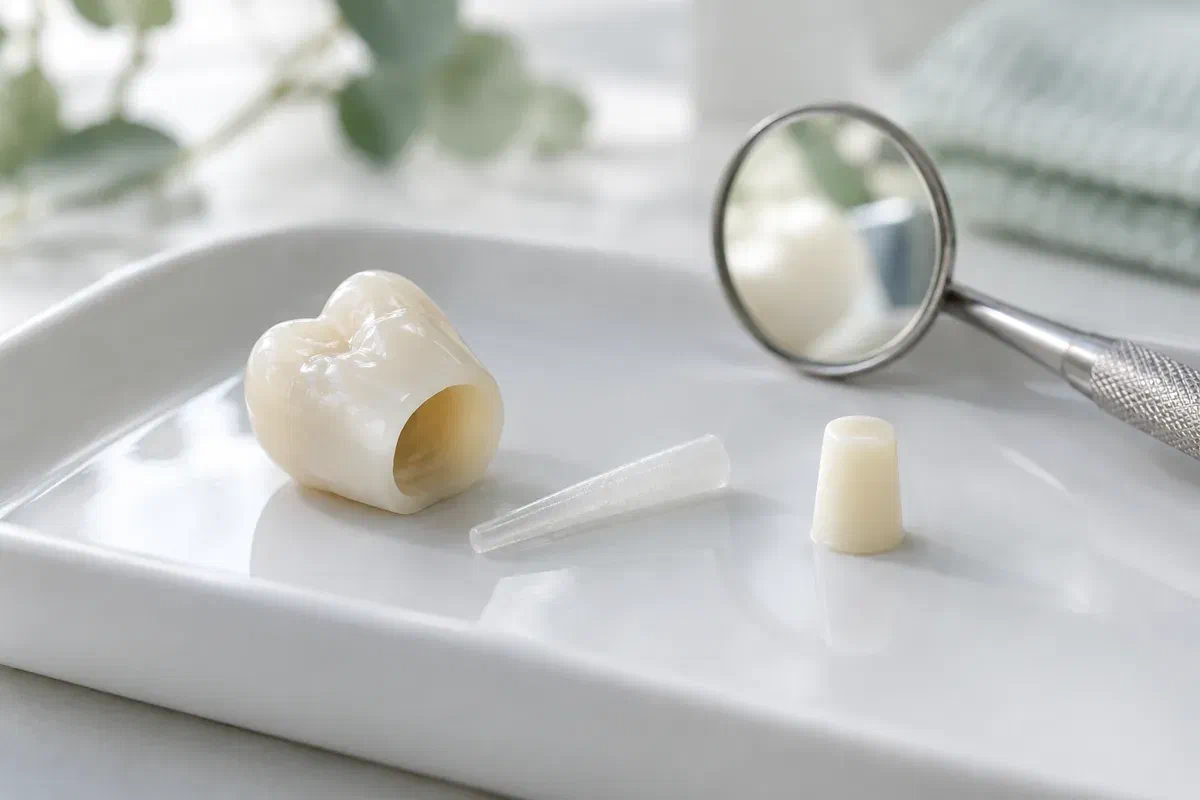
Illustrative crown, fibre post, and restorative material samples on a tray
Reasons to look closer

When foundation choices come up

If a particular post is recommended, you can ask why that one and why now. The answer should tie back to what was found in your tooth.

Very little crown of the tooth left

With most of the visible tooth gone, there may be little for a core to bond to. The dentist assesses the root and its surrounding support as well. Material choice only matters once a lasting restoration still looks achievable.

An old post came out with the crown

Older posts, often metal, sometimes come out attached to a crown. Keep them. Seeing what type was used and why it separated helps the dentist decide whether a new foundation is possible and which design would suit.

A recent root canal, crown still to come

If you have just finished root canal treatment, ask whether the tooth can be rebuilt with a core alone, or whether extra retention is needed. Ask too how the tooth should be protected while the crown is being arranged.

A post is a means of holding a core, not a mark of quality. Plenty of root-treated teeth are restored well without one, and any post uses up some root structure.

Choosing with care

The right material for the job in front of it

When the tooth is suitable, a secure core gives the crown a sound base and a proper outline. Materials differ in stiffness, colour and how they bond, and the dentist weighs these against your tooth’s shape and the crown planned. The aim is a working tooth that keeps as much of its own structure as possible.

No material can compensate for a cracked root or a tooth with very thin walls. Ask how the root’s condition, the gum and bone support, and the load on that tooth have shaped the choice, rather than focusing on the brand or the material alone.

Patient information: AAE — assessing whether a tooth can be restored

Ask for the reasoning

A good recommendation comes with a reason: why fibre or metal, why direct or lab-made. Ask the dentist to talk you through it using a model or your x-ray.

Weigh what preparation removes

Different post designs need different amounts of space inside the root. Ask how the proposed option conserves sound tooth, and whether a core alone would do.

Match the foundation to the crown

An all-ceramic crown and a metal-based one may call for different cores underneath. Discuss the crown’s material, colour and bite before settling on what supports it.

How it is made and fitted

Direct or indirect, the steps are similar

A core built in the mouth and one made in a lab follow slightly different paths. If you are coming from Georgetown, ask how many visits your chosen approach needs and when the crown will be fitted.

  1. Assess and image

    First comes a close look at how much tooth is left, how the earlier root treatment has held up, the health of the surrounding gum, and the way your teeth come together. X-rays are taken where needed, and records of earlier work help. Tell us about any pain or crowns that have loosened before.

  2. Choose and explain

    Here you will hear which post and core design is proposed and why, what it can and cannot achieve, and the full estimate including any temporary and the final crown. A specialist’s input is sometimes recommended.

  3. Prepare and fit

    For a post, part of the root filling is removed to make room, with a sealing portion left near the tip. A direct core is built at the same visit; an indirect one is shaped from an impression and fitted later.

  4. Crown and review

    The crown is made and seated, then checked for fit, contacts and bite. Confirm the care routine and the follow-up date. If a temporary bridges the gap, find out how long it will be in place.

After placement

Care that suits every material

Whatever the post or core is made of, the temporary stage needs a gentler routine than the finished crown. Tell us if any advice is hard to follow.

Treat the temporary as temporary

Avoid hard and sticky foods on that side until the final crown is fitted. A core can feel solid and still be vulnerable without its cover, so attend the completion visit or call to rebook.

Clean the margin daily

Brush along the gum line of the crowned tooth and floss on either side each day. Ask for a demonstration if the spot is awkward. Natural tooth at the crown edge remains prone to decay.

Call about changes

Get in touch if the crown feels loose, your bite changes or a piece chips. Avoid fiddling with it. Keep anything that comes away to show the dentist.

Design choices

Matching the foundation to the tooth

For each reasonable approach, ask what it offers and what it takes from the tooth. The choice should reflect your case, not a single preferred system.

When the walls can carry the build-up

A direct core alone

Where enough natural tooth remains, a bonded core may hold without any post. Ask if that is possible for you; leaving the canal alone preserves more root.

When the build-up needs anchorage

A post with its core

Fibre and metal posts, prefabricated or custom, each have uses. The dentist chooses based on the root shape, the remaining tooth and the crown planned. Ask about the trade-offs in your situation.

When the tooth may not hold a repair

Reconsidering restoration

If the root or remaining tooth looks unreliable, the dentist may suggest more assessment, treatment to improve the outlook, or removal. Ask what each path means for you in time and expected result.

Material questions

What goes into a post and core?

Material talk can quickly get technical. These answers cover the questions that come up most, in everyday language.

(905) 876-4488
What is a fibre post made of?
Typically glass or similar fibres set in resin, bonded into the canal. It is tooth-coloured and has different stiffness from metal. Whether it suits your tooth depends on the root and the crown planned.
Is a custom-cast post better than a prefabricated one?
Neither is better across the board. A cast post is made to the shape of your canal, while a prefabricated post comes in set sizes. The right choice depends on the root and how much tooth remains.
Should my old metal post be swapped for fibre?
Not just because it is metal. If the tooth is healthy and the crown fits, it may be left alone, since removing a post carries risk to the root. Replacement is considered when something has failed.
Can a core be made in the same visit?
A direct core, built from filling material, is usually completed in one appointment. A lab-made core needs an impression and a second visit for fitting. Ask which approach is proposed.
Does post material affect the colour of my crown?
It can, under some thin or translucent crowns, especially on front teeth. For many back teeth it makes little visible difference. Ask whether appearance is a factor for your tooth.
Do allergies affect which post is used?
If you have a known metal sensitivity or allergy, tell your dentist before treatment. It can be considered when choosing post and core materials. Mention any medical history updates at each visit.
Post-and-core consultations, Georgetown

Ask us what we would use, and why.

Curious about the materials proposed for a new foundation, or holding an old post that came out with your crown? Our Bronte Street team can talk it through. Bring any records or pieces, and we will explain the choices and the reasons behind them.

A painful or swollen tooth after a restoration loosens is best handled by phone, not online. Online booking is for non-urgent visits.

Visit Milton Dental Clinic
Unit 1, 342 Bronte St. S, Milton, ON L9T 5B7
Get directions Clinic hours
Monday–Thursday
11am–7pm
Friday–Sunday
By appointment only

Areas we serve

  • Milton
  • Oakville
  • Mississauga
  • Georgetown
  • Halton Hills
  • Acton
  • Campbellville
  • Brampton
  • Burlington
  • Puslinch
  • Rockwood
  • Erin
  • Caledon
  • Etobicoke
  • Old Milton
  • Bronte Meadows
  • Timberlea
  • Dorset Park
  • Dempsey
  • Clarke
  • Beaty
  • Coates
  • Harrison
  • Scott
  • Willmott
  • Ford
  • Bowes
  • Cobden
  • Walker
  • Mountain View
  • Milton Heights
  • Hawthorne Village
  • Valley View
  • Fallingbrook
  • Nassagaweya
  • Trafalgar
  • Esquesing
  • Nelson
  • Brookville
  • Moffat
  • Glen Williams
  • Norval
  • Limehouse
  • Stewarttown
  • Ashgrove
  • Hornby
  • Silver Creek
  • Speyside
  • Scotch Block
  • North Oakville
  • River Oaks
  • Glen Abbey
  • West Oak Trails
  • Palermo
  • Bronte Creek
  • College Park
  • Joshua Creek
  • Uptown Core
  • Preserve
  • Iroquois Ridge
  • Lisgar
  • Meadowvale
  • Meadowvale Village
  • Churchill Meadows
  • Erin Mills
  • Central Erin Mills
  • Streetsville
  • East Credit
  • Creditview
  • Heartland
  • Sheridan
  • Mount Pleasant
  • Credit Valley
  • Huttonville
  • Churchville
  • Springbrook
  • Northwest Brampton
  • Bram West
  • Fletcher's Meadow
  • Fletcher's Creek South
  • Alton Village
  • Orchard
  • Millcroft
  • Headon Forest
  • Tansley
  • Brant Hills
  • Tyandaga
  • Kilbride
  • Lowville
  • Aberfoyle
  • Morriston
  • Arkell
  • Hillsburgh
  • Freelton
  • Carlisle
  • Waterdown
  • Flamborough
  • Mountsberg

How can we help?

Milton Dental Clinic

Have a question about your smile? Choose the option that works best for you.

For urgent dental concerns, please call.
Messages are reviewed during clinic hours.