

Illustrative discussion of restoring a root-treated tooth before crown placement
Restorative Dentistry

Post-and-Core Restorations in Halton Hills

Pin, peg, post, build-up, core: dental words pile up fast when a tooth needs rebuilding. For households across Halton Hills, we sort out the vocabulary first, then explain what your own tooth actually needs under its crown.

Sorting out the terms

Words first, then the tooth

People often leave a dental visit repeating a word they half caught. A relative mentions the peg in their old crown; a friend talks about an implant post. When your own dentist says you may need a post and core, it is natural to wonder which of these things is meant and why.

In plain terms, a core is tooth-coloured or metal filling material that rebuilds the missing bulk of a tooth, so a crown has a shape to sit over. A post is a slim rod placed partway into a root canal that has already been treated, used only when the core would not stay put on what remains. The crown is the cap over the top. A post does not grow into bone and it is not a spare root, and it cannot fix a tooth that is fractured through.

Once the words make sense, the real question is about your tooth. Dr. Anjum will look at how much is left above the gum, the health of the root, and the crown it needs to carry, then explain what she recommends and why. Bring any old records or a crown that has come away.

Ask what your tooth needs
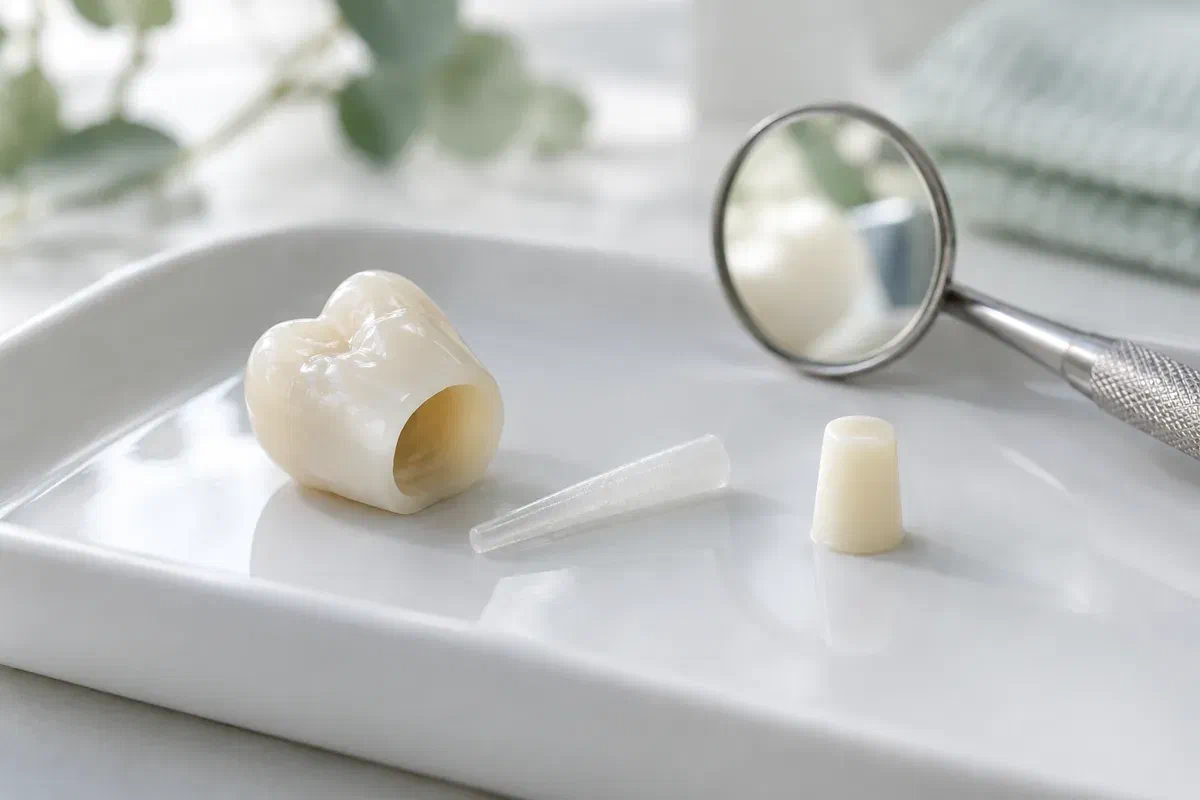
Illustrative crown, fibre post, and restorative material samples on a tray
When the term comes up

Where a post might enter the conversation

A post should only be proposed for a reason you can repeat back. Ask what will hold the core and what the dentist saw that led to that suggestion.

A tooth worn or broken to a stub

Heavy decay, an old large filling or a fracture can leave little standing. The dentist assesses the root and the gum and bone around it, not only the stub you can see. Retention with a post is weighed only if a dependable restoration is still in reach.

A crown with something stuck inside

When a crown comes off with a small rod or chunk attached, that is likely the old post or core. Keep every piece. Examining them alongside the tooth shows what gave way and whether a new foundation is possible.

A treated tooth waiting for its cap

After a root canal, many people are told a crown is next. That is a good moment to ask whether a core by itself is enough, whether a post is needed, and how to keep the tooth safe in the meantime.

A root canal and a post are not a package deal. Many treated teeth never receive a post, because the remaining tooth already holds the core well.

What the parts achieve

Each piece has one job to do.

In a suitable tooth, a well-retained core gives the crown the height and outline it needs to fit snugly and handle chewing. The point is to keep a natural tooth working while sparing the structure it still has. Once you know the vocabulary, you can check that each part of a plan actually serves that point.

Names of materials matter less than the tooth’s overall outlook. A post cannot hold a cracked root together or create tooth that is no longer there. Ask how the root’s condition, the surrounding support, and the forces on that tooth have shaped the recommendation.

Patient information: AAE — assessing whether a tooth can be restored

Point to each part

Ask the dentist to show you the post, core and crown on an x-ray or a model. Once you can point to each one, the estimate and the order of appointments become much easier to follow.

Ask about the tooth being kept

How much sound structure is left, and how will the preparation conserve it? A plan with fewer parts can be the better one when the findings support it.

Keep the crown in the picture

The core is shaped around the crown it supports, including how it fits, how it looks and how it meets the opposing teeth. Discuss the finished crown before deciding what goes underneath.

In order

What happens, appointment by appointment

Every tooth is different, and so is the number of visits. If you are coming from Georgetown, Acton or one of the smaller hamlets, ask which stages can be grouped and when the permanent crown will go on.

  1. Find out what is there

    Dr. Anjum looks at what is left of the tooth, how the old root canal looks, the gum around it and how you chew. X-rays show whether an old post is already present and how the root looks. Mention aches, past breaks or crowns that have come loose.

  2. Hear the plan in plain language

    Expect to hear whether the core needs a post to stay put, the material being considered and what it cannot do. Ask for a written estimate showing the core, any temporary and the final crown, and whether a specialist should weigh in.

  3. Build up the tooth

    Where a post is required, a narrow space is shaped in the treated canal and a protective portion of root filling is left at the end. The core is built around or onto the post, either directly or from a lab-made design.

  4. Cap it and check the bite

    The crown goes on and is adjusted until your teeth meet comfortably and the contacts feel right. Confirm cleaning instructions and when to return. If a temporary is staying on for now, note the date of the next visit.

Living with the rebuilt tooth

Simple care that protects the work

There is one set of tips for the temporary stage and another once the crown is final. Let us know if anything is hard to manage, and we will help you adapt.

Baby the temporary a little

Hard candy, ice, nuts and sticky toffee are best avoided on a temporarily restored tooth. Feeling solid is not the same as being finished, so keep your crown appointment and call if it needs to change.

Floss right up to the cap

Clean daily around the crowned tooth and on both sides of it. If floss shreds or the area is hard to see, ask for another technique. The tooth underneath a crown can still decay at the edge.

Pay attention to looseness

A crown that rocks, a bite that feels different, or a chipped corner all deserve a call. Please do not try to wiggle it free. Hold on to any piece that comes away and tell us how it happened.

Approaches explained

Post or no post: how the choice is made

Ask what each option involves and what it would cost the tooth. A good recommendation fits your situation rather than one favourite technique.

When remaining tooth gives enough grip

Core, no post

Plenty of teeth can hold a build-up on their own walls. If yours can, the canal is left alone, which keeps more of the root. Ask the dentist to explain how they judged that.

When the build-up needs an anchor

Core held by a post

If the core would likely work loose without help, a post may be added. Materials and shapes vary, and the right one depends on the tooth and crown. Ask what the advantages and trade-offs are for you.

When restoring may not be wise

Another plan entirely

Sometimes a tooth is too compromised to rebuild with confidence. More assessment, treatment to improve the situation, or removal may be discussed. Weigh what each would involve against the benefit you could expect.

Vocabulary questions

Common terms, plainly explained

Dental language borrows the same words for very different things. These short answers may help before your visit.

(905) 876-4488
Is a pin the same as a post?
Not quite. Some older fillings used small pins in the tooth to help hold material, while a post sits inside a treated root canal. People often use the words loosely, so ask your dentist which one is in your tooth.
What is a build-up, exactly?
It is another name for a core: restorative material that replaces missing tooth so a crown has a proper shape to fit over. A build-up may or may not be held by a post.
Why does the word post also appear with implants?
Implant systems include parts that are sometimes called posts or abutments, which attach to an implant in the jaw. A post-and-core goes inside your own treated tooth. The two are unrelated treatments.
Does the core need a crown on top?
Usually, yes. A core is designed as a foundation, and on its own it is not normally meant to take full chewing forces. The dentist will explain the plan for covering it.
What does root-treated mean on my chart?
It means the tooth has had root canal treatment, where the inner pulp was removed and the canal sealed. Only root-treated teeth can receive a post, because the post sits in that treated space.
Who in the family should come to the appointment?
Whoever has the tooth, of course, and anyone who helps make decisions or will drive them home. Families in Halton Hills often find it useful to plan visits together; just mention it when booking so we can schedule appropriately.
Halton Hills post-and-core care

Bring your questions. We’ll bring the diagrams.

A root-treated tooth, a proposed post or a crown that has come loose are all good reasons to sit down with us on Bronte Street. Bring old records, any pieces and a list of the terms that have been puzzling you.

Pain or swelling after a restoration comes out calls for a phone call rather than an online form. Online requests suit non-urgent questions.

Visit Milton Dental Clinic
Unit 1, 342 Bronte St. S, Milton, ON L9T 5B7
Get directions Clinic hours
Monday–Thursday
11am–7pm
Friday–Sunday
By appointment only

Areas we serve

  • Milton
  • Oakville
  • Mississauga
  • Georgetown
  • Halton Hills
  • Acton
  • Campbellville
  • Brampton
  • Burlington
  • Puslinch
  • Rockwood
  • Erin
  • Caledon
  • Etobicoke
  • Old Milton
  • Bronte Meadows
  • Timberlea
  • Dorset Park
  • Dempsey
  • Clarke
  • Beaty
  • Coates
  • Harrison
  • Scott
  • Willmott
  • Ford
  • Bowes
  • Cobden
  • Walker
  • Mountain View
  • Milton Heights
  • Hawthorne Village
  • Valley View
  • Fallingbrook
  • Nassagaweya
  • Trafalgar
  • Esquesing
  • Nelson
  • Brookville
  • Moffat
  • Glen Williams
  • Norval
  • Limehouse
  • Stewarttown
  • Ashgrove
  • Hornby
  • Silver Creek
  • Speyside
  • Scotch Block
  • North Oakville
  • River Oaks
  • Glen Abbey
  • West Oak Trails
  • Palermo
  • Bronte Creek
  • College Park
  • Joshua Creek
  • Uptown Core
  • Preserve
  • Iroquois Ridge
  • Lisgar
  • Meadowvale
  • Meadowvale Village
  • Churchill Meadows
  • Erin Mills
  • Central Erin Mills
  • Streetsville
  • East Credit
  • Creditview
  • Heartland
  • Sheridan
  • Mount Pleasant
  • Credit Valley
  • Huttonville
  • Churchville
  • Springbrook
  • Northwest Brampton
  • Bram West
  • Fletcher's Meadow
  • Fletcher's Creek South
  • Alton Village
  • Orchard
  • Millcroft
  • Headon Forest
  • Tansley
  • Brant Hills
  • Tyandaga
  • Kilbride
  • Lowville
  • Aberfoyle
  • Morriston
  • Arkell
  • Hillsburgh
  • Freelton
  • Carlisle
  • Waterdown
  • Flamborough
  • Mountsberg

How can we help?

Milton Dental Clinic

Have a question about your smile? Choose the option that works best for you.

For urgent dental concerns, please call.
Messages are reviewed during clinic hours.