

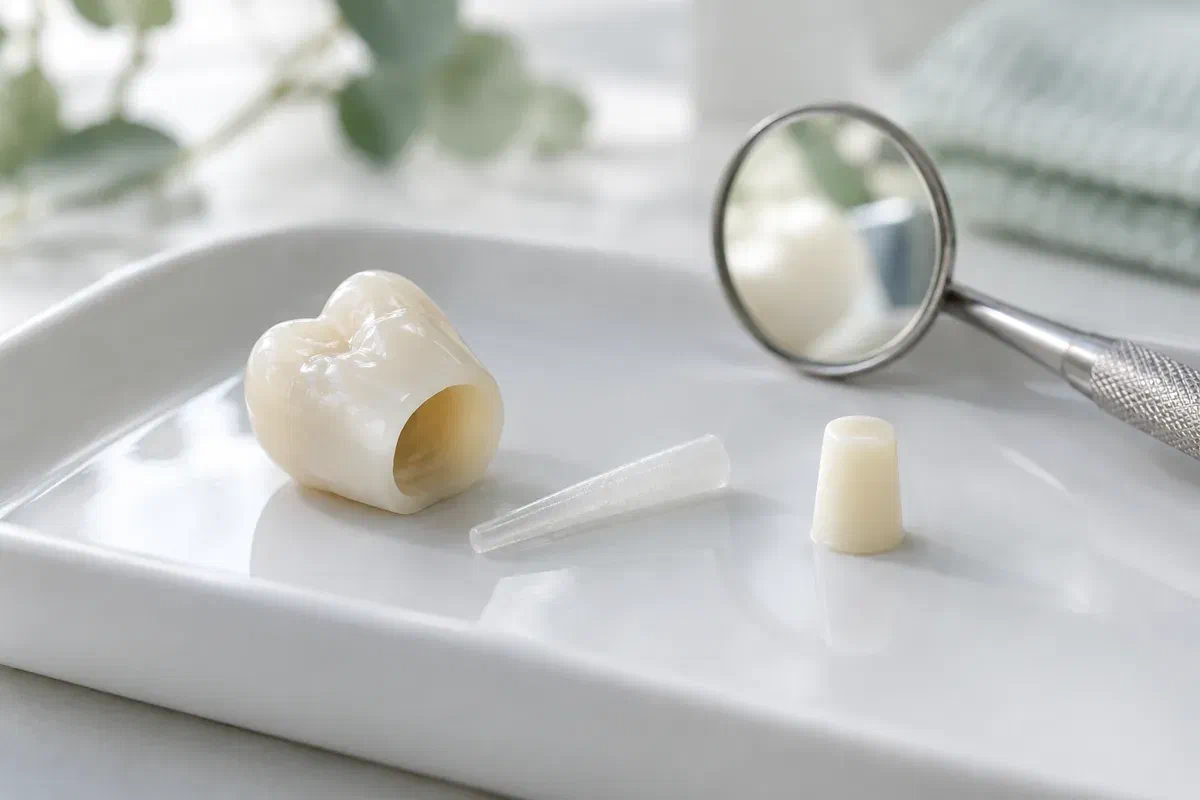
Illustrative discussion of restoring a root-treated tooth before crown placement
Restorative Dentistry

Post-and-Core Restorations in Old Milton

Older dental work tells a story. For a root-treated tooth from years ago, close to Old Milton, we review the post and core already there and the tooth around it before suggesting what comes next.

Work done long ago

An old crown, a newer question

On the established streets of Old Milton, plenty of people carry dental work that is twenty or thirty years old. A crown placed after an early root canal may sit on a core held by a metal post, and it can serve quietly for a long time. Questions come up when that crown loosens, the gum around it changes, or an x-ray shows something new.

It helps to know what each layer was for. The post, where present, anchors the core inside the treated root. The core replaces lost tooth bulk. The crown protects and restores shape. Together they do not make a fragile root sound again, and an older assembly is judged by how the tooth under it is doing today.

We begin by finding out what is there and what is still reliable. Records from a previous dentist, even rough dates, are useful. Dr. Anjum can then explain whether the existing foundation may be kept, needs replacing, or points to a different plan altogether.

Have an older restoration reviewed
Illustrative crown, fibre post, and restorative material samples on a tray
What prompts a review

Changes around long-standing work

Replacing an old post is a significant step, so the reason should be specific. Ask what has changed and what the dentist can see that supports a new foundation.

Little natural tooth left

After several rounds of fillings and a crown, the original tooth can be quite small underneath. The dentist looks at the root, the bone and gum support, and how much wall remains. A new post is discussed only if restoring the tooth still looks sensible.

A crown that has lifted off

Long-serving crowns sometimes come away with the core or post still inside. Save everything in a clean container. An exam shows whether cement failed, the core broke, or the tooth itself fractured, which changes what can be done next.

Old root treatment, new symptoms

Tenderness, a gum bump or a changed x-ray around a root-treated tooth may mean the root needs attention before any foundation work. Ask whether the existing root filling should be reviewed first and how the steps would be sequenced.

An old metal post is not automatically a problem. Removing one can affect the root, so the decision to replace it should rest on findings rather than age alone.

Keeping or rebuilding

A foundation worth trusting

When the tooth is suitable, a secure core lets the crown fit well and carry normal chewing. The goal is to keep the tooth working while respecting the structure that survives from earlier treatment. Each recommendation should explain how it serves that goal.

Age of the restoration matters less than the condition of what supports it. A new post cannot cancel out a cracked root or very thin walls. Weigh the health of the root, the support around it, and the load that tooth carries in your bite.

Patient information: AAE — assessing whether a tooth can be restored

Learn what is already in place

Ask the dentist to point out the post, core and crown on your x-ray. Seeing the layers makes it easier to follow why one part might be kept and another replaced.

Weigh what removal would cost the tooth

Taking out an old post can mean losing more root structure. Ask whether leaving it and rebuilding around it is an option, and what would make that unwise.

Plan around the finished crown

Any new foundation should suit the crown’s fit, contour and role in your bite. Discuss the end result before agreeing to the steps beneath it.

Step by step

Reviewing, then rebuilding

Older teeth sometimes need an extra stage of assessment. Ask what each visit will cover and when the tooth will be fully restored.

  1. Map the existing work

    The exam covers the remaining tooth, the old root filling, the gums and your bite. Images help show where the post sits and how long it is. Share any history of breaks, soreness or crowns that have come off before.

  2. Weigh keeping against replacing

    You should hear why a new foundation is advised, what material is proposed and what limits remain. Ask for an estimate that includes the core, temporary cover and final crown. A root canal specialist’s opinion is sometimes sensible first.

  3. Build the new foundation

    If a post is needed, space is shaped within the treated canal while leaving enough root filling to keep the seal. The post and core are then placed or fitted to the chosen design, in one or more appointments.

  4. Seat the crown and check in

    The finished crown is fitted and checked for contacts and bite. Confirm the home care and the follow-up plan. If a temporary stays on for a time, note your return date and how to protect it in the meantime.

After the rebuild

Habits that help a restored tooth last

Instructions differ between a temporary and a final crown. If something we ask is hard to do, let the team know and we will find a workable approach.

Treat a temporary gently

Favour the other side and avoid hard or chewy foods while a temporary is on. A firm-feeling core still needs its crown, so keep the completion visit. Call if you need to reschedule.

Floss along the crown edge

Daily cleaning around and between the restored tooth matters for years. Ask for a quick demonstration if the spot is awkward. A crown does not stop decay or gum disease at its margin.

Speak up about looseness

Phone if the crown shifts, your bite feels different or a fragment breaks away. Resist testing it with your fingers or tongue. Keep any loose piece and describe what happened.

Possible directions

Three ways forward for an older tooth

Ask what each choice offers and what it requires. Advice should reflect this tooth, not a standard preference.

When the walls can hold it

Rebuild with a core alone

If enough tooth remains, a build-up may stay secure without a post. Ask whether yours qualifies. Avoiding an unnecessary post leaves more root untouched.

When retention truly needs help

Replace or add a post

A post may be advised when a core would not stay put otherwise, or when an old one has failed. Design and material depend on the tooth and crown. Ask about benefits and risks specific to you.

When the root’s future is unclear

Step back and reassess

If the tooth may not support a dependable repair, further tests, root re-treatment, or removal may be discussed. For a tooth that has already had decades of work, it is worth asking honestly how much more it can give.

Questions about older work

What people ask about long-standing posts

Restorations from years ago can be hard to piece together. Starting with what is visible on your x-ray often clears things up.

(905) 876-4488
Does an old metal post have to be replaced?
Not simply because it is metal or old. If the tooth is healthy and the crown fits, it may be left alone. Replacement is considered when something has failed or new treatment is needed, and removal carries its own risk to the root.
How can a dentist tell a post is there?
Posts usually show clearly on an x-ray as a bright line or shape inside the root. Records from your earlier dentist can confirm the type. Ask to see the image so you understand what is under your crown.
Can a tooth with an old post need another root canal?
Sometimes. If infection or symptoms return, the root filling may need re-treatment, and the post may have to come out first. That decision is often shared with a root canal specialist. Ask about the steps and alternatives.
My crown is decades old. Is it at the end of its life?
Age alone does not decide that. The dentist looks at the fit at the gum, decay at the edges, wear and how the tooth feels. A sound older crown can stay; a leaking one may need attention.
Is a post the same as a dental implant?
No. A post sits inside a natural root that has had root canal treatment. An implant replaces a missing root in the jawbone. Ask which one a treatment note refers to if it is unclear.
Do I need records from my previous dentist?
They help but are not required. Dates, x-rays or a note about the original root canal can save time and guesswork. If you cannot get them, the assessment and new images still give a clear starting point.
Old Milton post-and-core care

Let’s look at what your older work is telling us.

Our Bronte Street practice is a short way from Milton’s historic downtown. Book a visit to have a long-standing crown, post or root-treated tooth reviewed, and bring any records or loose pieces you have.

An older restoration that comes out along with pain or swelling deserves a phone call. Online requests are best for non-urgent questions.

Visit Milton Dental Clinic
Unit 1, 342 Bronte St. S, Milton, ON L9T 5B7
Get directions Clinic hours
Monday–Thursday
11am–7pm
Friday–Sunday
By appointment only

Areas we serve

  • Milton
  • Oakville
  • Mississauga
  • Georgetown
  • Halton Hills
  • Acton
  • Campbellville
  • Brampton
  • Burlington
  • Puslinch
  • Rockwood
  • Erin
  • Caledon
  • Etobicoke
  • Old Milton
  • Bronte Meadows
  • Timberlea
  • Dorset Park
  • Dempsey
  • Clarke
  • Beaty
  • Coates
  • Harrison
  • Scott
  • Willmott
  • Ford
  • Bowes
  • Cobden
  • Walker
  • Mountain View
  • Milton Heights
  • Hawthorne Village
  • Valley View
  • Fallingbrook
  • Nassagaweya
  • Trafalgar
  • Esquesing
  • Nelson
  • Brookville
  • Moffat
  • Glen Williams
  • Norval
  • Limehouse
  • Stewarttown
  • Ashgrove
  • Hornby
  • Silver Creek
  • Speyside
  • Scotch Block
  • North Oakville
  • River Oaks
  • Glen Abbey
  • West Oak Trails
  • Palermo
  • Bronte Creek
  • College Park
  • Joshua Creek
  • Uptown Core
  • Preserve
  • Iroquois Ridge
  • Lisgar
  • Meadowvale
  • Meadowvale Village
  • Churchill Meadows
  • Erin Mills
  • Central Erin Mills
  • Streetsville
  • East Credit
  • Creditview
  • Heartland
  • Sheridan
  • Mount Pleasant
  • Credit Valley
  • Huttonville
  • Churchville
  • Springbrook
  • Northwest Brampton
  • Bram West
  • Fletcher's Meadow
  • Fletcher's Creek South
  • Alton Village
  • Orchard
  • Millcroft
  • Headon Forest
  • Tansley
  • Brant Hills
  • Tyandaga
  • Kilbride
  • Lowville
  • Aberfoyle
  • Morriston
  • Arkell
  • Hillsburgh
  • Freelton
  • Carlisle
  • Waterdown
  • Flamborough
  • Mountsberg

How can we help?

Milton Dental Clinic

Have a question about your smile? Choose the option that works best for you.

For urgent dental concerns, please call.
Messages are reviewed during clinic hours.