

Illustrative discussion of restoring a root-treated tooth before crown placement
Restorative Dentistry

Post-and-Core Restorations in Puslinch

A few millimetres of natural tooth above the gum can make a big difference to how a crown performs. For people travelling from Puslinch, we measure what is there, explain why it matters, and plan a core or post around it.

Above the gum line

The tooth you can still see counts most

When a dentist peers at a broken-down tooth and mentions millimetres, they are often judging something called a ferrule. It is the collar of your own tooth, above the gum, that a crown can hug. Having enough of it tends to help a crown cope with chewing, and it shapes almost every decision about how to rebuild.

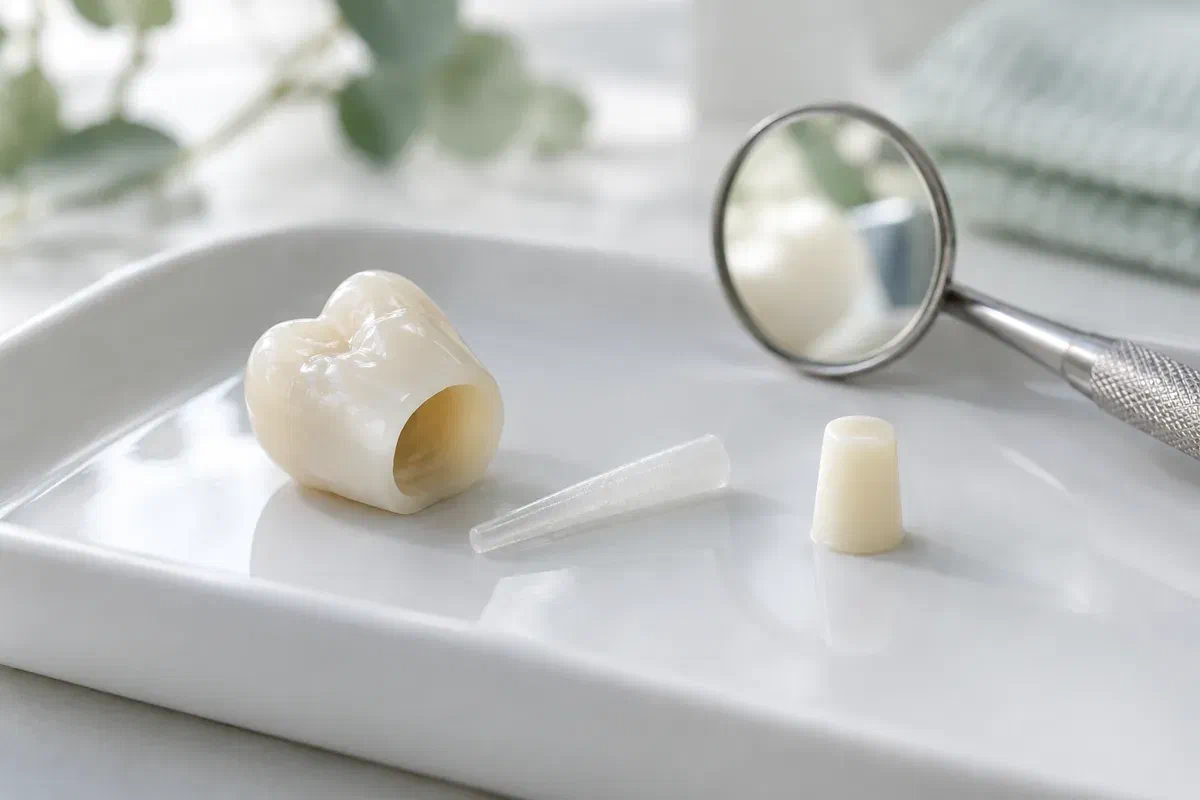
Beneath that collar sits the core, the material that replaces missing tooth so the crown has a shape to fit. If the tooth has had root canal treatment and too little wall remains to hold the core, a post may be placed into part of the treated canal as an anchor. A post holds; it does not strengthen, and it cannot stand in for the natural tooth a crown should wrap around.

So the first visit is partly a measuring exercise. Dr. Anjum will examine how much sound tooth stands above the gum, the root and its support, and the crown you need. Bring any root canal records or a crown that has come off, and you will leave knowing what the numbers mean for you.

Find out how much tooth remains
Illustrative crown, fibre post, and restorative material samples on a tray
When height is in question

Signs the foundation needs a careful look

If a post is part of the plan, ask how it relates to the tooth left above the gum. The explanation should rest on what was measured.

Broken close to the gum

When a tooth breaks low, there may not be enough height for a crown to grip natural structure. The dentist checks the root length and the gum and bone around it. A post comes into the discussion only if a dependable crown is still possible.

A crown that keeps coming off

Repeated loss of a crown, sometimes with its core attached, can point to too little tooth beneath it. Bring every piece. The exam shows what is separating and whether a new foundation can work, or whether another approach is needed first.

Root treatment finished, height uncertain

After a root canal, the remaining walls may be thin or short. Ask whether a core alone would be enough, whether a post or other step is advised, and how to protect the tooth until the crown is made.

A post does not replace missing height. When there is very little tooth above the gum, the plan may need to address that directly, or reconsider whether the tooth should be restored.

What a good foundation offers

Grip, height and a fair chance at lasting

In a suitable tooth, a core gives the crown its shape, and a band of natural tooth gives it something to grip. Together they help the restoration handle everyday chewing. The aim is to restore function while saving as much of your tooth as possible.

Be wary of any plan that relies on the post alone. Without enough natural tooth, even the best post cannot keep a crown performing well. Ask how the root, its support and your bite factor into the outlook.

Patient information: AAE — assessing whether a tooth can be restored

See the measurements

Ask the dentist to show you where the ferrule is, or is not, on your tooth, and how that relates to the post, core and crown. A diagram helps the whole plan make sense.

Hold on to what is sound

Every millimetre of healthy tooth matters. Ask how preparation for the crown and any post will conserve it, and whether a simpler foundation could do the job.

Design the crown around the collar

The crown’s edge is planned to wrap around the available tooth. Discuss its fit, contour and bite first, then decide what needs to go underneath.

Measured steps

Assess the height, then build

The number of visits depends on how much tooth there is and the crown planned. If you are coming in from Puslinch, ask whether any extra stage is needed and which visits can be grouped.

  1. Measure what stands above the gum

    The dentist checks the height and thickness of the remaining walls, the condition of the old root filling, and the bone and gum around the tooth. Bite and x-rays complete the picture. Mention any history of loose crowns.

  2. Discuss whether more height is needed

    If there is too little tooth to grip, options such as a gum procedure to expose more of it may be raised, sometimes with a specialist. You should also hear whether a post is advised, the material, its limits and a full estimate.

  3. Place the core, with a post if justified

    When a post is needed, a channel is shaped inside the treated canal while some root filling stays at the tip to keep it sealed. The core is then built or fitted, ready to receive a crown.

  4. Seat and check the crown

    The crown is fitted to wrap the available tooth, then adjusted for contacts and bite. Confirm home care and the follow-up. If a temporary covers the tooth for a while, ask how to look after it.

After the rebuild

Give the crown edge some attention

What to do depends on whether a temporary or final crown is on. Let us know if any advice is hard to manage, and we will help you find another approach.

Treat a temporary lightly

Avoid hard, sticky and chewy foods on the restored side. A short tooth under a temporary is especially vulnerable, so keep the final crown appointment and call ahead if you must change it.

Clean where tooth meets crown

That collar of natural tooth is where decay or gum problems can start. Brush and floss there every day, and ask for a demonstration if it is hard to reach.

Act on a wobble

A crown that rocks, a bite that feels different, or a chipped edge all warrant a call. Leave it in place rather than testing it. Keep anything that comes away.

Paths depending on height

More tooth, simpler plan. Less tooth, more thought.

For each realistic option, ask what it involves and how it affects the tooth. The right choice depends on what was measured.

When the walls are tall and thick enough

A core alone

With enough remaining structure, a core may hold without entering the canal. Ask if that is possible for you. Avoiding a post keeps more of the root.

When walls are too short to retain it

A core with a post

A post may be added when the core would otherwise not stay. It helps retention, but it cannot replace a missing collar. Ask about the benefits and risks in your case.

When there is very little to grip

Change the situation, or the plan

If height is lacking, procedures to expose more tooth, specialist advice, or removal and replacement may be discussed. Ask what each involves and whether the expected result justifies it.

Questions about tooth height

Millimetres, collars and crowns

The language of measurement can feel technical. These short answers explain why it matters for your restoration.

(905) 876-4488
How much tooth does a crown need to grip?
There is no single number for everyone, but a band of sound tooth all the way around tends to help. Your dentist will measure what is available and explain whether it is enough for a reliable crown.
Can a gum procedure give the crown more to hold?
In some cases, a procedure to reshape the gum and sometimes bone can expose more tooth. It has its own healing time and is not right for every tooth. Ask whether it applies and who would perform it.
Why does my crown keep falling out?
Possible reasons include too little tooth to grip, a failed core, worn-out cement, decay underneath or a fracture. Sometimes more than one is involved. The dentist needs to examine both the tooth and the crown to find out, and recementing without knowing the cause often leads to the same result again.
Will a longer post help if the tooth is short?
Not necessarily. Post length is limited by the root and the need to keep a seal at the tip, and a longer post removes more tooth. It does not make up for missing structure above the gum.
Is the collar of tooth also called a ferrule?
Yes. Ferrule is the dental term for the band of natural tooth the crown wraps around. Ask the dentist to point it out on your tooth or x-ray.
How do I plan the visits from Puslinch?
Ask at the assessment how many stages are expected, whether a specialist step is needed, and which appointments can be combined. Booking the next visit before you leave helps avoid long gaps.
Puslinch post-and-core care

Let’s measure what your tooth can offer.

Book an appointment at our Bronte Street practice for a root-treated tooth that has broken down or a crown that keeps loosening. Bring any records and pieces, and we will explain what the remaining tooth can support.

If a crown has come off and the tooth hurts or the gum swells, please call us. Online requests are for non-urgent bookings.

Visit Milton Dental Clinic
Unit 1, 342 Bronte St. S, Milton, ON L9T 5B7
Get directions Clinic hours
Monday–Thursday
11am–7pm
Friday–Sunday
By appointment only

Areas we serve

  • Milton
  • Oakville
  • Mississauga
  • Georgetown
  • Halton Hills
  • Acton
  • Campbellville
  • Brampton
  • Burlington
  • Puslinch
  • Rockwood
  • Erin
  • Caledon
  • Etobicoke
  • Old Milton
  • Bronte Meadows
  • Timberlea
  • Dorset Park
  • Dempsey
  • Clarke
  • Beaty
  • Coates
  • Harrison
  • Scott
  • Willmott
  • Ford
  • Bowes
  • Cobden
  • Walker
  • Mountain View
  • Milton Heights
  • Hawthorne Village
  • Valley View
  • Fallingbrook
  • Nassagaweya
  • Trafalgar
  • Esquesing
  • Nelson
  • Brookville
  • Moffat
  • Glen Williams
  • Norval
  • Limehouse
  • Stewarttown
  • Ashgrove
  • Hornby
  • Silver Creek
  • Speyside
  • Scotch Block
  • North Oakville
  • River Oaks
  • Glen Abbey
  • West Oak Trails
  • Palermo
  • Bronte Creek
  • College Park
  • Joshua Creek
  • Uptown Core
  • Preserve
  • Iroquois Ridge
  • Lisgar
  • Meadowvale
  • Meadowvale Village
  • Churchill Meadows
  • Erin Mills
  • Central Erin Mills
  • Streetsville
  • East Credit
  • Creditview
  • Heartland
  • Sheridan
  • Mount Pleasant
  • Credit Valley
  • Huttonville
  • Churchville
  • Springbrook
  • Northwest Brampton
  • Bram West
  • Fletcher's Meadow
  • Fletcher's Creek South
  • Alton Village
  • Orchard
  • Millcroft
  • Headon Forest
  • Tansley
  • Brant Hills
  • Tyandaga
  • Kilbride
  • Lowville
  • Aberfoyle
  • Morriston
  • Arkell
  • Hillsburgh
  • Freelton
  • Carlisle
  • Waterdown
  • Flamborough
  • Mountsberg

How can we help?

Milton Dental Clinic

Have a question about your smile? Choose the option that works best for you.

For urgent dental concerns, please call.
Messages are reviewed during clinic hours.