

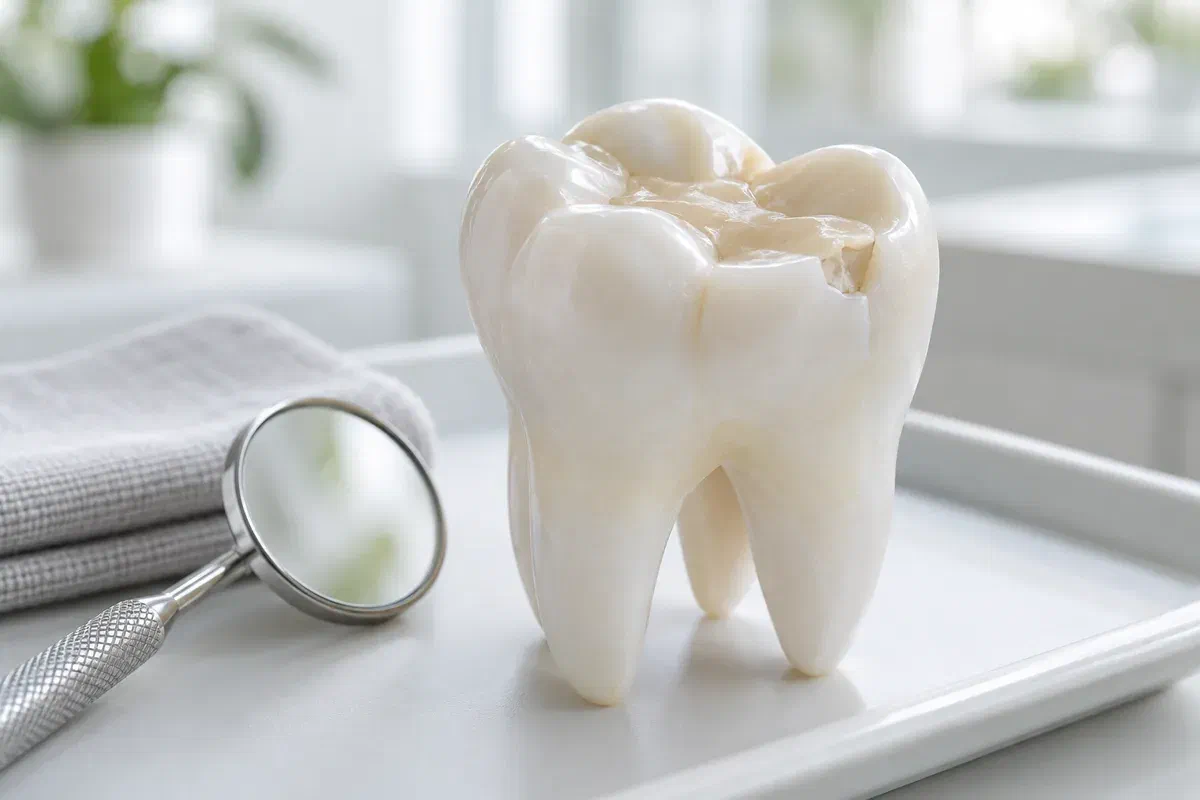
Illustrative dental consultation about a newly rough or broken filling
Restorative Dentistry

Replacement of Broken Fillings in Acton

You are holding a small grey or white piece and wondering what to do next. From Acton, keep it safe, give us a call, and come in so we can see what broke and restore the tooth properly.

A fragment in your hand

Filling, tooth, or both?

Spitting out something hard in the middle of a meal is unsettling. Maybe it is grey and metallic, maybe it looks almost exactly like tooth. Either way, the natural reaction is to wonder whether it can go back in. It usually cannot, and the more useful question is what that piece came from: the filling alone, a section of enamel beside it, or a tooth that was weaker underneath than it seemed.

Looking at the tooth answers that, not looking at the fragment. Small defects can occasionally be repaired with fresh material. A filling that has cracked through may need replacing in full. A tooth that has lost a cusp or wall might be better served by a restoration that covers and protects more of it. A tiny piece can leave a sizeable problem behind.

If you are calling from Acton, let us know when it happened and how the tooth feels: tender, sensitive to cold or sweets, or awkward to chew on. Pop the fragment into a small clean container rather than your pocket or your mouth, and bring it along. We will look at the tooth, explain the findings, and discuss what comes next.

Book a visit for your broken filling
Illustrative molar model showing a small defect in a tooth-coloured filling
What else to watch for

The fragment is one clue among several

What you feel after the piece came away matters as much as the piece itself. Tell us your symptoms, and whether a sharp edge is catching your tongue or cheek.

A gap with sharp sides

The space left behind can have rough walls of filling or enamel. Try not to explore it with fingernails or tools. Mention whether it collects food, snags floss, or scrapes soft tissue, since that guides how soon we should see you.

New reactions to cold or sweets

Note any reaction to cold, heat, sugar, or chewing, and whether it fades or keeps going. A tooth that suddenly reacts after losing a piece tells the dentist something about what may be exposed and the state of the nerve.

Earlier pieces from the same spot

If this is not the first fragment from the same tooth, share when previous repairs were done. Rebuilding the identical shape again without considering the tooth, the material, and your bite may not stop it happening once more.

Losing a piece without pain is still worth a visit. Comfort tells you little about whether what remains of the filling, or the enamel next to it, is properly supported.

Rebuilding what came away

Replace the missing part with something that lasts

The piece in your hand cannot normally be reattached, so the repair rebuilds that area with new material suited to the tooth that remains. A good result restores the chewing surface, re-establishes contact with the teeth next door, and leaves edges you can clean around easily. You will hear whether a straightforward filling can do that job, or whether the tooth would be better off with more coverage.

Understanding why it broke helps too. An old wide filling, decay that undermined it, a cracked cusp, or strong biting forces can each shift the recommendation. With that information, you can choose a plan with fair expectations instead of simply asking for the hole to be filled.

Patient information: Cleveland Clinic — dental filling care and complications

Knowing exactly what will be redone

Ask which part has failed and whether the rest of the filling is still sound enough to keep. Adding to a filling and replacing it entirely are different levels of treatment, and you should understand why one is advised.

Back to feeling normal

Explain how the tooth felt before the piece came away and whether food has been catching since. Rebuilding the right contour and contact helps chewing and cleaning, and your account guides the assessment.

A word about the cause

Mention grinding, clenching, crunching ice, or a sense that your bite has changed. These observations do not determine the cause on their own, but they can inform the repair and advice on protecting it.

Your repair visit

What happens after you hand us the fragment

The appointment may finish with a final restoration or a temporary one, depending on the findings and how much time is available. It is worth asking ahead of time.

  1. Examine the tooth, not just the piece

    The dentist checks the area the fragment came from, reviews symptoms, and may take an X-ray if it would help. The fragment can offer clues, but the tooth itself shows the extent of the damage.

  2. Discuss the repair

    You will go through the options, the suggested material, the expected fee, and what cannot be known until the old filling is removed. Ask what would happen if more treatment is needed partway through.

  3. Rebuild the missing area

    Freezing and isolation are used where needed. Remaining damaged material and any weak tooth structure are removed, then new material rebuilds the area, or a temporary covers it until a further visit. The method depends on what remains.

  4. Confirm it feels right

    Your bite and the shape of the new surface are checked. Ask how soon you can eat on it and whether a follow-up is planned. If it later feels high or rough, tell us so we can review it.

Until it is repaired, and after

Treat the tooth gently for a little while

Follow the guidance for your material and stage of care. If something changes while you are waiting for your appointment, call us.

Keep the gap clear and protected

Chew on the other side, avoid hard foods, and choose comfortable temperatures. Rinse with water after meals to clear food from the gap. Do not try to push the fragment back or remove pieces that still feel attached.

Let the new repair settle in

Wait until the freezing has worn off before eating, and follow any instructions specific to a temporary filling. Ask when you can use the tooth normally. The new restoration may need different care than the old one.

Speak up if something feels off

Brush and floss as you normally would unless told otherwise. Call if your bite seems uneven, floss catches, or the tooth becomes sore. Describing the change clearly is better than waiting for another piece to come out.

Patient information: NHS Wales — care while awaiting restoration assessment

Ways to restore the tooth

What fills the space depends on what surrounds it

Ask why a specific option suits the damage. Repeating the material that broke is not automatically the best choice for the tooth now.

When the rest is holding well

Add to the existing filling

Repairing just the missing section may be reasonable if the remaining restoration and tooth are sound. The dentist decides whether that will hold up. Ask what would be left in place and what replaced.

When the tooth has good support

Start over with a new filling

Removing what remains and placing a new direct filling may suit a tooth with enough healthy structure. Discuss material in light of the cavity, moisture control, and chewing forces. The aim is a repair suited to the tooth as it now is.

When a wall or the nerve is affected

Cover and protect more of the tooth

If the piece took a cusp or wall with it, an onlay or crown may protect the tooth better than another filling. A nerve that needs treatment has to be addressed too. Ask which finding steers the plan and how it would be staged.

Acton questions

About the piece, the gap, and the repair

Do not worry about identifying the fragment yourself. Tell us what happened and how the tooth feels, and bring the piece if you kept it.

(905) 876-4488
Can the piece of filling be cemented back in?
Usually not. Filling materials are bonded or shaped in place, and a broken fragment does not generally fit back securely. The dentist will rebuild the area with new material. Bring the piece if you like, as it may help explain what happened.
How do I store a fragment until my appointment?
Place it in a small clean container, such as a pill bottle or a sealed bag, and keep it somewhere safe. There is no need for special liquids. Please do not keep it in your mouth or try to wedge it back into the tooth.
What if I swallowed the piece?
Swallowing a small piece of filling is common and usually passes without problems. If you have trouble breathing, persistent coughing, or think you may have inhaled it, seek medical care promptly. Otherwise, call us to arrange an assessment of the tooth.
Is the piece I found tooth or filling material?
It can be hard to tell, especially with tooth-coloured materials. Avoid trying to work it out by probing the gap. The examination shows which structures are involved and whether there is damage that is not easily visible.
Does a gap with no pain still need treatment?
Yes. A comfortable gap can trap food and let the tooth weaken further, and the remaining enamel may be unsupported. An assessment helps decide what is needed and how soon, even when nothing hurts.
How should I plan an appointment from Acton?
When you phone, describe what came out and how the tooth feels so the team can suggest an appointment of the right length. Ask whether the repair is likely to be completed in one visit or will start with a temporary.
Acton broken filling care

Bring the piece. We will handle the rest.

Visit our Bronte Street practice to have a broken filling assessed and the tooth rebuilt. Bring the fragment if you kept it, a note of when it happened, and any questions about the repair.

Phone us for severe pain, facial swelling, or an edge that is hurting your mouth. The online form is for non-urgent bookings.

Visit Milton Dental Clinic
Unit 1, 342 Bronte St. S, Milton, ON L9T 5B7
Get directions Clinic hours
Monday–Thursday
11am–7pm
Friday–Sunday
By appointment only

Areas we serve

  • Milton
  • Oakville
  • Mississauga
  • Georgetown
  • Halton Hills
  • Acton
  • Campbellville
  • Brampton
  • Burlington
  • Puslinch
  • Rockwood
  • Erin
  • Caledon
  • Etobicoke
  • Old Milton
  • Bronte Meadows
  • Timberlea
  • Dorset Park
  • Dempsey
  • Clarke
  • Beaty
  • Coates
  • Harrison
  • Scott
  • Willmott
  • Ford
  • Bowes
  • Cobden
  • Walker
  • Mountain View
  • Milton Heights
  • Hawthorne Village
  • Valley View
  • Fallingbrook
  • Nassagaweya
  • Trafalgar
  • Esquesing
  • Nelson
  • Brookville
  • Moffat
  • Glen Williams
  • Norval
  • Limehouse
  • Stewarttown
  • Ashgrove
  • Hornby
  • Silver Creek
  • Speyside
  • Scotch Block
  • North Oakville
  • River Oaks
  • Glen Abbey
  • West Oak Trails
  • Palermo
  • Bronte Creek
  • College Park
  • Joshua Creek
  • Uptown Core
  • Preserve
  • Iroquois Ridge
  • Lisgar
  • Meadowvale
  • Meadowvale Village
  • Churchill Meadows
  • Erin Mills
  • Central Erin Mills
  • Streetsville
  • East Credit
  • Creditview
  • Heartland
  • Sheridan
  • Mount Pleasant
  • Credit Valley
  • Huttonville
  • Churchville
  • Springbrook
  • Northwest Brampton
  • Bram West
  • Fletcher's Meadow
  • Fletcher's Creek South
  • Alton Village
  • Orchard
  • Millcroft
  • Headon Forest
  • Tansley
  • Brant Hills
  • Tyandaga
  • Kilbride
  • Lowville
  • Aberfoyle
  • Morriston
  • Arkell
  • Hillsburgh
  • Freelton
  • Carlisle
  • Waterdown
  • Flamborough
  • Mountsberg

How can we help?

Milton Dental Clinic

Have a question about your smile? Choose the option that works best for you.

For urgent dental concerns, please call.
Messages are reviewed during clinic hours.