

Illustrative dental consultation about a newly rough or broken filling
Restorative Dentistry

Replacement of Broken Fillings in Brampton

A filling rarely breaks at a convenient time. For busy Brampton households, a short phone call sorts out how soon to come in, and the visit itself shows what failed and how to restore the tooth.

Fitting it into a full week

Work, school runs, and now a broken tooth

It tends to happen midweek, in the middle of a packed lunch or a rushed dinner. A crunch, a gritty fragment, and suddenly one tooth feels unfamiliar. The temptation is to push it to the back of the list. Yet what broke matters: the filling material, a sliver of enamel beside it, or a weakness further down that the break has just exposed.

Each of those leads to different care, and only an examination can sort them out. Some small defects can be fixed with a limited repair. A cracked or loose filling may have to be taken out and replaced. A tooth that has lost a wall can need a more protective restoration. How little came out is not a reliable measure of how much the tooth needs.

When you ring from Brampton, give us the essentials: roughly when it broke, whether there is pain or sensitivity, and whether you can still eat on that side. Weekday appointments run Monday to Thursday until 7pm, with Friday to Sunday by appointment only. Keep any fragment in a container, not in your mouth, and we will talk through findings before any work begins.

Schedule a broken filling check
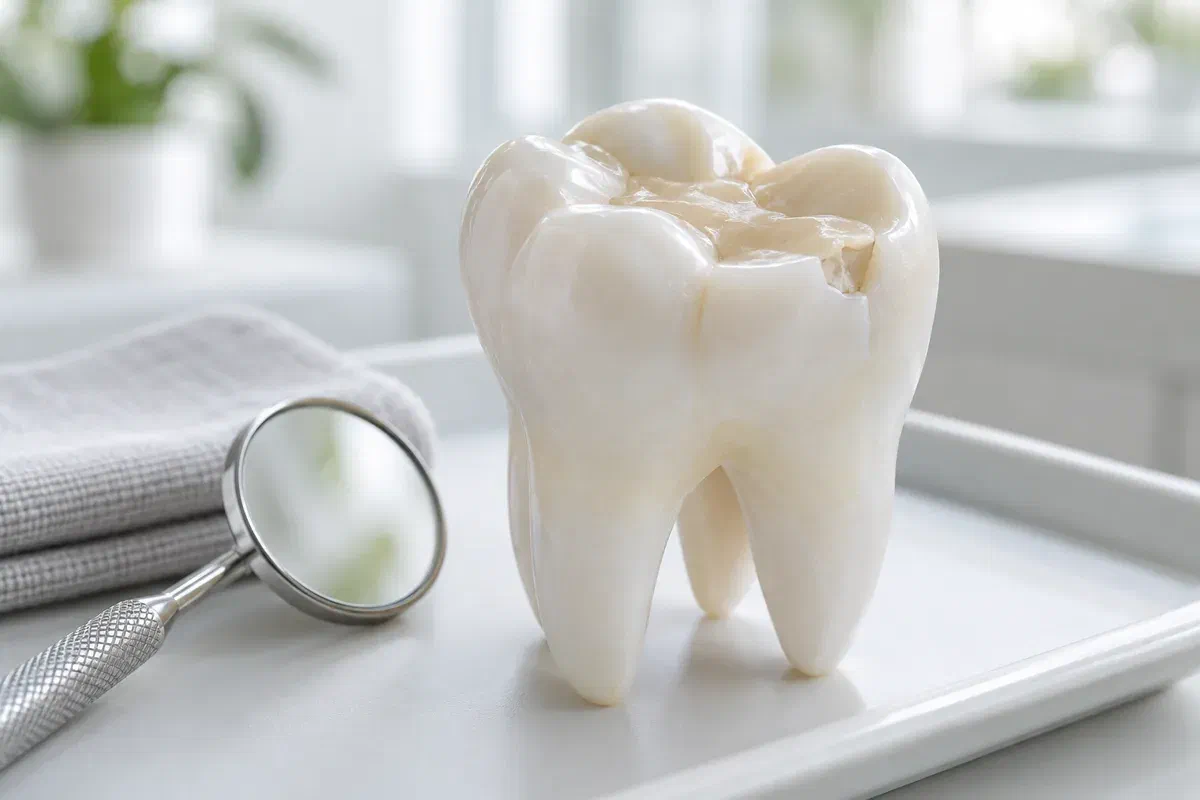
Illustrative molar model showing a small defect in a tooth-coloured filling
What to mention on the call

A minute of detail saves a lot of guesswork

Symptoms vary from one break to the next. Describe what you notice, including any sharp spot rubbing your tongue or cheek, so the team can suggest how quickly to book.

Something sharp in your mouth

An edge that suddenly feels jagged could be filling or enamel. Please leave it alone rather than trying to smooth it. Mention if it catches food, tears floss, or is irritating your cheek, since that helps us decide on timing.

A tooth that has started to react

Note what sets it off, whether cold, sweet, hot, or biting, and whether the feeling vanishes or lingers. That pattern gives the dentist useful information about the tooth and the nerve inside before the examination starts.

The filling that keeps letting go

If this is not the first time, let us know when the earlier repairs were done and how long they lasted. A repeatedly failing filling calls for a look at the tooth and the bite, not just another copy of the same shape.

No pain still means a visit. A tooth can feel fine after a filling breaks while the remaining restoration or surrounding enamel is left without enough support.

What the replacement should give you

One tooth you can stop thinking about

The goal is a repair that lets you eat and clean normally again. It should be shaped to suit the remaining tooth, meet the teeth opposite comfortably, touch its neighbours firmly, and leave edges you can floss. The dentist will say whether a direct filling is suitable or if a larger restoration should be considered.

Knowing why it broke helps the repair last. A big older filling, new decay, a cracked cusp, or heavy chewing forces can all change the recommendation. With that understanding, you can choose a plan with realistic expectations rather than a quick patch that only fills the visible space.

Patient information: Cleveland Clinic — dental filling care and complications

Clarity about the extent

Ask exactly what will be repaired and whether any existing filling can stay. A small fix and a complete replacement involve different amounts of treatment and chair time, and the reasoning should be clear before you agree.

Normal chewing and cleaning

Explain whether food has been catching and how the tooth felt before the break. Restoring the right shape and contact matters for daily comfort, and your description helps the dentist look beyond the missing fragment.

Attention to what caused it

Mention clenching under stress, grinding at night, chewing ice, or a change in your bite. These do not prove a cause on their own, yet they help shape the repair and any advice on protecting it.

What to expect in the chair

Check, discuss, repair, confirm

Depending on what is found and the time booked, the visit may finish the repair or place a temporary to protect the tooth. Ask when booking so you can plan around it.

  1. See what broke

    The dentist examines the filling and surrounding tooth, asks about symptoms, and may recommend an X-ray. The point is to understand the damage beyond the visible chip. Mention anything you felt in that tooth before the break.

  2. Agree on the approach

    Go through the options, the proposed material, the expected fee, and what may be unclear until the old filling is out. Ask what happens if deeper problems appear partway through. You should feel comfortable with the plan first.

  3. Remove and replace

    Freezing and isolation are used as needed. The failing material and any affected tooth structure are cleared, then the new restoration goes in, or a temporary covers the tooth. The method depends on the damage and remaining support.

  4. Make sure it fits

    Your bite and the shape of the repair are checked before you leave. Ask about eating, cleaning, and any follow-up, particularly if the repair is temporary. If it feels high or rough later on, call us instead of putting up with it.

Home care, before and after

Protect it until it is fixed, then follow the plan

Guidance depends on the material and the stage of treatment. If a symptom changes while you are waiting, call for advice rather than waiting to see.

In the meantime

Use the other side for chewing and avoid hard foods on the broken tooth. Keep food and drink at temperatures that do not trigger sensitivity. Do not keep checking the gap, and leave attached pieces alone.

After the appointment

Wait until the freezing wears off before eating, and follow any extra rules for a temporary restoration. Ask when normal chewing can resume. The new filling may come with different instructions from the old one.

If it still is not right

Carry on brushing and flossing as advised. Contact us if your bite feels uneven, floss catches, or discomfort is building. Describe exactly what is happening rather than waiting until more breaks.

Patient information: NHS Wales — care while awaiting restoration assessment

Repair choices

The tooth decides how much is needed

Ask why a given option suits your break. Choosing the same material as before is not automatically right when the tooth has changed.

Where the rest is in good shape

Fix the broken section

A limited repair may be considered if the surrounding restoration and tooth are sound. The dentist assesses whether that will deal with the defect well. Ask which material would remain and which would be renewed.

Where healthy tooth can hold one

Place a new filling

A replacement filling may suit a tooth with enough support left. Talk about material choice with the cavity size, moisture control, and biting forces in mind. The aim is a restoration that suits the tooth now.

Where walls or the nerve are affected

Move to stronger protection

Sometimes the remaining tooth is too weak for a filling to protect it well, and an onlay or crown becomes part of the conversation. If the nerve needs treatment, that comes into the plan as well. Ask what you would need and in what order.

Questions from Brampton

Practical answers when a filling breaks

You can book without knowing whether the fragment was filling or tooth. Describe what happened and how it feels now.

(905) 876-4488
How long does a filling replacement appointment usually take?
It varies with the size and location of the repair and whether other findings need attention. When you call, describe the break so the team can suggest an appropriate appointment length. Ask whether the visit is expected to complete the work.
Can I return to work right after the repair?
Many people do, though the freezing can make speaking and eating feel awkward for a few hours. Plan to avoid chewing until the numbness wears off. If you have concerns about timing, mention them when booking.
Is it fine to chew on the other side for a few days?
Favouring the other side is a sensible short-term step while you arrange an assessment. It does not replace having the tooth checked, since a broken filling can still trap food or weaken further. Call if symptoms change in the meantime.
What should I do with the piece that came out?
Keep it in a small clean container and bring it along if you like. Please do not put it back in your mouth or try to glue it in. It can help explain what happened, but it is not usually something that can be reused.
Can the dentist tell why the filling broke?
The examination may point to likely factors, such as a large older restoration, decay, a crack, or heavy biting forces, though the moment it broke does not prove the cause. Share your history so the dentist can consider the wider picture.
Should I wait to see if a new filling's bite settles on its own?
If the tooth feels like it touches first when you close, or chewing is uncomfortable, call the clinic. A review can check the bite and other causes. Repeatedly clenching to test it, or waiting months for a routine visit, is not necessary.
Booking from Brampton

Get the tooth sorted and off your list.

Our Bronte Street practice offers assessment and replacement of broken fillings. Bring what you remember about the break, any piece you saved, and your questions about getting the tooth back to normal.

Please phone for pain, swelling, or a sharp edge injuring your mouth. Online requests are for non-urgent appointments.

Visit Milton Dental Clinic
Unit 1, 342 Bronte St. S, Milton, ON L9T 5B7
Get directions Clinic hours
Monday–Thursday
11am–7pm
Friday–Sunday
By appointment only

Areas we serve

  • Milton
  • Oakville
  • Mississauga
  • Georgetown
  • Halton Hills
  • Acton
  • Campbellville
  • Brampton
  • Burlington
  • Puslinch
  • Rockwood
  • Erin
  • Caledon
  • Etobicoke
  • Old Milton
  • Bronte Meadows
  • Timberlea
  • Dorset Park
  • Dempsey
  • Clarke
  • Beaty
  • Coates
  • Harrison
  • Scott
  • Willmott
  • Ford
  • Bowes
  • Cobden
  • Walker
  • Mountain View
  • Milton Heights
  • Hawthorne Village
  • Valley View
  • Fallingbrook
  • Nassagaweya
  • Trafalgar
  • Esquesing
  • Nelson
  • Brookville
  • Moffat
  • Glen Williams
  • Norval
  • Limehouse
  • Stewarttown
  • Ashgrove
  • Hornby
  • Silver Creek
  • Speyside
  • Scotch Block
  • North Oakville
  • River Oaks
  • Glen Abbey
  • West Oak Trails
  • Palermo
  • Bronte Creek
  • College Park
  • Joshua Creek
  • Uptown Core
  • Preserve
  • Iroquois Ridge
  • Lisgar
  • Meadowvale
  • Meadowvale Village
  • Churchill Meadows
  • Erin Mills
  • Central Erin Mills
  • Streetsville
  • East Credit
  • Creditview
  • Heartland
  • Sheridan
  • Mount Pleasant
  • Credit Valley
  • Huttonville
  • Churchville
  • Springbrook
  • Northwest Brampton
  • Bram West
  • Fletcher's Meadow
  • Fletcher's Creek South
  • Alton Village
  • Orchard
  • Millcroft
  • Headon Forest
  • Tansley
  • Brant Hills
  • Tyandaga
  • Kilbride
  • Lowville
  • Aberfoyle
  • Morriston
  • Arkell
  • Hillsburgh
  • Freelton
  • Carlisle
  • Waterdown
  • Flamborough
  • Mountsberg

How can we help?

Milton Dental Clinic

Have a question about your smile? Choose the option that works best for you.

For urgent dental concerns, please call.
Messages are reviewed during clinic hours.