Illustrative dental consultation about a newly rough or broken filling
Restorative Dentistry

Replacement of Broken Fillings in Caledon

Sometimes a new filling is all a broken tooth needs, and sometimes it is not enough. From Bolton or elsewhere in Caledon, an assessment shows which applies and what a sensible plan would involve.

When a filling may not be the answer

More than a patch?

Most people expect a broken filling to be swapped for a new one, and often that is exactly what happens. Occasionally, though, the break turns out to be a sign that the tooth itself has changed. Before any plan, the dentist needs to see what fractured: only the restoration, a piece of enamel or cusp alongside it, or something deeper that has been building for a while.

Each finding leads somewhere different. A small defect in a sound filling can sometimes be repaired. A filling cracked through usually comes out and is replaced. When the tooth has lost a wall or cusp, or the nerve is involved, a filling alone may not protect it, and an onlay, crown, or root canal treatment could come into the conversation. A small piece does not rule out a large need.

Before travelling in from Caledon, give us a call. Tell us when it broke and whether the tooth aches, lingers after cold, or hurts to bite on, because those details help us plan the right length of visit. If a fragment came out, put it in a clean container instead of trying to reseat it. We will explain clearly what the tooth needs and why.


Find out what your tooth needs
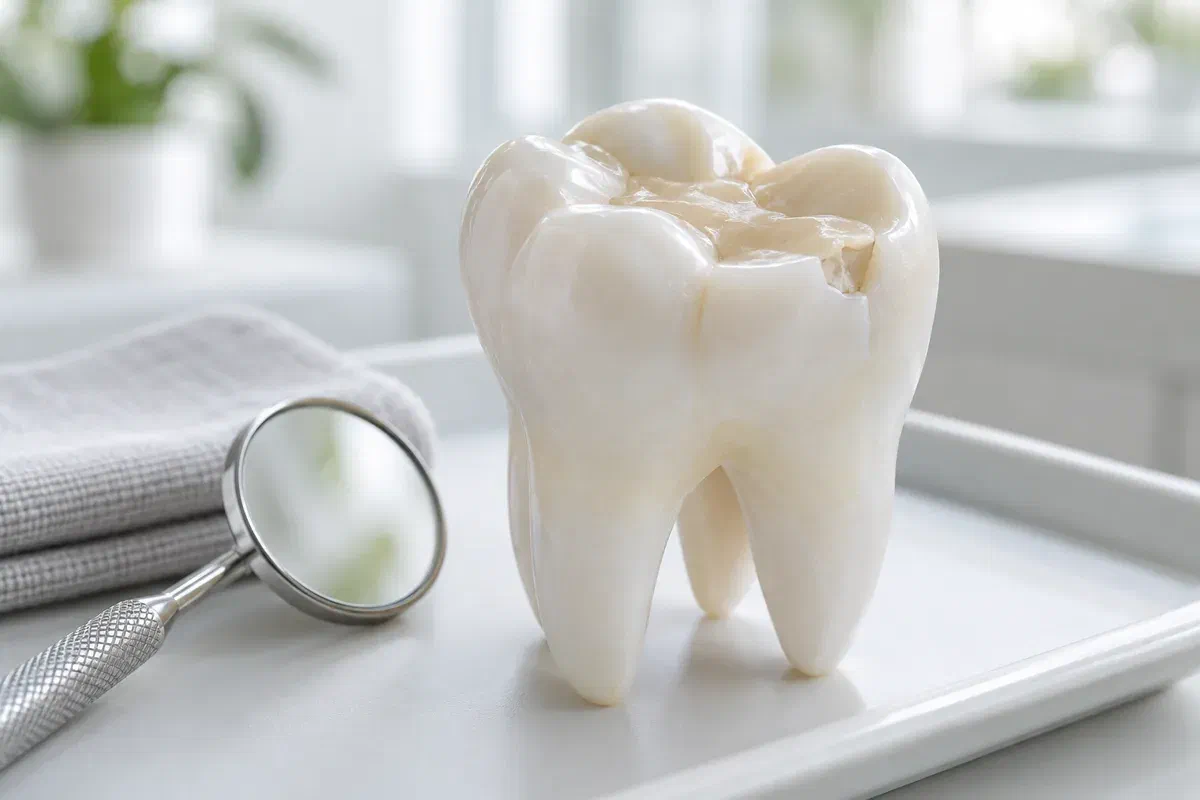
Illustrative molar model showing a small defect in a tooth-coloured filling
Clues the tooth needs more

Signs that point beyond a simple filling

Some symptoms suggest a straightforward repair; others hint at more. Describe yours, including any broken edge that is rubbing your tongue or cheek.

A large piece or a missing cusp

If a sizeable section has gone, or a corner of the tooth itself seems missing, mention it. Do not try to smooth or remove what remains. Say whether the area traps food, tears floss, or irritates soft tissue, as that guides timing.

Pain on biting or an ache that lingers

Sharp pain on release after biting, sensitivity that stays after the cold is gone, or an ache that starts by itself can suggest a crack or nerve involvement. Describe the pattern; it helps the dentist judge whether more than a filling is needed.

A tooth with many past repairs

Teeth that have been filled repeatedly can lose structure over time. Share what you know about earlier work. Placing another large filling without looking at how much sound tooth remains may not give it the support it needs.

A tooth that feels fine can still need more than a filling. Comfort does not show whether the remaining walls and enamel are strong enough to support a new restoration.

Choosing the right level of care

Enough treatment to protect it, and no more

The best repair is the one the tooth can actually support. That means a chewing surface that meets your bite, a snug contact with neighbouring teeth, and margins you can clean, built on enough healthy tooth to hold up. Where a direct filling can deliver that, it is usually the simpler choice; where it cannot, the dentist will explain the alternatives.

The reasons behind the break shape the decision. A very large older filling, decay underneath, a cracked cusp, or heavy forces can each make broader coverage worth discussing. Understanding the findings lets you weigh options with realistic expectations rather than choosing based only on the size of the gap.

Patient information: Cleveland Clinic — dental filling care and complications

Honest reasoning for the plan

Ask what the examination showed and why a filling is or is not expected to be enough. Partial repair, full replacement, and fuller coverage differ in how much tooth is involved, and the logic should be clear.

A restoration that works daily

Describe how chewing felt before the break and whether food has been catching. Whatever the repair, restoring the correct shape and contact helps with comfort and cleaning.

Thought given to the cause

Mention grinding, clenching, ice chewing, or any recent change in your bite. These do not settle the cause on their own, but they may affect whether a filling, onlay, or crown is the better fit.

How we decide and treat

Find out first. Then fix it properly.

A straightforward replacement may be done in one visit, while broader treatment usually involves more than one. Ask what to expect so you can plan your trips.

  1. Look closely

    The dentist examines the filling and tooth, discusses your symptoms, and uses imaging where it adds information. Checking for cracks, decay, and remaining wall thickness helps decide whether a filling will be enough.

  2. Explain the choice

    You will hear the options, the material or restoration type, the expected fee, and what cannot be known until the old filling is removed. Ask how the plan would change if more damage appears, and how many visits each option needs.

  3. Restore or protect

    Freezing and isolation are used where appropriate. After damaged material and tooth are removed, a new filling may be placed, or a temporary may protect the tooth while a crown, onlay, or other care is arranged.

  4. Confirm the bite

    The dentist checks how your teeth meet and how the restoration is shaped. Ask about eating, cleaning, and next steps if treatment continues. If anything feels high or sharp later, let us know rather than waiting.

Caring for the tooth through treatment

Protect it carefully, especially between stages

Instructions depend on the material and on whether the restoration is final or temporary. Call for advice if a symptom shifts while you wait.

Before treatment starts

Avoid chewing hard food on the broken tooth and choose comfortable temperatures. Leave the area alone instead of testing it, and do not pull at any part that still appears attached.

With a temporary in place

Follow the limits for the interim restoration, avoid sticky or hard foods on that side, and wait for numbness to pass before eating. If the temporary feels loose or comes out, call us.

Once the final repair is done

Keep up brushing and flossing as advised. Contact the clinic if your bite feels uneven, floss catches, or discomfort is building. Describing the change precisely helps us decide what to check.

Patient information: NHS Wales — care while awaiting restoration assessment

The range of repairs

From a small mend to full coverage

Ask why one option suits your tooth better than another. The filling type you had before is not always the right choice for the tooth now.

When the filling is mostly intact

Mend the defect

If the surrounding restoration and tooth are sound, a limited repair may be considered. The dentist judges whether it can deal with the defect reliably. Ask which parts would stay.

When enough sound tooth remains

Replace with a new filling

A new direct filling may suit a tooth that still has good structure. Material is chosen with the cavity size, moisture control, and biting forces in mind. The goal is a repair matched to the tooth today.

When walls are weak or the nerve is affected

Onlay, crown, or root canal care

For a tooth that has lost significant structure, partial or full coverage may protect it better. If the pulp is affected, root canal treatment may be needed before a final restoration. Ask which finding changes the plan and how the steps fit together.

Questions from Caledon

Filling, onlay, or crown?

No need to sort out whether the fragment was tooth or filling. Tell us what happened and how it feels.

(905) 876-4488
How does the dentist decide if I need a crown instead of a filling?
The decision depends on how much healthy tooth remains, whether cusps are cracked or missing, the forces on the tooth, and the state of the nerve. Ask the dentist to explain which findings point toward a crown in your case.
What is an onlay, and when is it used?
An onlay is a restoration that covers one or more cusps of a tooth, sitting between a filling and a full crown in coverage. It may be considered when a tooth has lost part of its structure but does not need complete coverage.
Does a broken filling ever lead to root canal treatment?
Sometimes. If decay or a crack has reached the nerve, or the nerve is inflamed, root canal treatment may be needed before the tooth is restored. Lingering pain or pain that starts by itself is worth describing when you call.
Can a temporary filling protect the tooth while I wait for a crown?
A temporary can protect the tooth for a period, but it is not designed to last. Follow the instructions, avoid hard or sticky foods on that side, and call if it loosens or the tooth becomes painful.
Is it possible the break is smaller than it looks?
It can go either way. A visible gap may involve only filling material, or it may hide a crack or decay. Avoid probing the area. The examination, sometimes with an X-ray, shows what has actually happened.
How many trips from Caledon might a larger repair need?
One appointment often covers a simple replacement filling, while onlays, crowns, and root canal treatment usually need more. The dentist will outline the likely number of appointments, so ask when the plan is discussed.
Caledon broken filling care

A clear answer before any treatment.

Our Bronte Street practice will examine a broken filling and explain whether a new filling or something more is the right fit. Come with a note of when it broke, the fragment if you have it, and your questions.

Please phone about severe pain, swelling, or an edge cutting your mouth. Use the online form for non-urgent requests.

Visit Milton Dental Clinic
Unit 1, 342 Bronte St. S, Milton, ON L9T 5B7
Get directions Clinic hours
Monday–Thursday
11am–7pm
Friday–Sunday
By appointment only

Areas we serve

  • Milton
  • Oakville
  • Mississauga
  • Georgetown
  • Halton Hills
  • Acton
  • Campbellville
  • Brampton
  • Burlington
  • Puslinch
  • Rockwood
  • Erin
  • Caledon
  • Etobicoke
  • Old Milton
  • Bronte Meadows
  • Timberlea
  • Dorset Park
  • Dempsey
  • Clarke
  • Beaty
  • Coates
  • Harrison
  • Scott
  • Willmott
  • Ford
  • Bowes
  • Cobden
  • Walker
  • Mountain View
  • Milton Heights
  • Hawthorne Village
  • Valley View
  • Fallingbrook
  • Nassagaweya
  • Trafalgar
  • Esquesing
  • Nelson
  • Brookville
  • Moffat
  • Glen Williams
  • Norval
  • Limehouse
  • Stewarttown
  • Ashgrove
  • Hornby
  • Silver Creek
  • Speyside
  • Scotch Block
  • North Oakville
  • River Oaks
  • Glen Abbey
  • West Oak Trails
  • Palermo
  • Bronte Creek
  • College Park
  • Joshua Creek
  • Uptown Core
  • Preserve
  • Iroquois Ridge
  • Lisgar
  • Meadowvale
  • Meadowvale Village
  • Churchill Meadows
  • Erin Mills
  • Central Erin Mills
  • Streetsville
  • East Credit
  • Creditview
  • Heartland
  • Sheridan
  • Mount Pleasant
  • Credit Valley
  • Huttonville
  • Churchville
  • Springbrook
  • Northwest Brampton
  • Bram West
  • Fletcher's Meadow
  • Fletcher's Creek South
  • Alton Village
  • Orchard
  • Millcroft
  • Headon Forest
  • Tansley
  • Brant Hills
  • Tyandaga
  • Kilbride
  • Lowville
  • Aberfoyle
  • Morriston
  • Arkell
  • Hillsburgh
  • Freelton
  • Carlisle
  • Waterdown
  • Flamborough
  • Mountsberg

How can we help?

Milton Dental Clinic

Have a question about your smile? Choose the option that works best for you.

For urgent dental concerns, please call.
Messages are reviewed during clinic hours.