

Illustrative dental consultation about a newly rough or broken filling
Restorative Dentistry

Replacement of Broken Fillings in Puslinch

A good repair is judged at home, at the next meal and the next floss. From Puslinch, we assess the broken filling, rebuild the tooth, and make sure you know what normal feels like afterwards.

Thinking ahead to afterwards

The real test comes at your kitchen table

People often picture the dental chair when they think about a broken filling. Yet the part that matters most happens later, back home, when you bite into supper and run floss past the new surface. A repair that feels right then starts with a careful look now at what broke: the material, a section of enamel beside it, or a weakness deeper in the tooth.

From that assessment comes the plan. Sometimes a small defect can be repaired on its own. Often a cracked filling is removed and a new one placed. Occasionally the tooth has lost so much that a more protective restoration should be discussed. Bear in mind that the size of the lost piece rarely tells you how much the tooth will need.

Calling ahead from Puslinch, let us know when the filling broke and what the tooth is doing now: aching, reacting to cold or sweet, or uncomfortable to chew on. Keep any fragment in a clean little container rather than pressing it back. On the day, the dentist explains the findings, and before you leave you will know what to expect over the following days.

Book a filling repair and review
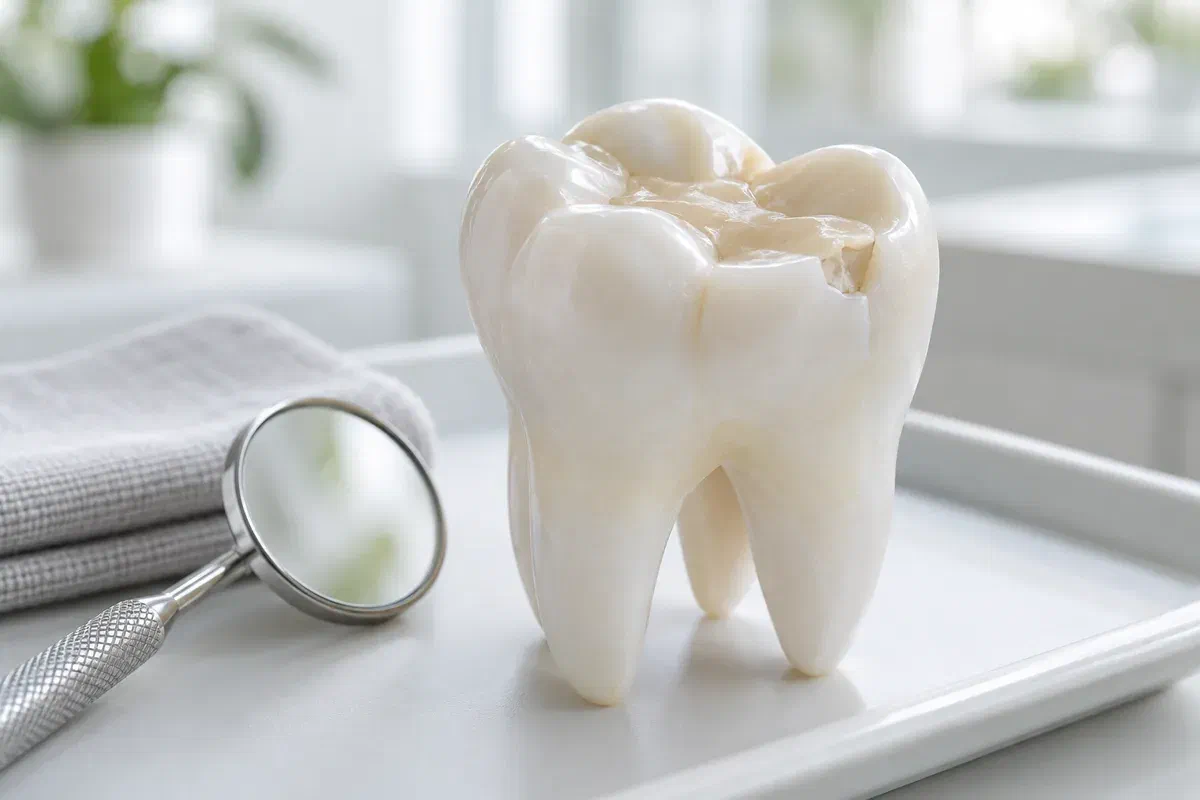
Illustrative molar model showing a small defect in a tooth-coloured filling
Before the repair

Tell us how the tooth is behaving

A clear description helps us plan the right visit. Mention symptoms and whether a broken edge is grazing your tongue or cheek.

Roughness you can feel

The edge may be leftover filling or enamel that cracked off. Leave it be rather than sanding or picking. Tell us whether it catches food, frays floss, or rubs soft tissue, since an edge that is hurting you can change how quickly we suggest coming in.

Reactions to temperature or chewing

Note whether cold, heat, sweets, or biting cause discomfort and how long it lasts. A sting that vanishes and an ache that lingers lead the assessment in different directions, and that history also helps us judge what is normal after treatment.

Breaks on a tooth already repaired

If the same tooth has been fixed before, mention when. Recurring failure points to a closer look at the bite and remaining tooth, because rebuilding an identical shape without asking why may not hold.

A pain-free break still warrants an appointment. How the tooth feels does not reveal whether the remaining restoration or enamel has adequate support.

What a well-finished repair feels like

Even bite, smooth edges, nothing to notice

Ideally, a week after treatment you stop thinking about the tooth. That means a surface shaped to the remaining tooth, a bite that meets evenly with its neighbours, a firm contact so food does not pack in, and margins floss slides past. You will hear whether a direct filling can achieve that or whether another type of restoration should be weighed.

Understanding the cause supports a lasting result. A large old filling, decay at the margin, a split cusp, or heavy chewing can all affect what is advised. With that background, you can agree to a plan with clear expectations about how the tooth should feel once treatment is done.

Patient information: Cleveland Clinic — dental filling care and complications

A plain scope of work

Ask what part of the filling needs attention and whether the rest can stay. A limited repair and full replacement differ in how much is done, and knowing why helps you understand what to expect afterwards.

A bite that feels natural

Tell the dentist how the tooth used to feel when you chewed and whether food has started catching. That baseline helps shape the new surface, and it gives you something to compare against once the repair settles.

Notes on habits and forces

Mention grinding, clenching, chewing ice, or any recent shift in your bite. These do not identify the cause by themselves, but they inform the repair and any advice to protect it in the long run.

Start to finish

Assessment, plan, repair, bite check

Some visits finish the restoration; others place a temporary and schedule a return. Asking which is likely helps you plan the drive and the days after.

  1. Understand the damage

    Your dentist examines the filling and surrounding tooth, discusses symptoms, and may suggest an X-ray. The goal is to see past the visible break. Mention any discomfort you noticed beforehand.

  2. Agree the approach

    Options, material, expected fee, and any uncertainty about hidden damage are all covered. Ask what happens if more care turns out to be needed once the old filling is out. Treatment only begins when the plan is clear to you.

  3. Restore the tooth

    Local anaesthetic and moisture control are used where suitable. Failed material and any damaged tooth are removed, then the new restoration is placed, or a temporary protects the area. The method depends on the defect and remaining support.

  4. Fine-tune the bite

    With marking paper, the dentist checks how your teeth meet and adjusts the surface if needed. Because freezing can mask how a bite feels, ask what to do if the tooth seems high once sensation returns. A quick review is better than putting up with it.

The days after treatment

What is normal, and what is worth a call

Instructions vary with the material and whether the repair is final or temporary. If anything shifts before or after your visit, phone us for advice.

Before your appointment

Chew on the other side and avoid hard foods on the broken tooth. Choose food and drink at temperatures that do not trigger sensitivity. Leave the break alone and do not pull at material that still seems attached.

The first day or two

Wait for the numbness to fade before eating, and follow any limits that apply to a temporary. Mild tenderness or brief sensitivity can occur after a new filling; ask what to expect and how long it should last.

Beyond the first week

Keep up your normal brushing and flossing as advised. Call if the tooth still feels high, floss catches, food packs in, or discomfort is increasing rather than easing. These are usually straightforward to review.

Patient information: NHS Wales — care while awaiting restoration assessment

Possible repairs

Small fix, full renewal, or more coverage

Ask why a particular option suits what was found. The previous material is not automatically the right one for a tooth that has changed.

Surrounding filling still sound

Localized repair

Fixing just the defect may be reasonable when the rest of the restoration and tooth are in good condition. The dentist decides whether it will hold. Ask which parts would stay and which be renewed.

Enough healthy tooth to support it

New filling

Replacing the whole filling may suit a tooth that still has good structure. Material choice depends on the cavity, moisture control, and chewing load. The repair should match the tooth as it is today.

Weakened tooth or nerve involvement

Fuller restoration

When much of the tooth has been lost, an onlay or crown may protect it better than another filling. If the nerve needs treatment, that is addressed as part of the plan. Ask what finding led there and how the steps would be ordered.

After-repair questions

How should the tooth feel now?

You can book without knowing whether the fragment was filling or tooth. Start with what happened, and ask us anything about recovery.

(905) 876-4488
Is some sensitivity normal after a filling is replaced?
Mild, short-lived sensitivity to cold or pressure can happen after a new filling. It usually settles, but call the clinic if it is getting worse, lingers for a long time after a trigger, or the tooth starts to ache on its own.
How soon can I eat after the replacement?
Wait until the numbness has worn off so you do not bite your cheek or tongue. Your dentist may give extra guidance depending on the material and whether the repair is temporary. Ask before you leave the appointment.
Why might my bite feel off only after the freezing wears off?
Freezing can make it hard to judge how your teeth meet during the appointment. If the new filling feels high or the tooth is tender when you bite once sensation returns, call so the bite can be reviewed. It is usually a short adjustment.
Should floss pass smoothly over the new filling?
In general, floss should slide through the contact without shredding or catching. If it snags, tears, or food keeps packing in, mention it. A review can check the contact and margins of the restoration.
Can the dentist always tell what caused the filling to break?
Not always. The examination may point to likely factors, such as a large older filling, decay, a crack, or heavy biting forces, but the moment it broke does not confirm the cause. Sharing your history helps the dentist consider the bigger picture.
If I need a follow-up from Puslinch, how is that arranged?
The dentist will tell you whether a review or a second visit is part of the plan. You can book it before leaving or call later. If something feels wrong in between, phone to describe it so the team can advise whether you need to come in.
Puslinch to our Milton practice

Repaired properly, and comfortable at home.

Come to our Bronte Street practice to have a broken filling assessed and rebuilt, with clear guidance for afterwards. Bring details of the break, any piece you kept, and your questions about recovery.

Pain, swelling, or an edge hurting your mouth? Please call rather than booking online, which is for non-urgent visits.

Visit Milton Dental Clinic
Unit 1, 342 Bronte St. S, Milton, ON L9T 5B7
Get directions Clinic hours
Monday–Thursday
11am–7pm
Friday–Sunday
By appointment only

Areas we serve

  • Milton
  • Oakville
  • Mississauga
  • Georgetown
  • Halton Hills
  • Acton
  • Campbellville
  • Brampton
  • Burlington
  • Puslinch
  • Rockwood
  • Erin
  • Caledon
  • Etobicoke
  • Old Milton
  • Bronte Meadows
  • Timberlea
  • Dorset Park
  • Dempsey
  • Clarke
  • Beaty
  • Coates
  • Harrison
  • Scott
  • Willmott
  • Ford
  • Bowes
  • Cobden
  • Walker
  • Mountain View
  • Milton Heights
  • Hawthorne Village
  • Valley View
  • Fallingbrook
  • Nassagaweya
  • Trafalgar
  • Esquesing
  • Nelson
  • Brookville
  • Moffat
  • Glen Williams
  • Norval
  • Limehouse
  • Stewarttown
  • Ashgrove
  • Hornby
  • Silver Creek
  • Speyside
  • Scotch Block
  • North Oakville
  • River Oaks
  • Glen Abbey
  • West Oak Trails
  • Palermo
  • Bronte Creek
  • College Park
  • Joshua Creek
  • Uptown Core
  • Preserve
  • Iroquois Ridge
  • Lisgar
  • Meadowvale
  • Meadowvale Village
  • Churchill Meadows
  • Erin Mills
  • Central Erin Mills
  • Streetsville
  • East Credit
  • Creditview
  • Heartland
  • Sheridan
  • Mount Pleasant
  • Credit Valley
  • Huttonville
  • Churchville
  • Springbrook
  • Northwest Brampton
  • Bram West
  • Fletcher's Meadow
  • Fletcher's Creek South
  • Alton Village
  • Orchard
  • Millcroft
  • Headon Forest
  • Tansley
  • Brant Hills
  • Tyandaga
  • Kilbride
  • Lowville
  • Aberfoyle
  • Morriston
  • Arkell
  • Hillsburgh
  • Freelton
  • Carlisle
  • Waterdown
  • Flamborough
  • Mountsberg

How can we help?

Milton Dental Clinic

Have a question about your smile? Choose the option that works best for you.

For urgent dental concerns, please call.
Messages are reviewed during clinic hours.