

Illustrative consultation about concerns with an existing dental implant
Restorative Dentistry

Replacement of Failing Dental Implants in Acton

An implant crown that comes off in your hand is alarming, but it does not always mean the implant has failed. From Acton, bring the piece in, and we will find out what let go and what can be done next.

When part of it comes away

The crown is in your hand. Now what?

First, keep it. Rinse it gently, put it in a small container and call. A crown or abutment that detaches is often a mechanical problem, such as a screw that has loosened or cement that has let go, and the implant underneath may be perfectly sound. It can also be a sign of something deeper, which is why it needs to be looked at.

Inflamed gum and lost bone support are the other common problems, and they need different care. Removing the implant and placing a new one comes up only if the findings show it should not be kept. Even then, they are two decisions, guided by what caused the trouble, the remaining bone and gum, the tooth to be fitted and your preferences.

When you come in from Acton, we examine the implant and the piece you bring, check stability and gum health, and take suitable imaging. We explain what has happened, whether a repair is realistic, and whether a specialist's opinion would be useful. Nothing goes ahead until you understand the options.

Arrange a check after a crown comes off
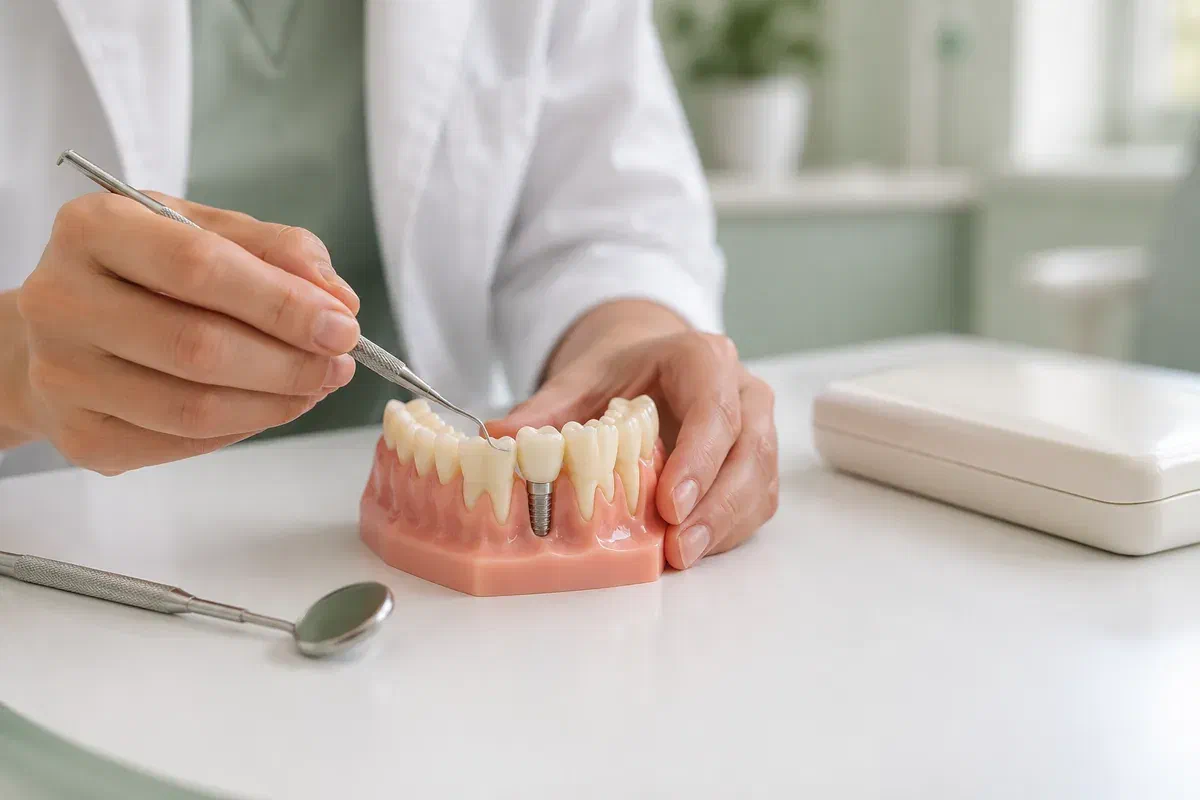
A dentist examining an illustrative jaw teaching model with an implant crown
What you might be dealing with

A loose piece, sore gum, or a worrying X-ray.

Tell us roughly when the implant and its crown were placed and what happened. The detached part, earlier X-rays and notes from the first office can all help.

A crown that came off or moves

The cause might be the crown, the screw or abutment, or the implant's hold in bone. Do not try to push a crown back on or glue it. Call and describe whether it happened suddenly, after biting something hard, or after a period of looseness.

Gum that bleeds or feels sore

Changes in the gum around an implant should be checked even when everything feels firm. Mention what you see while cleaning and whether there is tenderness, discharge or an odd taste. The exam shows how gum and bone are doing.

A concern raised on review

Sometimes a dentist notices a change on an X-ray before you feel anything. Ask for it to be explained and compared with earlier images where possible. That makes it easier to follow why treatment is being suggested.

A detached crown is not proof of a failed implant. We check the implant itself before anyone discusses replacing it.

Finding out what let go

Repair what broke, and ask why it broke.

The aim is to decide whether the current implant can stay healthy, with or without a repair, or whether removal is wiser. If a new implant is proposed, the plan should deal with whatever led to the first problem. Swapping in new hardware does not by itself change the conditions that caused it.

Meanwhile, you need a workable tooth. Ask before any treatment how the space will look, what you can eat and whether a temporary crown or removable tooth will be used. Knowing the interim plan, any further procedures and the final tooth helps you decide whether another implant is right.

Patient information: ITI — assessing implant complications and removal

Knowing which piece failed

Ask whether the cause is mechanical, biological, positional or several together. You do not need the vocabulary, but you should know which part needs attention and what supports that view.

A look at the bone and gum

The surrounding tissue affects both repair and replacement. Ask whether grafting or healing time would be needed and how that changes the schedule.

A clear set of choices

Compare repair, replacement and alternatives, including temporary teeth, upkeep, fees and the chance that plans shift. That gives you a sound basis for choosing.

What happens after you call

Check the implant, then plan from what we find.

There may be several visits and sometimes a specialist involved. Ask who is responsible for each stage and when the plan will be reviewed.

  1. Examine the implant and the loose part

    We look at the symptoms, the detached piece, the implant, gum health, stability and relevant imaging. Implant system details help with sourcing parts. Mention medical changes, smoking, grinding, earlier treatment and cleaning difficulty.

  2. Decide if repair is enough

    Replacing a screw, abutment or crown, or treating the tissue, may solve the problem, and we consider that first. If removal is advised, ask why and what other routes exist. A specialist can help with complex questions.

  3. If removal is needed, plan the site

    The procedure, its risks and the aftercare are explained beforehand, along with whether grafting or a healing pause will follow. A new implant may be placed when the site is ready; it is not assumed to happen at once. The temporary tooth is arranged in advance.

  4. Confirm healing before the final crown

    A new implant and crown each get their own evaluation and follow-up, and the plan may change with healing. Ask when you can chew normally and how maintenance will be organised.

Until you are seen, and after

Simple steps for each stage.

Advice after an assessment, a repair, a removal, a graft and a new implant varies. Keep the written instructions and the contact number of whoever is treating you now.

Protect the area until it is checked

Chew on the other side and avoid poking the site. Do not try to reseat or glue a crown. Keep any detached part dry in a container and bring it with you.

Follow instructions after treatment

Stick to the advice on cleaning, food and any temporary appliance. Check before wearing an old denture over the area. If something in the routine does not work for you, tell us so we can adjust it.

Report changes between reviews

Follow-up keeps an eye on the gum, the parts and the new tooth. Call about new movement, discharge or increasing soreness rather than waiting for the next appointment, and mention any cleaning difficulty.

Patient information: Cambridge University Hospitals — implant care and complications

What can be done

From a simple repair to a new approach.

Ask what each option is meant to achieve and what is still uncertain. One implant does not commit you to another.

When the implant is sound

Repair and keep the implant

A new screw or crown, or professional treatment of peri-implant inflammation, may be all that is needed in some cases. It depends on what the examination shows and how the area heals. Ask how the implant will be checked afterwards.

When it should not stay

Remove and replace it

Removal may be recommended for an implant that cannot reasonably be kept. A new one depends on the site and the plan as a whole. Ask about grafting, healing time, a changed position and the replacement crown.

When you prefer not to re-implant

Use a different solution

A bridge or a removable partial denture may suit, depending on which teeth are missing and the support available. Talk through the effect on neighbouring teeth, cleaning, appearance and day-to-day comfort.

Patient information: EFP — treatment of peri-implant disease

Questions after a crown comes off

Practical answers for right now.

You can ask for the diagnosis and planned steps in writing, which helps if more than one clinician is involved.

(905) 876-4488
Should I try to put my implant crown back on myself?
No. Forcing it back or using household glue can damage the parts or trap bacteria. Keep the crown safe, avoid chewing on that side and call. The team can advise how soon you should be seen.
How should I store a crown that has come off?
Rinse it gently, let it dry and keep it in a small container or bag. Bring it to the appointment, along with any screw or small part you find. It can help show what came loose and whether it can be reused.
Does a crown falling off mean the implant has failed?
Not necessarily. Crowns and abutments can loosen while the implant stays well anchored in bone. The examination and imaging show whether the implant itself is involved before any replacement is discussed.
Can a loose implant screw be retightened?
Often a loosened screw can be retightened or replaced, if the implant and parts are in good condition. The dentist will also look at why it loosened, such as bite forces, to reduce the chance of it happening again.
If the implant must be replaced, can a new one go in straight away?
Sometimes, depending on the site, the reason for removal, the bone available and the surgical plan. A healing or grafting stage is often needed first. Ask what in your situation would allow or prevent immediate placement.
What should I do if this happens on a weekend in Acton?
Keep the piece safe and call; Friday to Sunday visits are by appointment, so phoning lets the team advise you. If there is severe pain or swelling affecting breathing or swallowing, seek emergency medical care.
Implant help for Acton

Bring the piece. We will find the cause.

Book a visit at our Bronte Street practice and bring the detached part, any records and your questions. We will explain what came loose, what else needs checking and the options for the implant and tooth.

Please call about a moving, painful or swollen implant rather than requesting online. Online booking is for non-urgent issues.

Visit Milton Dental Clinic
Unit 1, 342 Bronte St. S, Milton, ON L9T 5B7
Get directions Clinic hours
Monday–Thursday
11am–7pm
Friday–Sunday
By appointment only

Areas we serve

  • Milton
  • Oakville
  • Mississauga
  • Georgetown
  • Halton Hills
  • Acton
  • Campbellville
  • Brampton
  • Burlington
  • Puslinch
  • Rockwood
  • Erin
  • Caledon
  • Etobicoke
  • Old Milton
  • Bronte Meadows
  • Timberlea
  • Dorset Park
  • Dempsey
  • Clarke
  • Beaty
  • Coates
  • Harrison
  • Scott
  • Willmott
  • Ford
  • Bowes
  • Cobden
  • Walker
  • Mountain View
  • Milton Heights
  • Hawthorne Village
  • Valley View
  • Fallingbrook
  • Nassagaweya
  • Trafalgar
  • Esquesing
  • Nelson
  • Brookville
  • Moffat
  • Glen Williams
  • Norval
  • Limehouse
  • Stewarttown
  • Ashgrove
  • Hornby
  • Silver Creek
  • Speyside
  • Scotch Block
  • North Oakville
  • River Oaks
  • Glen Abbey
  • West Oak Trails
  • Palermo
  • Bronte Creek
  • College Park
  • Joshua Creek
  • Uptown Core
  • Preserve
  • Iroquois Ridge
  • Lisgar
  • Meadowvale
  • Meadowvale Village
  • Churchill Meadows
  • Erin Mills
  • Central Erin Mills
  • Streetsville
  • East Credit
  • Creditview
  • Heartland
  • Sheridan
  • Mount Pleasant
  • Credit Valley
  • Huttonville
  • Churchville
  • Springbrook
  • Northwest Brampton
  • Bram West
  • Fletcher's Meadow
  • Fletcher's Creek South
  • Alton Village
  • Orchard
  • Millcroft
  • Headon Forest
  • Tansley
  • Brant Hills
  • Tyandaga
  • Kilbride
  • Lowville
  • Aberfoyle
  • Morriston
  • Arkell
  • Hillsburgh
  • Freelton
  • Carlisle
  • Waterdown
  • Flamborough
  • Mountsberg

How can we help?

Milton Dental Clinic

Have a question about your smile? Choose the option that works best for you.

For urgent dental concerns, please call.
Messages are reviewed during clinic hours.