

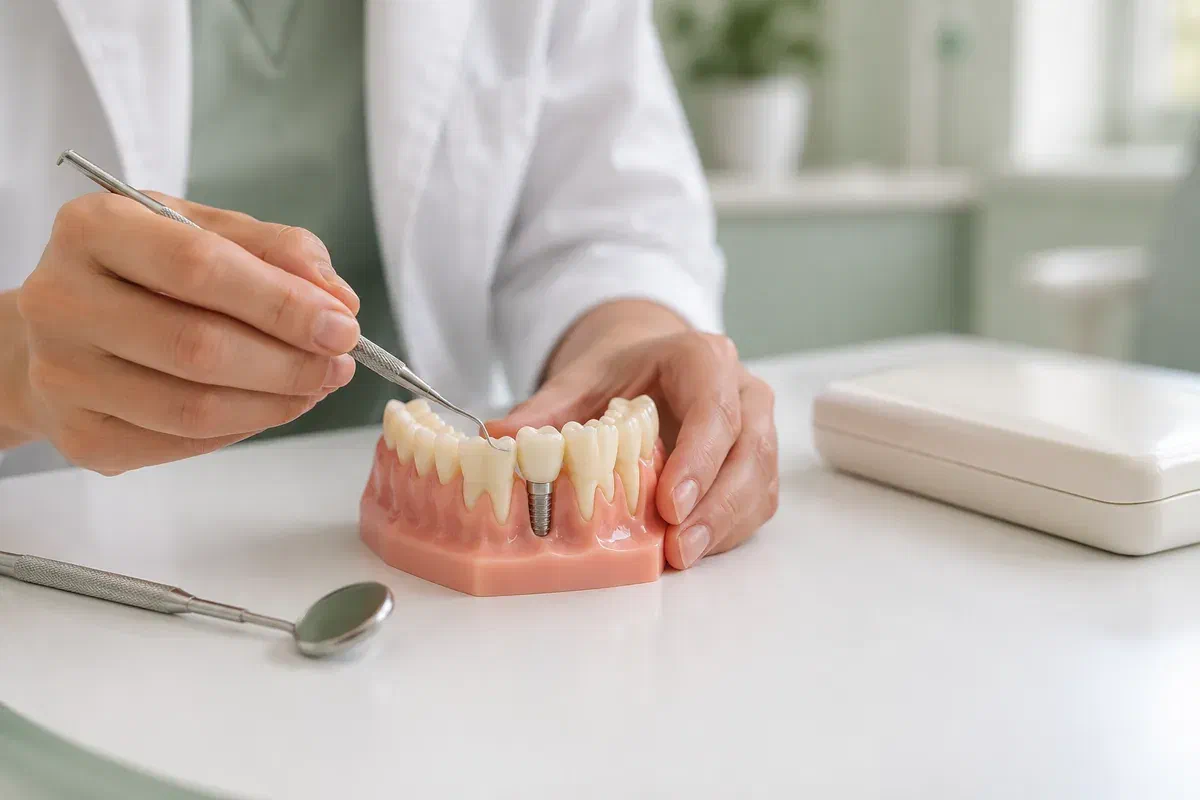
Illustrative consultation about concerns with an existing dental implant
Restorative Dentistry

Replacement of Failing Dental Implants in Halton Hills

Before replacing an implant, it pays to understand why it struggled. For households across Halton Hills, our review looks at habits, health and cleaning access as closely as the implant itself.

Starting with the why

The next implant begins with the last one's story.

Implants run into trouble for different reasons. Gum inflammation can build where cleaning is awkward. Heavy grinding can strain the parts. Changes in health, smoking or the original position can all play a role. Pinning down which applies to you is the most useful thing a review can do.

It also determines the treatment. A loose crown, a worn connector, inflamed tissue and lost bone support are each managed differently. Replacing the implant enters the discussion only if the findings show it should not be kept, and even then, removal and a new implant are weighed one after the other, with the cause, remaining tissue, future tooth and your wishes in mind.

For anyone in Halton Hills, whether in Georgetown, Acton or a smaller hamlet, the first appointment is an examination and a conversation. We check the implant, the gum and suitable imaging, ask about your health and habits, and explain what we see. If a specialist's assessment would help, you will know, and you will hear the alternatives before choosing.

Find out why your implant is struggling
A dentist examining an illustrative jaw teaching model with an implant crown
Clues worth sharing

Small details often explain the problem.

Approximate dates for the implant and its crown help, as does anything that changed around the time trouble began: a new medication, more clenching, a dental injury.

The crown feels like it has shifted

That sensation could involve the crown, the part linking it to the implant, or the implant in the bone. Leave it be rather than testing it. Phone and tell us if it changed suddenly, after a knock, or slowly, and whether you grind at night.

The gum around it bleeds or swells

Tissue changes near an implant are worth an exam even when the tooth is firm. Mention how easy or hard it is to clean there, any soreness, and any discharge or bad taste. Examination shows the condition of gum and bone.

Bone loss has been mentioned

A finding on an X-ray can be the first sign. Ask what was seen, how it compares with earlier images, and what might have caused it. Linking the change to a likely cause is what makes the treatment plan make sense.

A crown problem does not prove the implant has failed. Which part is affected needs to be established before replacement comes up.

Risk factors and planning

Change what you can before trying again.

The assessment weighs whether the current implant can be kept healthy or should come out. If replacement is chosen, the plan should address what contributed to the problem: cleaning access, grinding, smoking, health factors or the earlier position. Without that, a new implant meets the same pressures.

There is also the practical side. Before treatment, discuss the look of the gap, what you will be able to eat and whether a removable tooth will fill in for a while. Knowing the temporary stage, extra procedures and final restoration helps you decide whether another implant is the right path.

Patient information: ITI — assessing implant complications and removal

A named cause, where possible

Ask whether the issue is biological, mechanical, positional or a mix, and what likely led to it. Not every cause can be identified with certainty, but you should understand the reasoning behind the recommendation.

A healthier site to build on

Bone and gum condition matter for any new implant. Ask whether gum treatment, grafting or extra healing time would come first and what that does to the timeline.

Steps you can take yourself

Ask which risk factors are within your control, such as cleaning technique, a night guard or support with quitting smoking. Comparing options is easier once you know what would genuinely be different next time.

The path through treatment

Understand, decide, act, recheck.

More than one clinician may be involved over several visits. Ask who is responsible for each stage and when the plan will be reconsidered.

  1. Look closely at the implant and your history

    We examine the crown, the gum, stability and suitable imaging, and go through your symptoms. Previous X-rays and implant details are helpful. Tell us about medical changes, smoking, grinding, earlier treatment there and any difficulty cleaning.

  2. Judge whether it can be kept

    If fixing a part or treating the tissue could resolve the problem, we discuss that first. When removal is advised, you will hear the reasons and the alternatives. Specialist assessment may help where the case is complex.

  3. Prepare the site after removal

    If you go ahead with removal, we explain what the procedure involves, its risks, how to care for the area and whether grafting or healing comes next. A new implant may be placed later; immediate replacement is not a given. The temporary tooth is settled first.

  4. Recheck before the final tooth

    A new implant and its crown are assessed and followed up on their own terms. Healing may change the plan. Ask when you can chew normally and how ongoing maintenance, including any night guard, will be managed.

Caring for the area

Each phase comes with its own instructions.

What to do after an assessment is different from what to do after removal, a graft or a new implant. Keep the written guidance and the number for the clinician currently looking after you.

Keep weight off a moving tooth

Until it is checked, chew on the other side and leave the implant tooth alone. Do not attempt to tighten or remove anything. If a piece has detached, keep it safe and bring it in.

Follow the healing plan you were given

After treatment, stick to the advice on cleaning, food and any temporary appliance. Ask before wearing an old denture over the site. If you grind, ask whether you should wear a guard during healing.

Stay on top of reviews

Follow-up checks the gum, the components and the new tooth. Report new movement, discharge or worsening soreness promptly instead of waiting. Let us know about cleaning trouble so the routine can be adjusted.

Patient information: Cambridge University Hospitals — implant care and complications

Options once the cause is clear

Which route actually fixes your problem?

Ask what each option is designed to do and what is still unknown. A previous implant does not commit you to another.

When the implant is maintainable

Keep it and manage the cause

Professional care of the inflamed tissue, repair of the crown or parts, and changes to cleaning or grinding protection may be enough in some cases. Outcomes depend on the findings and the response. Ask how progress will be judged.

When it cannot reasonably stay

Remove it and plan another

Removal may be recommended when keeping the implant is not sensible. Whether a new one is possible depends on the site and wider plan. Ask about grafting, healing, a revised position and how the contributing factors will be handled.

When another implant is not chosen

Replace the tooth without an implant

A bridge, removable partial denture or another arrangement may be possible, depending on missing teeth and support. Discuss how each affects nearby teeth, cleaning, appearance and comfort.

Patient information: EFP — treatment of peri-implant disease

Questions from Halton Hills

Causes, risks and what can change.

You may ask for the diagnosis and planned steps in writing, which helps when more than one clinician is involved.

(905) 876-4488
Can you always tell why an implant failed?
Not always with certainty. Often the dentist can identify likely contributors, such as inflammation, load from grinding, health factors or position. Ask what the evidence suggests and how confident the assessment is, since that shapes the plan.
Would a night guard help protect a new implant?
If grinding or clenching is thought to be a factor, a guard may be suggested to reduce load during sleep. Whether it is appropriate depends on your bite and the overall plan. Ask how it would be fitted and cared for.
Do conditions like diabetes affect implants?
Some health conditions, including poorly controlled diabetes, can affect gum health and healing. Tell us about your medical history and medications. Where relevant, coordinating with your physician may be part of planning.
Could the original implant have been placed in the wrong spot?
Position is one possible factor, and imaging can show how an implant sits. It is rarely the only consideration. Ask whether position seems relevant in your case and how a replacement would be planned to account for it.
Do I need to quit smoking before another implant?
Smoking is a known risk factor for implant complications and slower healing. Your dentist will discuss how it affects your plan. Cutting down or quitting may be encouraged, and you can ask about support to do so.
Can a review be arranged around work in Halton Hills?
Yes. Our weekday hours run until evening, and Friday to Sunday visits are by appointment. Once the plan is clear, we can outline the visits so you can arrange them around work and family.
Halton Hills implant reviews

Understand the cause before choosing the cure.

Book an assessment at our Bronte Street practice. Share your history, habits and questions, and we will discuss what is happening, what more needs checking, and the options for the site and tooth.

A loose implant, severe pain or swelling should be phoned in. Online booking is for non-urgent enquiries.

Visit Milton Dental Clinic
Unit 1, 342 Bronte St. S, Milton, ON L9T 5B7
Get directions Clinic hours
Monday–Thursday
11am–7pm
Friday–Sunday
By appointment only

Areas we serve

  • Milton
  • Oakville
  • Mississauga
  • Georgetown
  • Halton Hills
  • Acton
  • Campbellville
  • Brampton
  • Burlington
  • Puslinch
  • Rockwood
  • Erin
  • Caledon
  • Etobicoke
  • Old Milton
  • Bronte Meadows
  • Timberlea
  • Dorset Park
  • Dempsey
  • Clarke
  • Beaty
  • Coates
  • Harrison
  • Scott
  • Willmott
  • Ford
  • Bowes
  • Cobden
  • Walker
  • Mountain View
  • Milton Heights
  • Hawthorne Village
  • Valley View
  • Fallingbrook
  • Nassagaweya
  • Trafalgar
  • Esquesing
  • Nelson
  • Brookville
  • Moffat
  • Glen Williams
  • Norval
  • Limehouse
  • Stewarttown
  • Ashgrove
  • Hornby
  • Silver Creek
  • Speyside
  • Scotch Block
  • North Oakville
  • River Oaks
  • Glen Abbey
  • West Oak Trails
  • Palermo
  • Bronte Creek
  • College Park
  • Joshua Creek
  • Uptown Core
  • Preserve
  • Iroquois Ridge
  • Lisgar
  • Meadowvale
  • Meadowvale Village
  • Churchill Meadows
  • Erin Mills
  • Central Erin Mills
  • Streetsville
  • East Credit
  • Creditview
  • Heartland
  • Sheridan
  • Mount Pleasant
  • Credit Valley
  • Huttonville
  • Churchville
  • Springbrook
  • Northwest Brampton
  • Bram West
  • Fletcher's Meadow
  • Fletcher's Creek South
  • Alton Village
  • Orchard
  • Millcroft
  • Headon Forest
  • Tansley
  • Brant Hills
  • Tyandaga
  • Kilbride
  • Lowville
  • Aberfoyle
  • Morriston
  • Arkell
  • Hillsburgh
  • Freelton
  • Carlisle
  • Waterdown
  • Flamborough
  • Mountsberg

How can we help?

Milton Dental Clinic

Have a question about your smile? Choose the option that works best for you.

For urgent dental concerns, please call.
Messages are reviewed during clinic hours.