
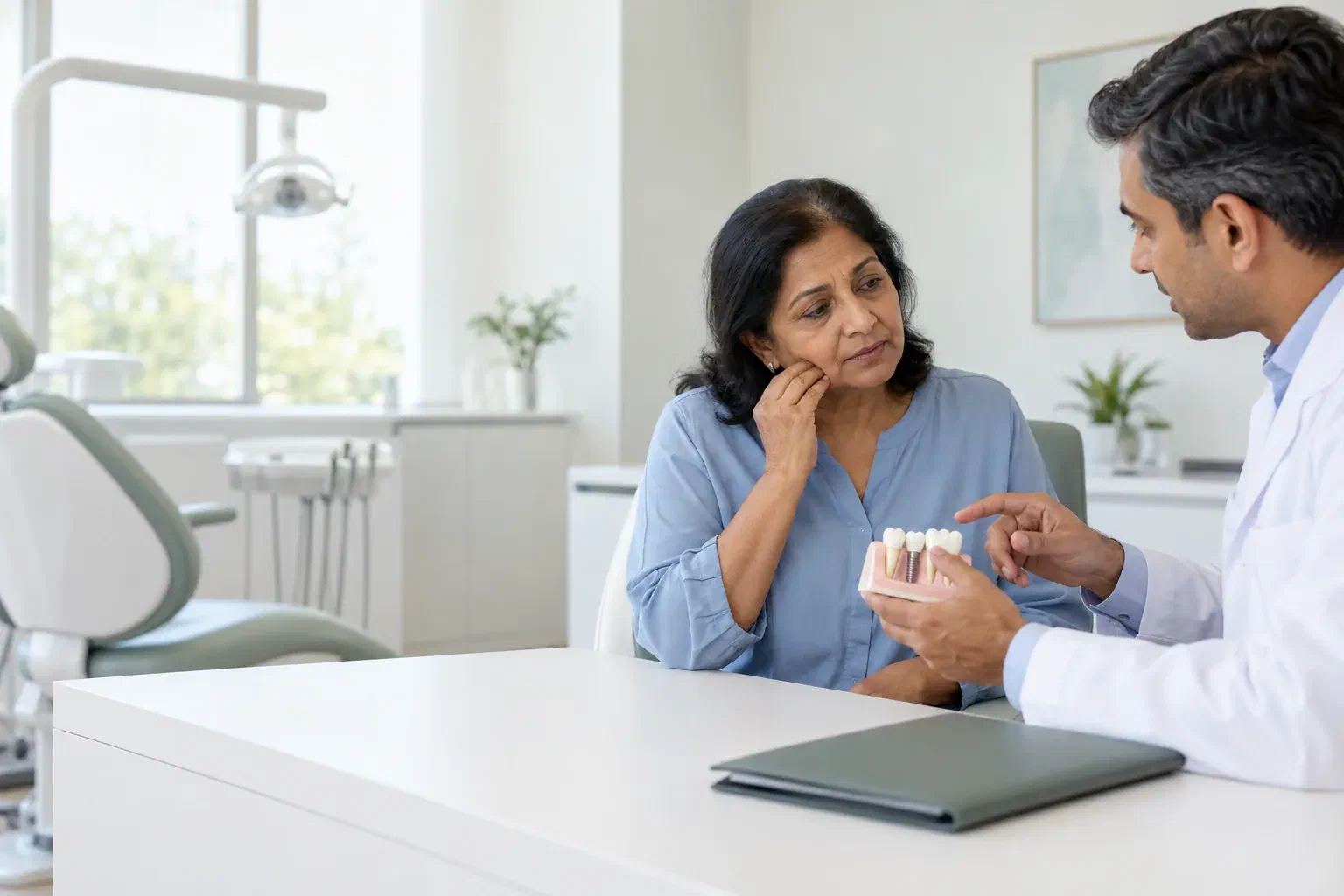
Illustrative consultation about concerns with an existing dental implant
Restorative Dentistry

Replacement of Failing Dental Implants in Old Milton

An implant that served you well for years can still develop problems. From Old Milton, you can have an older implant reviewed close to home, learn what has changed, and weigh repair, removal or another route calmly.

Implants with a long history

What happens when a trusted implant starts to cause trouble?

Some implants are placed and then quietly forgotten for a decade or more. So when one begins to ache, feel loose or bleed, it can be a surprise. Over time a crown can wear, a screw can loosen, gum tissue can become inflamed, or the bone holding the implant can recede. Each of these is handled differently.

Taking out an implant and putting in a new one is considered only once the examination shows that keeping it would not be sensible. Removal and replacement are still weighed one at a time. Why it failed, what bone and gum are left, the planned tooth on top and your own wishes decide what makes sense.

For many people in Old Milton, the dentist who placed the implant has since moved or retired. That is fine. We can start with whatever you have, including old invoices, X-rays or just the approximate year, examine the area, and explain what we see. If a specialist's view would help, we will tell you, and you will hear the alternatives before agreeing to anything.

Have an older implant checked
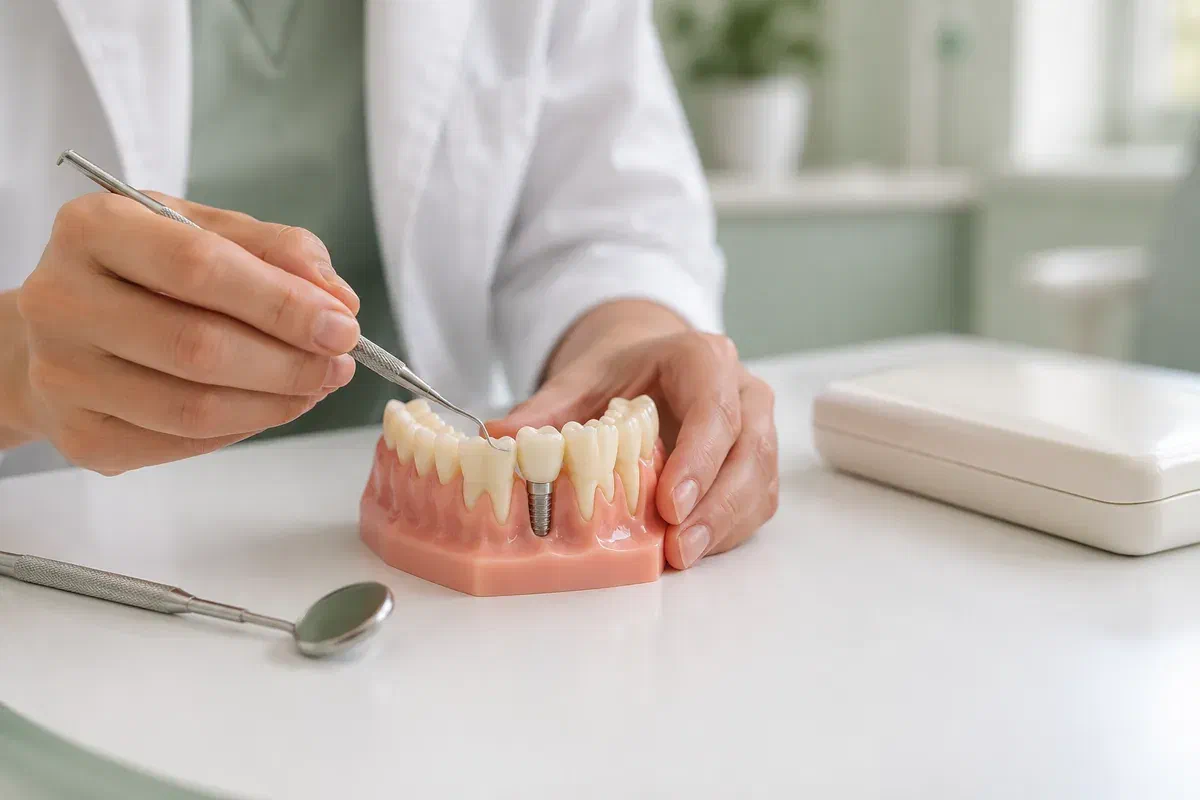
A dentist examining an illustrative jaw teaching model with an implant crown
Signs worth mentioning

You describe the change; the examination finds the source.

Share whatever you remember about when the implant and its tooth were placed, and what feels different now. Even partial records can fill in gaps.

A crown that rocks or clicks

That feeling can come from the crown itself, the piece joining it to the implant, or the implant's anchorage. Try not to push on it to see which. Phone us and say whether the change was sudden, followed a fall or a hard bite, or developed gradually.

Puffy gums or a bad taste nearby

Inflamed tissue around an implant should be examined even when the tooth feels perfectly firm. Let us know what happens when you clean there, whether it feels sore, and if anything drains from the gum. The visit shows the state of the soft tissue and bone.

Bone loss noted on an X-ray

Not every problem hurts. A dentist may raise a concern after comparing images over the years. Ask to see the change, and if you have older X-rays, bring them. Understanding what moved and by how much helps you follow why treatment is being suggested.

A worn or loose crown is not proof that the implant beneath it has failed. The part responsible has to be pinned down before replacement is discussed.

Tracing the reason behind it

Why did it fail, and will that happen again?

A thorough assessment sets out to answer whether the implant can be kept in good health or whether taking it out is the wiser course. If another implant is proposed, the plan has to account for what went wrong the first time. A new implant does not wipe the slate clean on its own.

Then there is daily life during treatment. Before the first step, talk over how the space will look, what you can chew, and whether you will wear a removable tooth for a time. Seeing the whole journey, including the temporary stage and the finished result, helps you decide if a second implant is right.

Patient information: ITI — assessing implant complications and removal

Knowing which part let you down

Ask whether the trouble lies with the gum and bone, the mechanical parts, the implant's angle or placement, or several of these. Medical terms are optional. What matters is that you understand the reasoning behind the recommendation.

Assessing the bone and gum that remain

Years of change can alter the bone around an implant. Ask whether a graft or extra healing time might be needed and how that shapes the schedule. The condition of the site is central to the plan, not an afterthought.

A fair comparison of routes

Set the replacement pathway beside the realistic alternatives. Factor in upkeep, temporary teeth, fees and the possibility of changes once more is known. A fuller picture leads to a decision you can stand behind.

From first visit to final tooth

One decision at a time, with a check between each.

Your care may involve a specialist as well as our team, spread across several visits. Ask who leads each stage and at what points the plan will be reviewed.

  1. Gather the background and examine

    We consider your symptoms, the crown, gum health, how firm the implant is and suitable imaging. Any details about the original implant are useful. Tell us about new medications or conditions, smoking, grinding, past treatment in the area and how easy it is to clean.

  2. Weigh keeping it against removal

    Could repairing a part or treating the gum and bone be enough? We discuss that first. If removal is advised, you will hear the reasoning and the other options. Complex cases may benefit from a referral for specialist assessment.

  3. Take it out and prepare the area

    Should removal go ahead, the procedure, its risks, aftercare and any graft or healing interval are explained in advance. Another implant may be placed later when the site allows, but immediate replacement is never taken for granted. The temporary tooth is agreed beforehand.

  4. Review before the new crown

    A replacement implant and its tooth have their own evaluation and follow-up. Healing may prompt changes to the plan. Ask when you can use the tooth for normal chewing and how regular maintenance will be scheduled.

Instructions that match the stage

Different steps, different care at home.

What you are asked to do after an assessment differs from advice after removal, grafting or a new implant. Keep each written sheet and the contact number for whoever is treating you at the moment.

Rest the loose tooth

Until it has been examined, chew elsewhere and leave the implant tooth untouched. Do not try to twist, tighten or remove anything. If a crown or part has already come off, keep it in a small container and bring it along.

Care for the healing area as directed

Once a procedure is done, follow the guidance on cleaning, food and any temporary appliance. An existing denture may not be safe to wear over the area, so check first. Tell us if the instructions are hard to fit into your routine.

Attend scheduled reviews

These visits let us check the gum, the components and the new tooth as it comes together. If movement, drainage or soreness appears in between, call rather than waiting. Mention any cleaning struggles so the plan stays realistic.

Patient information: Cambridge University Hospitals — implant care and complications

Paths you can take

Save it, replace it, or close the gap another way.

Each route has its own aim and its own unknowns, so ask about both. An earlier implant does not bind you to choosing a second one.

If the issue can be managed

Keep and treat the implant

Cleaning and treatment of inflamed tissue around the implant, or repair of the crown or its parts, may be enough in some cases. It depends on the findings and how the area heals. Ask what will be watched and what would alter that advice.

If it cannot reasonably stay

Remove it and look at replacement

Removal may be advised once an implant has lost too much support. Whether a new one can follow depends on the site and the wider plan. Ask about grafting, healing time, a revised position and the eventual tooth.

If you would rather not have another implant

Use a different kind of replacement

Depending on the missing teeth and remaining support, a bridge, a removable partial denture or another arrangement may suit you. Consider what each means for nearby teeth, cleaning, appearance and comfort so you can compare them fairly.

Patient information: EFP — treatment of peri-implant disease

Questions about an older implant

What people ask before deciding.

Feel free to request the diagnosis and the planned order of treatment in writing, particularly if another clinician will share your care.

(905) 876-4488
My implant is over ten years old. Can it still be repaired?
Possibly. An older implant’s crown or screw can sometimes be replaced while the implant itself stays. That depends on its condition and whether compatible parts are available. The examination and imaging show what is realistic before replacement of the implant is discussed.
What if I do not know what brand of implant I have?
That is common with older work. An X-ray can sometimes give clues, and the original office may still hold records. Missing details do not stop an assessment from going ahead, though they may affect how easily parts can be sourced for a repair.
Could a health change have affected my implant?
Some conditions and medications can influence gum health and healing, which is why we ask about your medical history. Mention anything new since the implant was placed. Where relevant, your physician may be involved in planning further treatment.
Is removal of a failing implant always done right away?
No. Timing depends on symptoms, the findings and your overall plan. Some situations call for prompt treatment, while others allow time to arrange specialist input or a temporary tooth. Ask what the risks of waiting would be in your case.
If the implant is replaced, can the old crown be kept?
Sometimes, but often not. A new implant may sit in a different position or use a different connection. Ask whether the existing crown can be adapted or must be remade, and request an estimate that separates the implant, the crown and any temporary tooth.
Can I ask for my care to be coordinated near Old Milton?
Yes. We can explain which stages happen at our Bronte Street practice and where a referral might be suggested. Knowing that sequence early helps you plan the visits around your week and decide which appointments to group together.
Implant reviews near Old Milton

Bring the history. We will help with the next chapter.

Arrange a review at our Bronte Street practice, close to Milton's historic downtown. Bring any records you can find, along with your questions, and we will discuss the problem, further assessment and your choices.

Please phone for a moving implant, strong pain or swelling. Online booking is meant for non-urgent requests.

Visit Milton Dental Clinic
Unit 1, 342 Bronte St. S, Milton, ON L9T 5B7
Get directions Clinic hours
Monday–Thursday
11am–7pm
Friday–Sunday
By appointment only

Areas we serve

  • Milton
  • Oakville
  • Mississauga
  • Georgetown
  • Halton Hills
  • Acton
  • Campbellville
  • Brampton
  • Burlington
  • Puslinch
  • Rockwood
  • Erin
  • Caledon
  • Etobicoke
  • Old Milton
  • Bronte Meadows
  • Timberlea
  • Dorset Park
  • Dempsey
  • Clarke
  • Beaty
  • Coates
  • Harrison
  • Scott
  • Willmott
  • Ford
  • Bowes
  • Cobden
  • Walker
  • Mountain View
  • Milton Heights
  • Hawthorne Village
  • Valley View
  • Fallingbrook
  • Nassagaweya
  • Trafalgar
  • Esquesing
  • Nelson
  • Brookville
  • Moffat
  • Glen Williams
  • Norval
  • Limehouse
  • Stewarttown
  • Ashgrove
  • Hornby
  • Silver Creek
  • Speyside
  • Scotch Block
  • North Oakville
  • River Oaks
  • Glen Abbey
  • West Oak Trails
  • Palermo
  • Bronte Creek
  • College Park
  • Joshua Creek
  • Uptown Core
  • Preserve
  • Iroquois Ridge
  • Lisgar
  • Meadowvale
  • Meadowvale Village
  • Churchill Meadows
  • Erin Mills
  • Central Erin Mills
  • Streetsville
  • East Credit
  • Creditview
  • Heartland
  • Sheridan
  • Mount Pleasant
  • Credit Valley
  • Huttonville
  • Churchville
  • Springbrook
  • Northwest Brampton
  • Bram West
  • Fletcher's Meadow
  • Fletcher's Creek South
  • Alton Village
  • Orchard
  • Millcroft
  • Headon Forest
  • Tansley
  • Brant Hills
  • Tyandaga
  • Kilbride
  • Lowville
  • Aberfoyle
  • Morriston
  • Arkell
  • Hillsburgh
  • Freelton
  • Carlisle
  • Waterdown
  • Flamborough
  • Mountsberg

How can we help?

Milton Dental Clinic

Have a question about your smile? Choose the option that works best for you.

For urgent dental concerns, please call.
Messages are reviewed during clinic hours.