

Illustrative consultation comparing options for several older restorations
Restorative Dentistry

Replacement of Metal Fillings in Georgetown

Some old silver fillings take up most of the tooth. If you are travelling from Georgetown, we can check whether a large one still has enough support, and whether a new filling, an onlay or simply monitoring makes sense.

Big fillings, assessed for Georgetown

When the filling is bigger than the tooth around it.

Look closely at an older molar and you may see that the metal covers far more surface than the enamel does. Those large fillings were common for many years. They can last a long time, but the thin walls of tooth beside them sometimes crack under heavy chewing.

That is why the size of a filling is often more important than its colour. A small, sealed amalgam may be best left in place. A large one with a fracture line, a missing corner or decay at the edge may need more than a like-for-like swap, because a new filling alone might not give the tooth enough support.

From Georgetown, it is worth booking a review that looks at strength as well as appearance. Point out any tooth that feels tender when you bite or that you suspect has chipped, and mention fillings you would like to change for looks. The dentist will explain the options tooth by tooth.

Have a large filling assessed
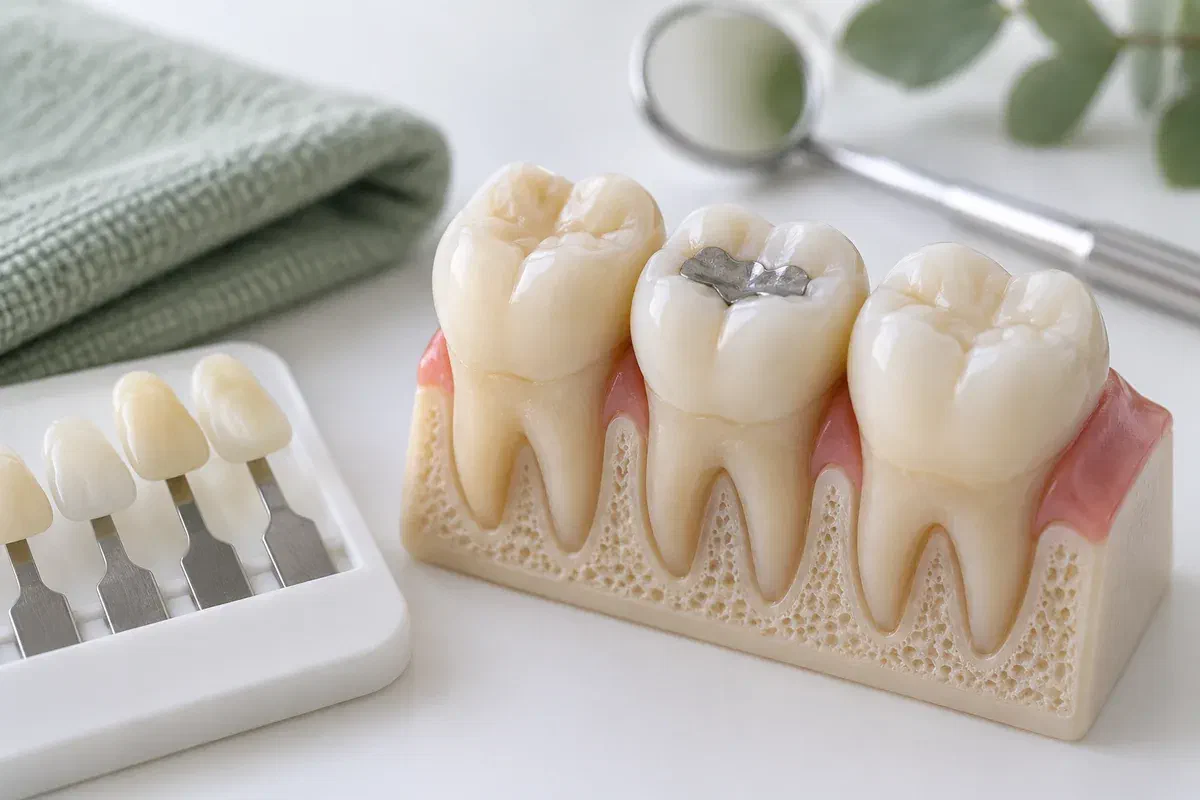
Teaching model of back teeth with a sound silver filling beside shade samples
Questions to bring

Strength, appearance and symptoms each get a turn.

The review should note what is found at every tooth. A dark colour by itself cannot tell you whether a filling is ready to come out.

Large repairs from years ago

You may have big fillings with no clear history of when they were placed. The dentist checks how the surrounding tooth is holding up and reviews any available records. Metal fillings do not all reach the end of their service at the same age.

One visible filling you dislike

If one restoration is visible when you speak, name it. That helps keep the appearance discussion to the teeth that matter to you, rather than turning it into a plan for every filling.

Tenderness, chips or rough edges

A tooth that hurts on release from biting, a corner that feels missing or a sharp ridge should be mentioned separately. These can point to a crack or a weakened cusp, which may need a different solution than a darker-looking filling.

Intact amalgam fillings are not routinely removed to prevent health problems. Talk with your dentist about any medical or material-sensitivity concern and, if appropriate, involve your physician.

Choosing with support in mind

The right restoration depends on what is left of the tooth.

A plan for several fillings works better when each tooth is described honestly. Is there a crack or decay that needs treatment? Is it a large filling to watch? Or is the change mainly cosmetic? Asking for these labels makes it easier to see where your effort and budget are best spent.

Material and design go together. A moderate cavity may be well served by a direct tooth-coloured filling. A tooth with thin, unsupported walls might do better with an onlay or crown that covers and protects the weaker areas. Restorations of different kinds can still look consistent in a smile.

Patient information: FDA — choices of restorative materials

Priorities based on risk

Ask which teeth are most at risk of breaking or worsening, and which can wait. That helps with planning time and cost while the clinical picture, not the shiniest filling, sets the order.

Appearance with realistic limits

Choosing a suitable shade helps new work blend in, though your own enamel and older restorations influence the result. Discuss each visible tooth so you know what to expect.

An outline you can study

A clear written plan with estimates for each stage lets you compare a filling with an onlay or crown, check benefits and come back with questions. It may change if new findings appear once an old filling is removed.

Steps in the review

Assess the tooth, not just the filling.

Reviewing several restorations does not commit you to treating all of them. The examination sets a sensible scope and sequence.

  1. Examine the fillings and the walls around them

    The dentist looks at each filling, the remaining tooth structure and any symptoms. X-rays or bite tests may be suggested where they help. Share whether your priority is comfort, appearance or understanding an earlier recommendation.

  2. Compare filling, onlay and monitoring

    For each tooth, the options are explained in plain terms. Ask about materials, fees and what happens if a crack or decay is found once the old filling is out. Be clear on which steps are clinically necessary and which are elective.

  3. Decide the order

    Teeth at higher risk usually come first. The plan also considers how much work is comfortable in one visit and how you will eat between appointments. Ask which side will be done first and what to avoid on teeth that are waiting.

  4. Confirm fit and bite

    Each completed restoration is checked for contour and how it meets the opposing teeth, and you get care instructions. For staged treatment, confirm the next visit and any decisions left. Mention new difficulty chewing or cleaning.

After a larger repair

Give your bite a few days, then tell us how it feels.

When more than one tooth has been treated, explaining exactly where a feeling is and what brings it on helps the team find the right tooth.

Follow the guidance for each restoration

Avoid chewing until numbness has gone, and follow any material-specific advice. A tooth with a temporary may need protecting until its final restoration is placed. Keep your care sheet handy until the next appointment.

Report how the bite feels

Mention a tooth that contacts first, tenderness when chewing, or food catching where it did not before. Say which side and when. That helps us decide whether a quick adjustment or a fuller review is needed.

Keep looking after the untreated fillings

Brush, floss and attend regular exams for every tooth, including metal fillings left in place. A large filling that is being monitored should be checked again at future visits.

Matching the repair to the tooth

A filling, a bigger restoration, or no change yet?

Consider what each option does for the teeth identified. Ask for the trade-offs to be explained before you decide.

When there is no reason to remove

Keep sound fillings in service

An intact filling that works can stay and be reviewed. Removing it may cost some healthy tooth. Ask what change would prompt reassessment and how its current condition will be recorded.

When specific teeth have findings

Replace particular fillings

A targeted plan can deal with a defect, or a cosmetic change you have agreed to, without touching every metal filling. Ask about the material and size of the repair for each tooth. Fillings that look similar may need different treatment.

When a filling will not give support

Cover and protect a weak tooth

Where a large filling has left thin walls or a cracked cusp, an onlay, crown or other restoration may be proposed. Ask why, and what extra preparation or visits it involves. The choice reflects the tooth’s strength, not only its colour.

Georgetown questions about large fillings

Big fillings, common questions.

By the end of your visit, you should know which teeth are involved and the reasoning for each. Ask about strength, timing, appearance or earlier advice.

(905) 876-4488
Can a very large silver filling be replaced with another filling?
Sometimes. It depends on how much healthy tooth remains and how it is supported. If the walls are thin or cracked, the dentist may suggest an onlay or crown instead. Ask to see why one option is favoured over another.
Why does my tooth hurt when I let go after biting?
Pain on release can be a sign of a cracked tooth, though other causes are possible. The dentist may use bite tests and imaging to investigate. Mention exactly which tooth and what you were eating.
What is the difference between an onlay and a crown?
An onlay covers part of the biting surface, including weak cusps, while a crown covers the whole visible tooth. Which is suitable depends on how much tooth remains. The dentist can explain the preparation and visits each would involve.
Is replacing healthy amalgam safer because of mercury?
Discuss it before arranging removal. According to the FDA, amalgam that is intact and free of decay underneath should not be removed without a clinical reason. Removing it can sacrifice healthy tooth and temporarily increase exposure to mercury vapour. Any specific medical concern should be talked through individually.
Can I get separate estimates for a filling and an onlay?
Yes. Ask for each option to be listed by tooth, surface, material and stage. Check whether exams, imaging or temporary care are separate. If you have dental benefits, confirm how each option is treated before deciding.
Can I plan visits from Georgetown so treatment is not rushed?
Often, yes. Ask which teeth are at higher risk and should come first, and which can be scheduled later. If a tooth breaks or becomes painful in the meantime, call the clinic rather than waiting for the planned date.

Patient information: FDA — existing amalgam fillings

Large metal fillings and Georgetown smiles

Let’s check how much support each tooth has left.

Book a review at our Bronte Street practice to look at your existing metal fillings, especially the larger ones. We will explain each tooth’s condition and the options for it before you decide on treatment.

For significant pain, swelling or a broken tooth, call the clinic. Online requests are for non-urgent appointments.

Visit Milton Dental Clinic
Unit 1, 342 Bronte St. S, Milton, ON L9T 5B7
Get directions Clinic hours
Monday–Thursday
11am–7pm
Friday–Sunday
By appointment only

Areas we serve

  • Milton
  • Oakville
  • Mississauga
  • Georgetown
  • Halton Hills
  • Acton
  • Campbellville
  • Brampton
  • Burlington
  • Puslinch
  • Rockwood
  • Erin
  • Caledon
  • Etobicoke
  • Old Milton
  • Bronte Meadows
  • Timberlea
  • Dorset Park
  • Dempsey
  • Clarke
  • Beaty
  • Coates
  • Harrison
  • Scott
  • Willmott
  • Ford
  • Bowes
  • Cobden
  • Walker
  • Mountain View
  • Milton Heights
  • Hawthorne Village
  • Valley View
  • Fallingbrook
  • Nassagaweya
  • Trafalgar
  • Esquesing
  • Nelson
  • Brookville
  • Moffat
  • Glen Williams
  • Norval
  • Limehouse
  • Stewarttown
  • Ashgrove
  • Hornby
  • Silver Creek
  • Speyside
  • Scotch Block
  • North Oakville
  • River Oaks
  • Glen Abbey
  • West Oak Trails
  • Palermo
  • Bronte Creek
  • College Park
  • Joshua Creek
  • Uptown Core
  • Preserve
  • Iroquois Ridge
  • Lisgar
  • Meadowvale
  • Meadowvale Village
  • Churchill Meadows
  • Erin Mills
  • Central Erin Mills
  • Streetsville
  • East Credit
  • Creditview
  • Heartland
  • Sheridan
  • Mount Pleasant
  • Credit Valley
  • Huttonville
  • Churchville
  • Springbrook
  • Northwest Brampton
  • Bram West
  • Fletcher's Meadow
  • Fletcher's Creek South
  • Alton Village
  • Orchard
  • Millcroft
  • Headon Forest
  • Tansley
  • Brant Hills
  • Tyandaga
  • Kilbride
  • Lowville
  • Aberfoyle
  • Morriston
  • Arkell
  • Hillsburgh
  • Freelton
  • Carlisle
  • Waterdown
  • Flamborough
  • Mountsberg

How can we help?

Milton Dental Clinic

Have a question about your smile? Choose the option that works best for you.

For urgent dental concerns, please call.
Messages are reviewed during clinic hours.